
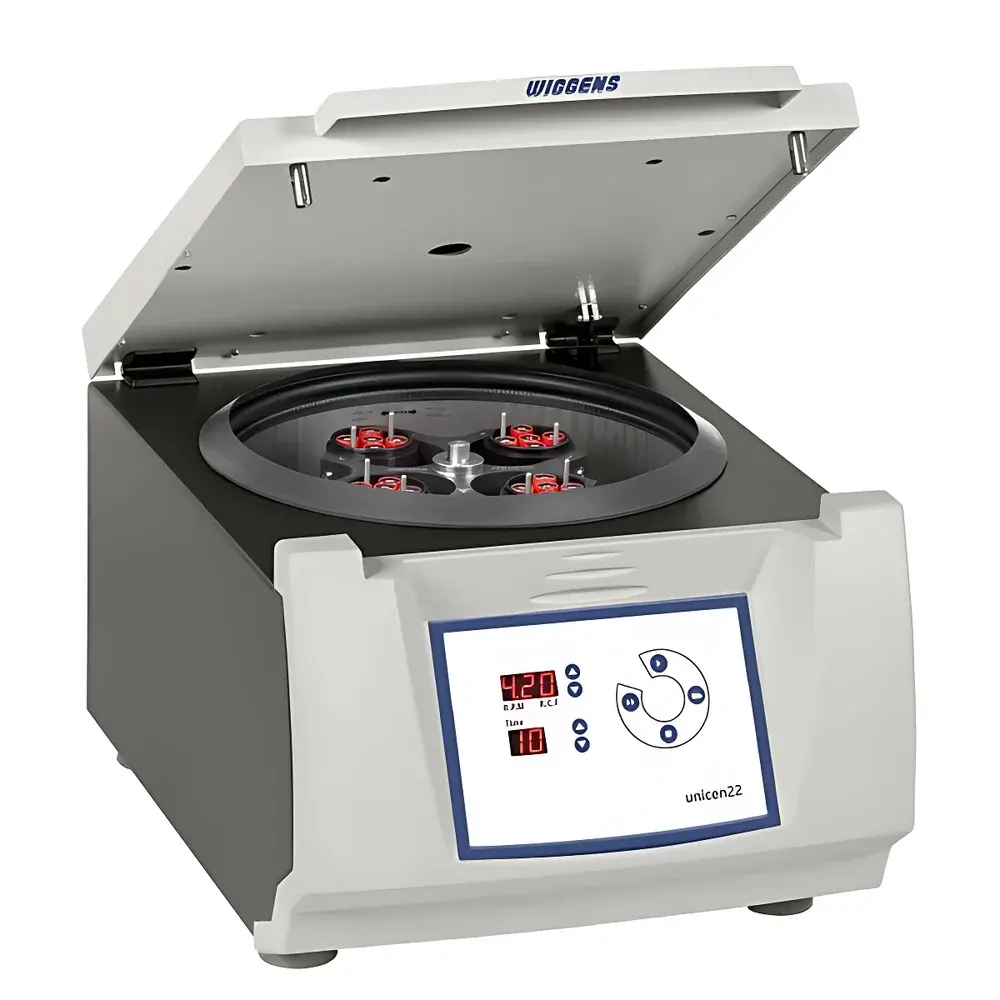
WIGGENS UNICEN21 Benchtop Low-Speed Centrifuge
| Brand | WIGGENS |
|---|---|
| Origin | Germany |
| Model | UNICEN21 |
| Type | Benchtop Centrifuge |
| Max. Speed | 4200 rpm |
| Max. RCF | 2938 × g |
| Max. Capacity | 4 × 100 mL |
| Dimensions (W×D×H) | 410 × 530 × 320 mm |
| Noise Level | <60 dB(A) |
| Motor | Brushless DC, Maintenance-Free |
| Safety Compliance | EN 61010-1, EN 61010-2-020, EN 61326-1, EN 61326-2-6 |
| EU Directives | 2011/65/EU (RoHS), 2012/19/EU (WEEE), 2014/30/EU (EMC), 2014/35/EU (LVD), 98/79/EC (IVDR) |
Overview
The WIGGENS UNICEN21 Benchtop Low-Speed Centrifuge is an engineered solution for routine separation tasks in clinical, academic, and industrial laboratories where reproducible, low-force sedimentation is required. Operating on the principle of centrifugal sedimentation—where differential particle migration under rotational acceleration separates components based on density, size, and shape—the UNICEN21 delivers precise control over relative centrifugal force (RCF) and rotational speed (RPM) within a robust, compact footprint. Designed for applications including blood fractionation, cell pelleting, precipitate recovery, and routine sample clarification, it bridges the operational gap between high-speed microcentrifuges and floor-standing preparative systems. Its maximum rated speed of 4200 rpm and RCF of 2938 × g ensure compatibility with standard conical-bottom tubes (up to 100 mL), while its brushless DC motor eliminates carbon wear, reduces thermal drift, and extends service intervals—critical for GLP-compliant environments requiring long-term instrument stability.
Key Features
- Brushless DC motor with zero maintenance requirements and extended operational lifetime
- Digital LED display showing real-time RPM, RCF, elapsed time, and remaining time
- Programmable timer (1–99 min, 1-min increments) with both forward and reverse countdown modes
- Three-stage acceleration/deceleration profiles: rapid, medium, and inertia-based—minimizing sample resuspension and tube stress
- Automatic lid opening upon cycle completion, enabling immediate post-run access without manual intervention
- Auto-memory function retaining last-used parameters (speed, time, RCF mode) across power cycles
- RPM/RCF dual-mode operation with 50 rpm or 10 × g step resolution for fine-tuned method development
- Acoustic and visual status alerts during run—including imbalance detection, overspeed warning, and lid-lock confirmation
- Stainless-steel centrifuge chamber (AISI 304) resistant to corrosion and compatible with autoclaving of rotors and adapters
- Integrated forced-air cooling system to limit temperature rise during extended runs—critical for thermolabile biological samples
Sample Compatibility & Compliance
The UNICEN21 accommodates a broad range of primary and secondary containers via interchangeable horizontal rotors (e.g., RT177, RT260, RT175, RT173), supporting volumes from 0.2 mL PCR tubes to 100 mL conical centrifuge bottles. All rotor-adaptor combinations are validated for mechanical integrity at maximum rated speed and RCF. Rotors and adapters are fully autoclavable (121 °C, 20 min, saturated steam), satisfying ISO 13485 and CLSI GP15-A3 requirements for reusability in diagnostic workflows. The unit complies with IEC/EN 61010-1 (safety of laboratory equipment), EN 61010-2-020 (particular safety requirements for centrifuges), and EN 61326-1/-2-6 (EMC for laboratory use). It carries CE marking per applicable EU directives including 2014/35/EU (Low Voltage Directive), 2014/30/EU (EMC Directive), and 98/79/EC (IVDR), confirming conformity for in vitro diagnostic use in regulated markets.
Software & Data Management
While the UNICEN21 operates as a standalone instrument without external PC connectivity, its embedded firmware supports full audit-trail capability through non-volatile parameter logging. Each run records timestamp, setpoint values (RPM/RCF, time), actual achieved parameters, and event flags (e.g., lid lock engagement, imbalance stop, auto-open activation). These logs remain accessible via front-panel navigation and support retrospective review during internal quality audits. For laboratories operating under FDA 21 CFR Part 11 or EU Annex 11, optional documentation packages—including IQ/OQ protocols, calibration certificates traceable to NIST standards, and electronic signature-ready validation templates—are available upon request. Firmware updates are delivered via secure USB interface with version-controlled release notes and change logs.
Applications
The UNICEN21 serves core workflows across multiple disciplines: hematological sample processing (serum/plasma separation from whole blood in 15–100 mL tubes); microbiological culture harvesting (E. coli, yeast, mammalian cells at ≤2938 × g); environmental sample concentration (waterborne pathogens, particulate matter); pharmaceutical QC (clarification of suspensions, excipient settling studies); and bioprocessing support (buffer exchange, intermediate product recovery). Its low-noise design (<60 dB[A]) and compact form factor make it suitable for shared lab spaces, biosafety cabinets, and point-of-care settings where spatial constraints and acoustic sensitivity are limiting factors. The ability to process small numbers of tubes (e.g., 1–2 × 15 mL) without performance degradation enhances responsiveness during urgent assay preparation—reducing turnaround time without compromising reproducibility.
FAQ
Is the UNICEN21 compliant with Good Laboratory Practice (GLP) requirements?
Yes—the instrument’s parameter memory, event logging, mechanical safety interlocks, and traceable calibration path align with GLP principles for data integrity and instrument accountability.
Can rotors be sterilized using autoclaving?
All standard horizontal rotors (RT-series) and tube adapters (RE-series) are rated for repeated autoclaving at 121 °C, 20 min, 100 kPa saturated steam pressure.
What safety mechanisms prevent operation with unbalanced loads?
The system performs dynamic imbalance detection during acceleration; if mass asymmetry exceeds ±5 g per rotor position, it halts rotation and displays an error code before reaching set speed.
Does the centrifuge support RCF-based method programming?
Yes—users may select either RPM or RCF as the primary control variable, with automatic conversion performed in real time using stored rotor radius values.
Is remote monitoring or network integration possible?
No native Ethernet or Wi-Fi interface is included; however, third-party Lab Information Management Systems (LIMS) may integrate via RS-232 serial output (optional accessory cable required).
Related Products



