
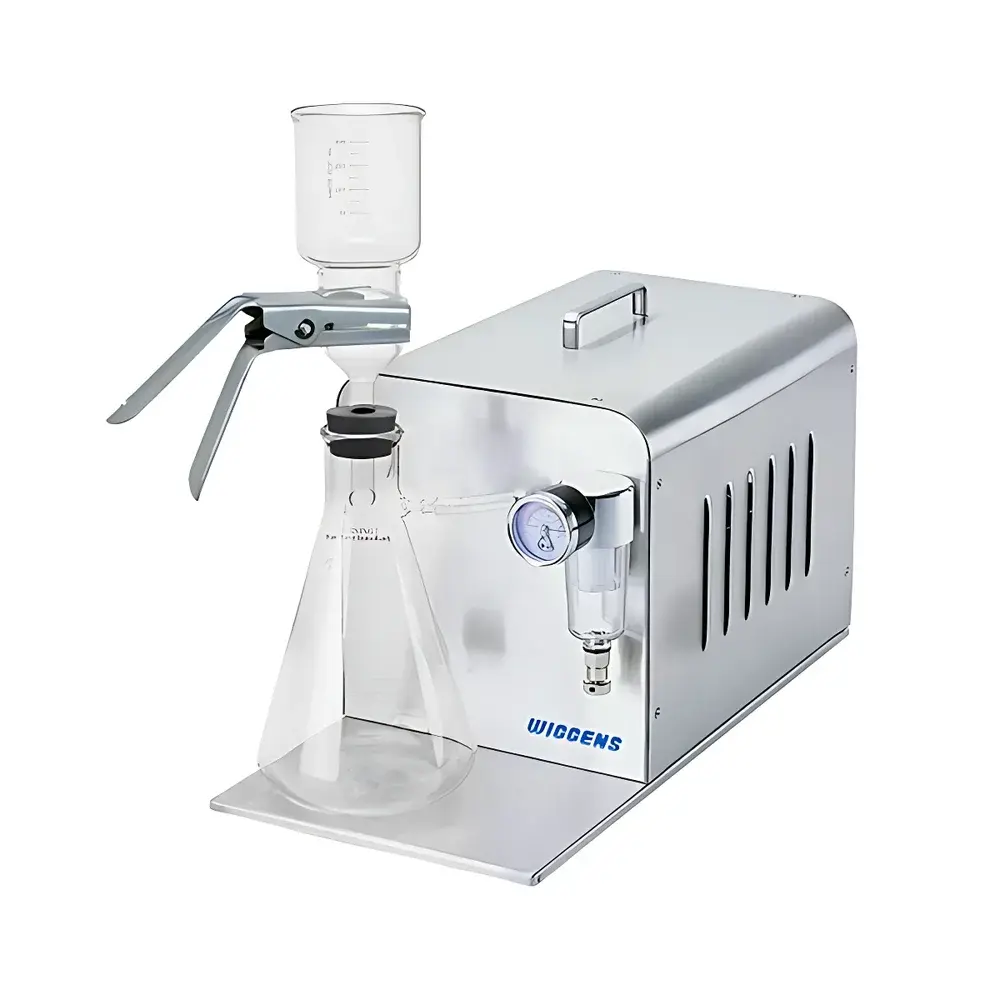
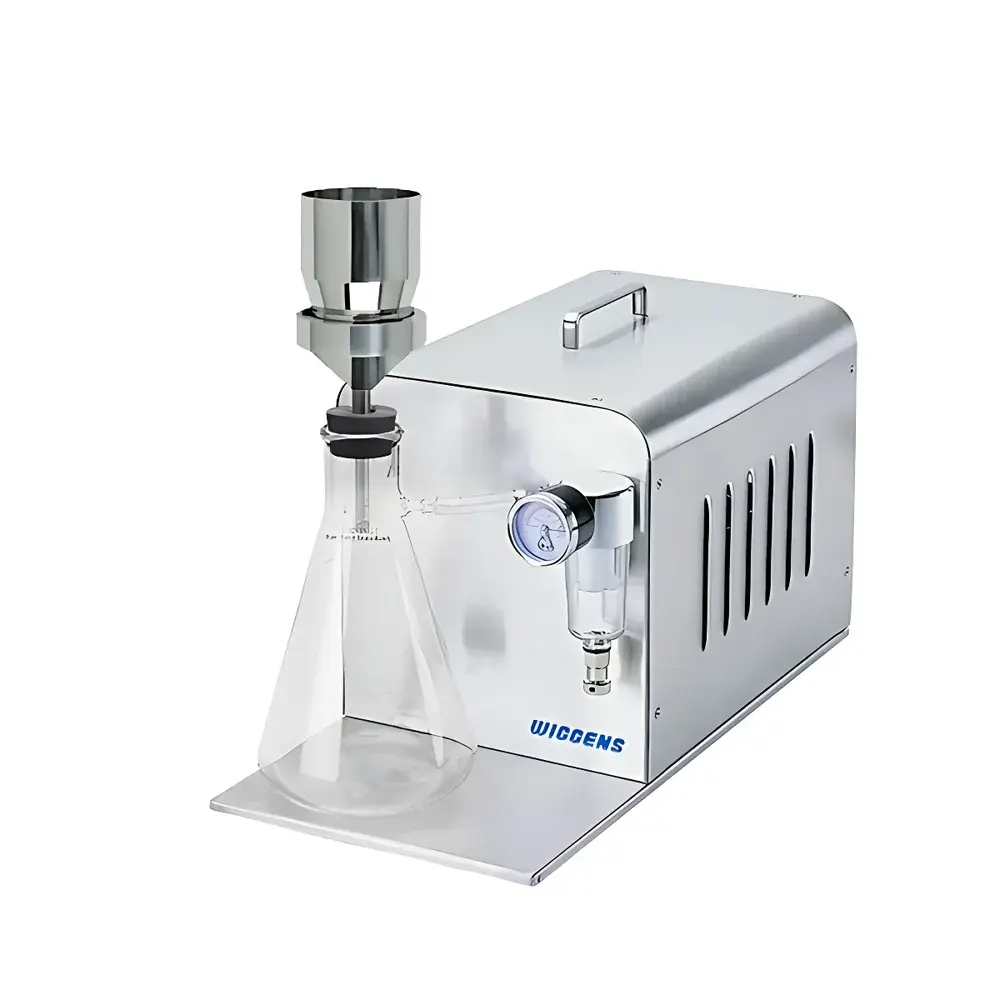
WIGGENS VF Series Portable Vacuum Filtration System
| Brand | WIGGENS |
|---|---|
| Origin | Germany |
| Manufacturer Type | Authorized Distributor |
| Origin Category | Imported |
| Model | VF Series |
| Price Range | USD 680–2,050 |
| Instrument Type | Vacuum Filtration System |
| Product Type | Oil-Free Diaphragm Vacuum Pump |
| Pumping Speed | 17–34 L/min |
| Ultimate Vacuum | 150 mbar (VF203/VF205), 100 mbar (VF204), 13 mbar (VF214) |
| Motor Power | 60–95 W |
| Voltage | 220–240 V / 50 Hz |
| Noise Level | 50–60 dB(A) |
| Weight | 7.1–8.3 kg |
| Internal Tubing ID | 8 mm |
| Rated Speed | 1450 rpm |
Overview
The WIGGENS VF Series Portable Vacuum Filtration System is an integrated, benchtop-ready solution engineered for precise, reliable, and contamination-controlled liquid-solid separation across analytical, biological, pharmaceutical, and environmental laboratories. Built upon a diaphragm-based vacuum generation principle, the system delivers consistent negative pressure without oil lubrication—eliminating risk of hydrocarbon contamination, reducing maintenance burden, and ensuring compliance with ISO 8573-1 Class 0 air purity requirements for critical sample handling. Each configuration combines a chemically resistant vacuum pump, modular glass filtration assemblies (including Büchner-type funnels and side-arm collection flasks), PTFE-coated inline moisture traps, and calibrated vacuum regulation via front-mounted control valves. The architecture supports both coarse particulate removal (e.g., suspended solids quantification per ISO 11923) and fine-particle retention (e.g., microbial recovery per ISO 8199 or USP ), while maintaining structural integrity under repeated sterilization cycles.
Key Features
- Oil-free diaphragm pump technology ensures zero oil carryover, enabling use in sterility-critical applications such as microbiological membrane filtration and HPLC mobile phase degassing.
- Integrated vacuum regulation valve allows real-time adjustment of suction pressure (13–150 mbar range across models), optimizing filter cake formation and preventing membrane rupture during delicate filtrations.
- PTFE-lined moisture trap (0.2 µm pore size) and dual-stage overflow protection—including float-activated cut-off in polycarbonate waste reservoirs and secondary PTFE disc filter—prevent liquid ingress into the pump chamber.
- All glass components (Duran®-grade borosilicate 3.3) comply with DIN ISO 3585 and are autoclavable at 121 °C/2 bar for ≥20 cycles without dimensional drift or surface degradation.
- Modular design supports rapid reconfiguration: VF2 (250 mL funnel + 500 mL flask), VF3 (500 mL funnel + 1 L flask), and VF6 (1 L funnel + 2 L flask) assemblies accommodate volumes from 10 mL to 2 L per run.
- Low-noise operation (≤60 dB[A] at 1 m) meets ISO 7779 and EU Directive 2000/14/EC noise emission limits for laboratory environments.
Sample Compatibility & Compliance
The VF Series accommodates a broad spectrum of sample matrices, including aqueous suspensions, buffered culture media, organic solvent mixtures (e.g., acetonitrile/water), and mildly acidic or alkaline solutions (pH 2–12). Corrosion-resistant variants (VF205B, VF214) feature full PTFE wetted-path construction—including pump head, valve seats, and gas ballast lines—validated per ASTM D543 for resistance to 37% HCl, 48% HF, and 98% H₂SO₄ exposure. All systems conform to IEC 61010-1:2010 for electrical safety in laboratory equipment and support GLP/GMP workflows through traceable calibration records, audit-ready log files (via optional RS232 interface), and compatibility with FDA 21 CFR Part 11-compliant data acquisition software.
Software & Data Management
While the base VF Series operates as a standalone analog instrument, optional digital integration enables full traceability. When paired with WIGGENS LabLink™ v3.2 firmware (sold separately), users gain access to time-stamped vacuum profile logging, cycle counting, automatic shutdown on overpressure events, and export of CSV-formatted datasets compliant with ISO/IEC 17025 documentation requirements. The system’s RS232 port supports bidirectional communication with LIMS platforms and integrates seamlessly with electronic lab notebooks (ELNs) such as LabArchives and Benchling via standard SCPI command sets.
Applications
- Suspended solids determination (SS) in wastewater per EPA Method 160.2 and ISO 11923.
- Microbial enumeration using membrane filtration per ISO 7899-2 (coliforms), ISO 8199 (total viable count), and APHA Standard Methods 9222 B.
- Preparative filtration of cell lysates, protein precipitates, and nanoparticle suspensions prior to SEC or DLS analysis.
- Mobile phase purification and degassing for HPLC, GC, and AAS—reducing baseline noise and column fouling.
- Routine sterile filtration of sera, antibiotics, and tissue culture media in biosafety cabinets (Class II A2/B2).
- High-throughput environmental sampling (e.g., PFAS, microplastics) where solvent compatibility and low blank levels are essential.
FAQ
Can the VF214 model be used for solvent degassing in HPLC applications?
Yes—the VF214 achieves an ultimate vacuum of 13 mbar and features full PTFE wetted-path construction, making it suitable for degassing acetonitrile, methanol, THF, and other common HPLC solvents without risk of pump corrosion or vapor-phase contamination.
Are replacement PTFE filters and glassware available as spare parts?
All consumables—including 0.2 µm PTFE disc filters (Cat. No. VF-PTFE-02), GF/F glass fiber membranes (1 µm), and complete VF2/VF3/VF6 glass kits—are stocked globally and supplied with ISO-certified CoA documentation.
Does the system meet requirements for ISO 13485-certified medical device manufacturing?
When configured with autoclavable components and operated within validated parameters (e.g., ≤150 mbar drawdown, ≤60 °C ambient), the VF Series supports process validation per ISO 13485:2016 Annex C for filtration steps in Class IIa/IIb device production.
Is remote monitoring supported out-of-the-box?
No—remote monitoring requires optional LabLink™ firmware and RS232-to-Ethernet gateway hardware; however, analog vacuum gauge output (0–10 V DC) is provided for third-party PLC integration.
What is the recommended service interval for the diaphragm pump?
Under typical laboratory use (≤4 hrs/day, non-corrosive samples), the pump requires no scheduled maintenance; diaphragm life exceeds 10,000 operating hours per ISO 12100 risk assessment, with wear indicators accessible via front-panel diagnostic mode.



