
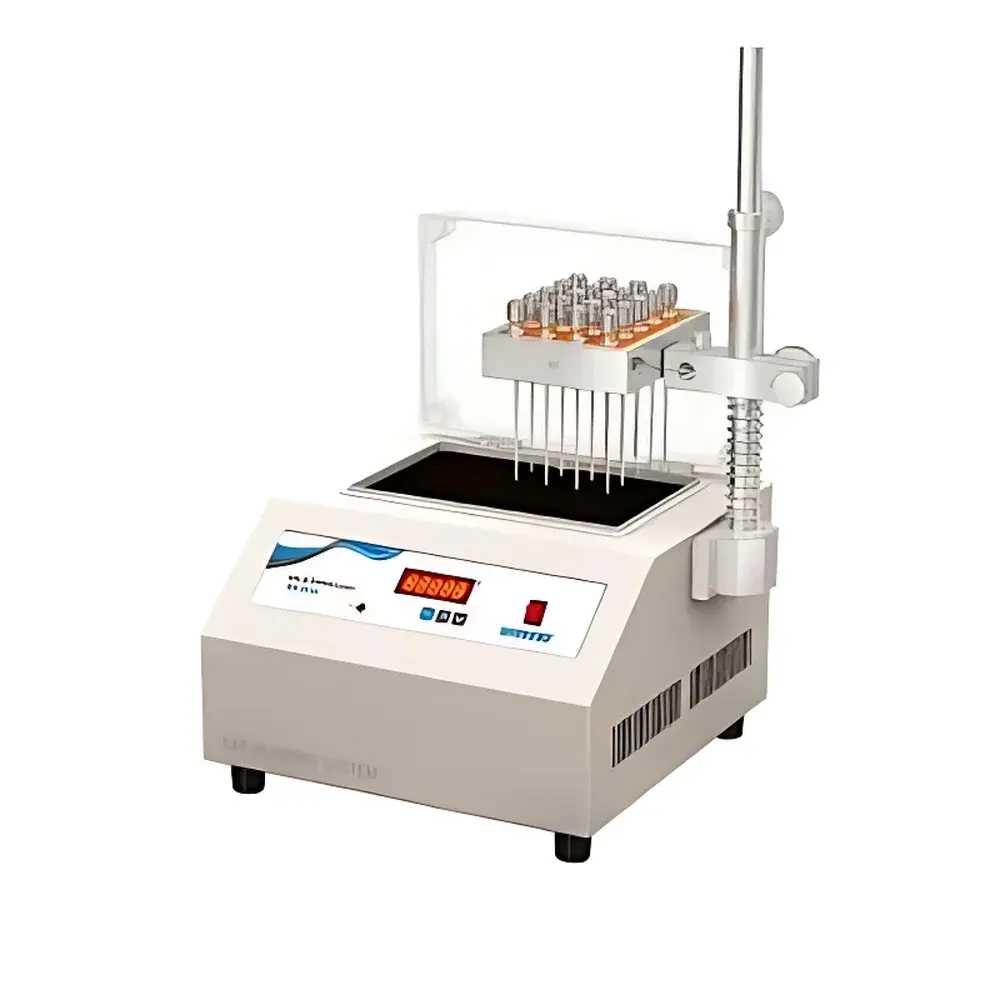
WIGGENS WB-503G Nitrogen Evaporator with Dry-Block Heating
| Brand | WIGGENS |
|---|---|
| Origin | Germany |
| Model | WB-503G |
| Heating Method | Dry-block heating |
| Temperature Range | Ambient +5 °C to 120 °C |
| Temperature Stability | ±0.1 °C |
| Sample Capacity | 20 positions |
| Tube Diameters Supported | 11 mm, 13 mm, 16 mm |
| Heating Power | 125 W |
| Dimensions (W×D×H) | 310 × 250 × 435 mm |
| Weight | 6 kg |
| Power Supply | 110/220 V, 50/60 Hz |
Overview
The WIGGENS WB-503G Nitrogen Evaporator is an engineered dry-block heating system designed for precise, parallel solvent evaporation and sample concentration in analytical, environmental, pharmaceutical, and clinical laboratories. It operates on the principle of inert gas-assisted surface evaporation: nitrogen—selected for its chemical inertness and absence of oxidative reactivity—is delivered via individually controllable stainless-steel needles to the headspace above liquid samples, accelerating volatilization while minimizing thermal degradation of thermolabile analytes. Unlike water-bath or open-flame methods, the WB-503G employs a solid aluminum heating block with PID-regulated temperature control, eliminating cross-contamination risks and ensuring reproducible thermal profiles across all 20 sample positions. Its modular architecture supports standardized tube formats (11 mm, 13 mm, and 16 mm OD), making it compatible with common vials used in GC, HPLC, and LC-MS sample preparation workflows.
Key Features
- PID-controlled dry-block heating with ±0.1 °C temperature stability over the full operating range (ambient +5 °C to 120 °C), enabling method transfer consistency and compliance with ISO/IEC 17025 thermal validation requirements.
- 20 independently adjustable gas inlet valves—each equipped with a precision flow-control knob—allow selective activation, deactivation, or fine-tuning of nitrogen flow per position without affecting adjacent channels.
- Gear-driven vertical height adjustment mechanism with locking screws ensures repeatable needle positioning across varying tube heights; eliminates manual re-alignment during batch changes.
- Dedicated exhaust manifold with centralized vent port facilitates connection to laboratory fume hoods or optional WIGGENS tail-gas capture units (e.g., EV-TCU series), supporting VOC containment and regulatory adherence to OSHA PEL and EPA Method 8260B emission guidelines.
- LED touchscreen interface with intuitive menu navigation supports parameter logging, real-time temperature display, and system status feedback—designed for unattended overnight operation under GLP-compliant environments.
- Robust construction: anodized aluminum heating block, stainless-steel gas manifolds, and flame-retardant polymer housing meet IEC 61010-1 safety standards for laboratory electrical equipment.
Sample Compatibility & Compliance
The WB-503G accommodates standard borosilicate glass and polypropylene tubes with outer diameters of 11 mm, 13 mm, and 16 mm—covering formats used in EPA 500-series drinking water analysis, FDA 21 CFR Part 11–aligned residue testing, and USP dissolution sample workups. Its dry-block design prevents water ingress, corrosion, or bath contamination—critical for trace-metal analysis (e.g., ASTM D5600) where aqueous carryover must be avoided. The system’s gas distribution architecture ensures laminar, non-turbulent nitrogen delivery, reducing splashing and foaming in viscous or surfactant-containing extracts (e.g., lipidomics or pesticide residue matrices). All operational parameters—including setpoint, actual temperature, runtime, and valve status—are timestamped and exportable via USB, supporting audit-ready data integrity per ALCOA+ principles.
Software & Data Management
While the WB-503G operates as a standalone instrument with embedded firmware, its LED interface records up to 10 user-defined protocols with temperature ramping profiles and dwell times. Event logs—including power-on cycles, temperature deviations exceeding ±0.5 °C, and valve actuation sequences—are stored internally for ≥30 days and retrievable via USB flash drive in CSV format. For integration into LIMS or electronic lab notebook (ELN) ecosystems, WIGGENS provides optional RS-232/USB-to-serial drivers compatible with LabVIEW™, Python-based automation scripts, and third-party SCADA platforms. Firmware updates maintain compatibility with evolving regulatory expectations around electronic record retention (21 CFR Part 11 Subpart B) and secure user authentication.
Applications
- Concentration of environmental extracts (e.g., EPA Method 8082 PCBs, Method 8270 semivolatiles) prior to GC-ECD or GC-MS analysis.
- Preparative cleanup of biological matrices—including plasma, urine, and tissue homogenates—in clinical toxicology and doping control labs (WADA-accredited workflows).
- Routine evaporation of derivatized amino acid standards in food authenticity testing (ISO 18365).
- Parallel drying of SPE eluates in pharmaceutical QC labs performing residual solvent analysis per ICH Q2(R2) validation guidelines.
- Controlled desolvation of nanomaterial suspensions prior to DLS or TEM characterization—where thermal shock or oxidation must be excluded.
FAQ
What gas pressure range is recommended for optimal performance?
Nitrogen supply pressure should be maintained between 30–60 psi at the instrument inlet. Excessive pressure (>80 psi) may cause turbulent flow and sample loss; insufficient pressure (<20 psi) results in uneven evaporation rates.
Can the WB-503G be used with gases other than nitrogen?
Yes—argon and helium are acceptable alternatives for specialized applications requiring higher thermal conductivity or lower molecular weight; however, oxygen or compressed air must never be used due to oxidation and explosion hazards.
Is the heating block interchangeable with other WIGGENS modules?
No—the WB-503G uses a proprietary 20-position aluminum block calibrated specifically for this model. Module interchangeability is limited to within the FlexiVap and ZipVap product families.
Does the system support 21 CFR Part 11 compliance out-of-the-box?
The base unit provides audit-trail-capable logging but requires supplementary IT infrastructure (e.g., networked time servers, role-based access controls) and procedural SOPs to achieve full Part 11 compliance.
What maintenance is required to ensure long-term accuracy?
Annual calibration of the PT100 sensor against NIST-traceable references is recommended. Gas pathways should be purged monthly with filtered nitrogen to prevent particulate accumulation in needle orifices.



