
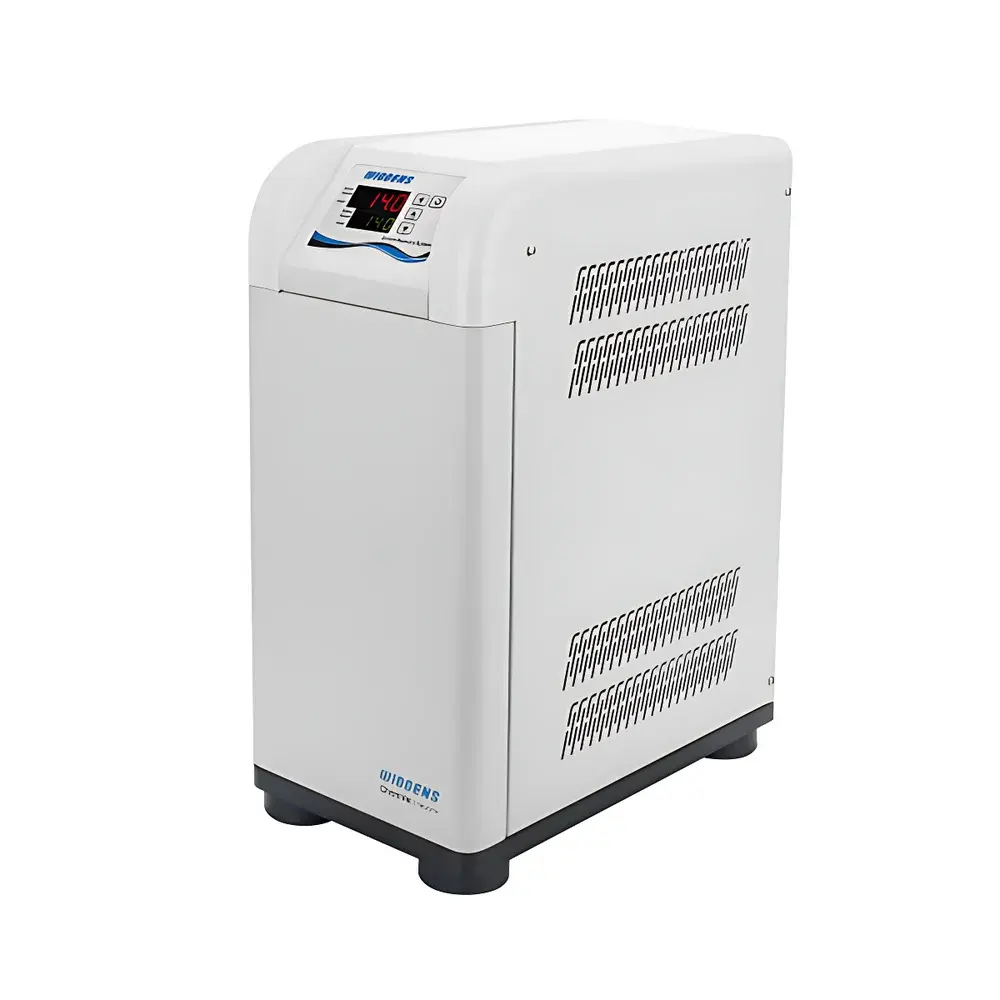
WIGGENS C980VEF Corrosion-Resistant Variable-Frequency Diaphragm Vacuum Pump System
| Brand | WIGGENS |
|---|---|
| Origin | Germany |
| Model | C980VEF |
| Pump Type | Diaphragm Vacuum Pump |
| Ultimate Vacuum | < 1 mbar |
| Pumping Speed | 40 L/min |
| Motor Power | 400 W |
| Dimensions (W×D×H) | 220 × 400 × 495 mm |
| Weight | 25 kg |
| Vacuum Pressure Resolution | 0.1 mbar |
| Setpoint Range | 0.1–1000 mbar |
| Motor Speed | 1380 rpm (50 Hz) / 1680 rpm (60 Hz) |
| Inlet/Outlet Port Size | 10 mm |
| Noise Level | 50 dB(A) |
| IP Rating | IP20 |
| Protection | Thermal Overload Auto-Shutdown & Auto-Restart |
Overview
The WIGGENS C980VEF Corrosion-Resistant Variable-Frequency Diaphragm Vacuum Pump System is an engineered solution for laboratories and industrial process environments requiring precise, stable, and chemically inert vacuum generation. Unlike conventional fixed-speed or basic PID-controlled diaphragm pumps, the C980VEF integrates a digitally regulated brushless motor with an embedded intelligent control unit featuring AI-assisted self-tuning PID logic. This architecture enables real-time adaptation of proportional-integral-derivative parameters to dynamic load conditions—such as fluctuating vapor loads during rotary evaporation or condensate accumulation in filtration—thereby maintaining setpoint stability within ±0.1 mbar across variable gas composition and flow resistance. Its fully oil-free operation eliminates risks associated with hydrocarbon contamination, oil carryover, or disposal compliance, while its hermetically sealed drive chamber physically isolates mechanical components from corrosive process gases, extending service intervals and ensuring long-term repeatability.
Key Features
- AI-enabled auto-tuning PID controller: Dynamically adjusts control parameters based on real-time system response, eliminating manual calibration and minimizing pressure overshoot or oscillation under non-stationary conditions.
- Full PTFE-wetted path: All gas-contact surfaces—including diaphragms, valves, inlet/outlet manifolds, and internal chambers—are constructed from virgin polytetrafluoroethylene, delivering exceptional resistance to halogenated solvents, strong acids (e.g., HCl, HNO₃), alkalis, and organic vapors.
- Thermal protection circuitry: Integrated temperature sensors trigger automatic shutdown at critical thresholds (>85 °C); system resumes operation autonomously once thermal equilibrium is restored, ensuring uninterrupted workflow integrity.
- Compact modular architecture: Combines pump head, frequency inverter, and control interface into a single footprint (220 × 400 × 495 mm), reducing benchspace requirements by up to 40% compared to traditional multi-component vacuum systems.
- Energy-efficient operation: Variable-speed motor reduces power consumption by up to 35% during low-demand phases (e.g., hold mode in vacuum drying), supporting ISO 50001-aligned lab sustainability objectives.
- Noise-optimized design: Acoustic enclosure and vibration-damping mounts limit operational noise to ≤50 dB(A) at 1 m distance—compliant with ISO 7779 and suitable for shared laboratory environments.
Sample Compatibility & Compliance
The C980VEF is validated for continuous duty with aggressive chemical media commonly encountered in pharmaceutical synthesis (e.g., THF/HCl mixtures), petrochemical sample preparation (e.g., chlorinated hydrocarbons), and academic research involving reactive intermediates. Its PTFE construction meets ASTM D543-20 requirements for plastic resistance to chemical reagents and complies with EU Directive 2011/65/EU (RoHS) regarding hazardous substance restrictions. While not intrinsically rated for Zone 1/2 explosive atmospheres, it satisfies IEC 61000-6-3 (EMC emission limits) and carries CE marking per Machinery Directive 2006/42/EC. For GLP/GMP-regulated workflows, the system supports audit-ready event logging when interfaced via RS-485 with compliant LIMS or SCADA platforms.
Software & Data Management
The integrated controller provides local setpoint adjustment via intuitive membrane keypad and dual-line LCD display showing real-time vacuum pressure, motor RPM, and system status. Optional Modbus RTU (RS-485) communication enables remote monitoring and parameter configuration through third-party software (e.g., LabVIEW, MATLAB, or custom Python scripts). Event logs—including thermal shutdowns, setpoint deviations >0.5 mbar, and cumulative runtime—are timestamped and stored internally for ≥30 days. Though not FDA 21 CFR Part 11-compliant out-of-the-box, the system can be validated for electronic record integrity when deployed with qualified data acquisition software and procedural controls governing user access, change management, and backup protocols.
Applications
- High-capacity solvent removal: Stable vacuum control during large-scale rotary evaporation (up to 50 L flasks) and thin-film distillation of thermolabile compounds.
- Process-scale filtration: Continuous vacuum-assisted filtration of corrosive slurries in API manufacturing, including catalyst recovery and crystallization mother liquor handling.
- Vacuum drying ovens: Precise pressure ramping and dwell control for moisture-sensitive materials (e.g., lyophilized biologics, metal-organic frameworks).
- Reaction vessel evacuation: Safe degassing of autoclaves and jacketed reactors prior to hydrogenation or anhydrous Grignard reactions.
- Environmental sample prep: Solid-phase extraction (SPE) and purge-and-trap concentration of volatile organic compounds (VOCs) from aqueous matrices.
- Semiconductor wafer processing: Low-particulate, oil-free vacuum for pre-deposition chamber conditioning and photoresist baking steps.
FAQ
Is the C980VEF certified for use with explosive or flammable vapors?
No—the unit is not ATEX or IECEx certified. It must be operated in well-ventilated areas outside classified hazardous zones.
Can the pump handle saturated solvent vapors without performance degradation?
Yes; its PTFE diaphragm and cold-trap-compatible design tolerate transient condensate ingress. For sustained high-vapor-load applications, we recommend pairing with a WIGGENS CTC-100 chilled trap.
What maintenance intervals are recommended for routine operation?
Diaphragm replacement every 12,000 hours (≈1.4 years at 24/7 operation); valve inspection every 6 months; no lubrication or oil changes required.
Does the system support analog output for integration into building management systems?
Not natively—but a 4–20 mA vacuum pressure transmitter module (WIGGENS PXM-01) can be added as a field-installable option.
How does the AI PID differ from standard auto-tuning implementations in competitive models?
Unlike heuristic-based auto-tuners that execute one-time step-response characterization, the C980VEF’s algorithm continuously refines Kp, Ki, and Kd coefficients using recursive least-squares estimation, adapting to aging-related friction shifts and ambient temperature drift.



