
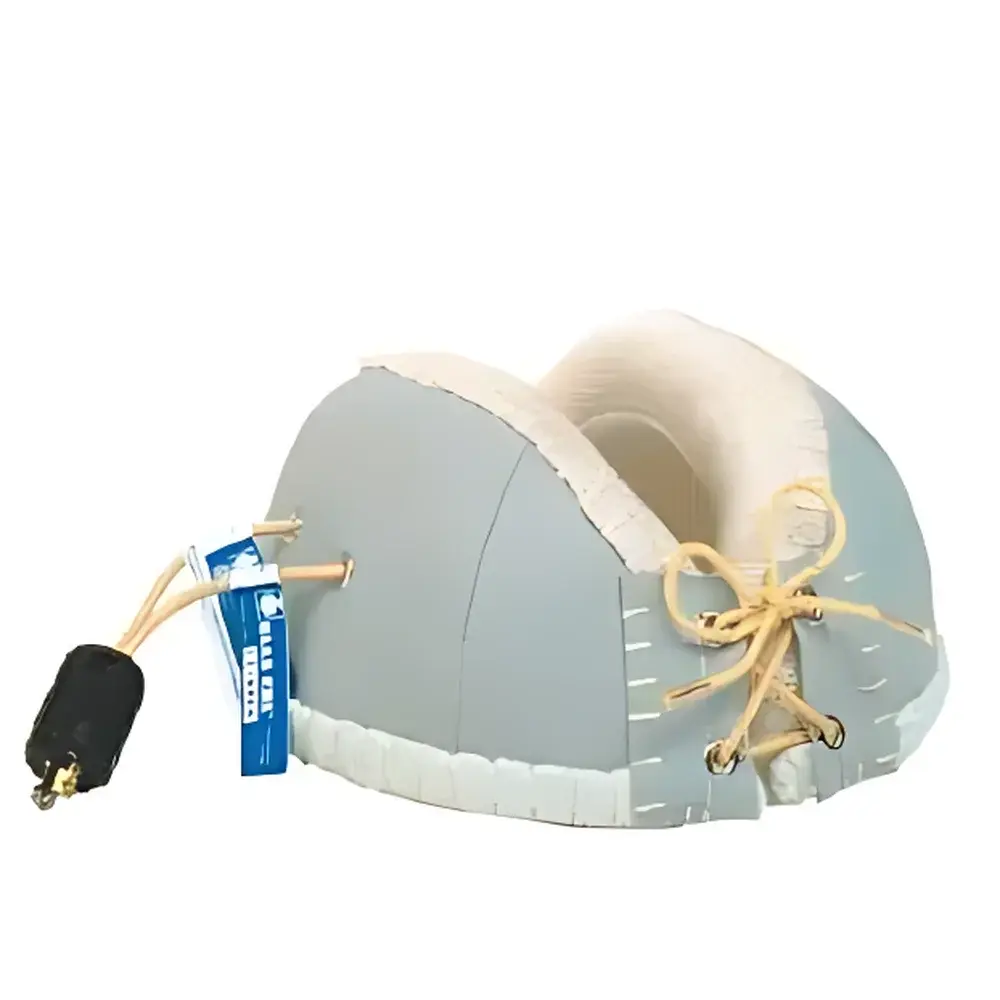
WIGGENS INS1023 Insulating Jacket for Electric Heating Mantles
| Brand | WIGGENS |
|---|---|
| Origin | Germany |
| Manufacturer Type | Authorized Distributor |
| Origin Category | Imported |
| Model | INS1023 |
| Price Range | USD 2,700 – 6,700 |
| Compatible With | WIGGENS M / TM / STM Series Heating Mantles |
| Material | High-Density E-Glass Fiberglass Fabric with Silicone Coating |
| Max Operating Temperature (Jacket Surface) | 250 °C |
| Max Inner Layer Temp (Contact Side) | 450 °C |
| Fastening | Adjustable Hook-and-Loop Straps & Elastic Side Bands |
| Opening Shape | Elliptical |
| Wire Length | 1.2 m, 2-Conductor, Locking Plug (CEE 7/7 or IEC 60320 C13 per regional variant) |
| Weight | 0.3–5.3 kg (varies by size) |
| Compliance | RoHS 3, REACH, CE Marked per EN 61000-6-3 / EN 61000-6-4 |
Overview
The WIGGENS INS1023 Insulating Jacket is an engineered thermal management accessory designed specifically for use with WIGGENS M, TM, and STM series electric heating mantles. It functions as a precision-engineered thermal barrier—not a primary heat source—intended to minimize radial and axial heat loss from the upper portion of reaction vessels during distillation, reflux, and high-vacuum evaporation processes. By maintaining uniform thermal gradients along the vessel wall, the jacket mitigates condensation in the vapor path, suppresses thermal stress-induced microfractures in borosilicate glass, and enhances process stability under reduced pressure conditions. Its construction employs high-density E-glass fiberglass fabric with silicone impregnation, delivering mechanical resilience, dielectric integrity, and long-term dimensional stability at sustained temperatures up to 250 °C on the outer surface and 450 °C at the inner contact layer.
Key Features
- Elliptical aperture geometry accommodates single-, double-, and triple-neck round-bottom flasks without mechanical interference or thermal bridging.
- Hook-and-loop fastening system combined with elastic lateral bands ensures secure, repeatable fit across variable neck configurations and vessel diameters (83–522 mm).
- Non-rigid, conformal structure eliminates point-loading on glassware—critical for preventing thermal shock during rapid temperature transitions.
- Integrated 1.2 m two-conductor cable with locking plug enables safe, standardized power interface compatible with laboratory-grade mains distribution systems.
- Surface-treated fiberglass matrix resists moisture absorption, chemical splashes (including common solvents), and incidental contact with cleaning agents per ISO 15190 laboratory safety guidelines.
Sample Compatibility & Compliance
The INS1023 series is validated for use with standard borosilicate 3.3 glassware (e.g., DIN 12331, ASTM E438 Type I Class A) ranging from 250 mL to 72 L capacity. It complies with EU Directive 2014/30/EU (EMC Directive) and 2014/35/EU (Low Voltage Directive), bearing CE marking under harmonized standards EN 61326-1 (electromagnetic compatibility for laboratory equipment) and EN 61010-1 (safety requirements for electrical equipment). The material formulation meets RoHS 3 (2015/863/EU) restrictions on hazardous substances and REACH SVHC thresholds. No regulatory claim is made for direct FDA 21 CFR Part 11 compliance, though audit-ready documentation packages—including calibration traceability logs and material certificates of conformance—are available upon request for GLP/GMP-aligned installations.
Software & Data Management
As a passive thermal accessory, the INS1023 does not incorporate embedded electronics, sensors, or firmware. Its operational parameters are fully deterministic and require no software configuration. However, when integrated into automated distillation workflows (e.g., coupled with WIGGENS WT-2000 programmable controllers or third-party SCADA platforms via analog 4–20 mA feedback loops), the jacket contributes directly to improved PID loop stability and reduced overshoot variance—particularly during ramp-hold-cool cycles governed by ASTM D86, D1160, or ISO 3405 test protocols. Full technical documentation—including dimensional schematics, thermal resistance curves (R-value ≈ 0.85 m²·K/W), and installation torque specifications—is provided in English PDF format compliant with ISO 8000-110 data quality standards.
Applications
- Prevention of premature vapor condensation in fractional distillation columns, thereby preserving theoretical plate efficiency and accurate reflux ratio control.
- Structural reinforcement of large-volume glass reactors (≥20 L) under high vacuum (<1 mbar), reducing risk of implosive failure due to differential thermal expansion between heated base and ambient-temperature upper wall.
- Thermal isolation of sight glasses, thermowell ports, or gas inlet/outlet fittings to avoid localized cooling that could trigger nucleation or crystallization artifacts.
- Protection against accidental impact damage during routine lab handling—especially in teaching laboratories where multi-user access increases mechanical exposure risk.
- Reduction of ambient heat load in temperature-controlled rooms, supporting HVAC energy efficiency targets aligned with ISO 50001 energy management systems.
FAQ
Is the INS1023 rated for continuous operation at 450 °C?
No—the 450 °C rating applies only to the innermost contact layer under transient, localized conditions; maximum recommended continuous surface temperature is 250 °C per EN 60519-2.
Can it be used with non-WIGGENS heating mantles?
Yes, provided the mantle’s external diameter, height profile, and thermal output align with the dimensional and power dissipation limits specified in the INS1023 sizing table.
Does the jacket require periodic recalibration?
No—being a passive thermal insulator, it has no drift-prone components and requires only visual inspection for fabric integrity and strap functionality prior to each use.
Are custom sizes available for non-standard reactor geometries?
Yes; WIGGENS offers OEM engineering support for bespoke elliptical apertures, reinforced edge treatments, and alternative fastening configurations under NDA.
What maintenance procedures are recommended?
Wipe clean with isopropyl alcohol; avoid abrasive cleaners or steam sterilization—neither is necessary nor approved for this material system.
Related Products



