
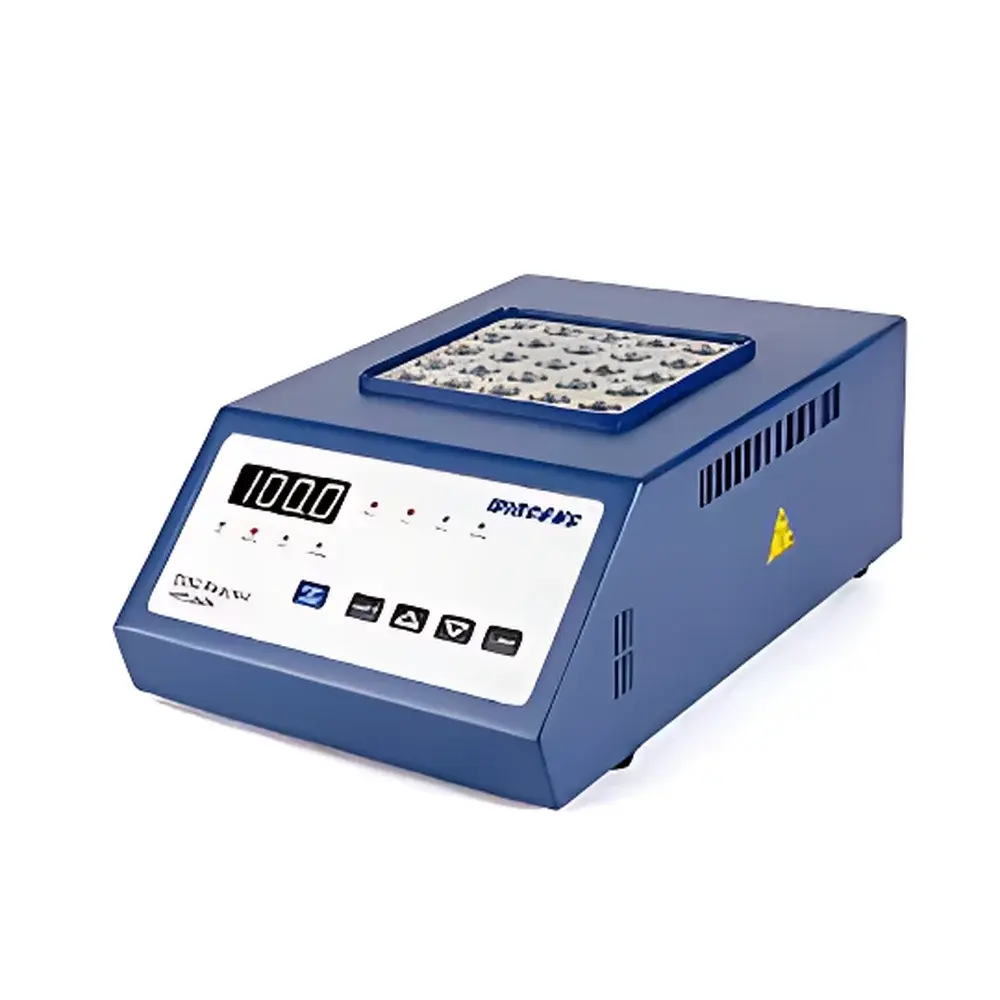
WIGGENS WD325 COD Digestion Block with Programmable Metal Bath
| Brand | WIGGENS |
|---|---|
| Origin | Germany |
| Model | WD325 |
| Temperature Range | 60–200°C (adjustable) / Fixed 150°C COD Program |
| Temperature Accuracy | ±2°C at 150°C |
| Timer Range | 1–999 min (plus continuous mode) |
| Dimensions | 189 × 116 × 315 mm |
| Net Weight | 4.5 kg |
| Sample Capacity | 25 × 16 mm test tubes |
| Safety Features | Overheat warning (>70°C), auto-shutdown at >240°C |
| Memory | 3 programmable heating profiles |
| Power Supply | 220 V, 50 Hz |
| Operating Environment | 10–50°C |
Overview
The WIGGENS WD325 COD Digestion Block is a precision-engineered programmable metal bath designed specifically for standardized chemical oxygen demand (COD) sample preparation in environmental, wastewater, and regulatory compliance laboratories. It operates on the principle of conductive heating via an aluminum block with uniform thermal distribution, ensuring reproducible digestion conditions required by method-specific protocols—including USEPA Method 410.4. Unlike general-purpose heating blocks, the WD325 integrates a dedicated 150°C/120-min COD digestion cycle that initiates automatic ramping, holds temperature with ±2°C stability at setpoint, and terminates with audible alert and power cutoff—eliminating manual timing errors and operator intervention during critical digestion phases. Its compact footprint and robust thermal architecture make it suitable for benchtop deployment in ISO/IEC 17025-accredited labs, municipal testing facilities, and university research environments where traceability, repeatability, and method adherence are non-negotiable.
Key Features
- Dedicated COD digestion program: Pre-configured 150°C hold for exactly 120 minutes per ASTM D1252 and USEPA 410.4 requirements, with integrated alarm and auto-shutdown.
- Flexible temperature control: Adjustable setpoints from 60°C to 200°C in 1°C increments, supporting alternative digestion protocols (e.g., total phosphorus, heavy metal leaching, or BOD pre-treatment).
- Programmable timer: Digital countdown from 1 to 999 minutes or continuous operation mode, enabling extended thermal treatments beyond standard COD workflows.
- Triple-program memory: Stores up to three user-defined temperature/time profiles for rapid recall—ideal for multi-method labs running parallel analyses.
- Thermal safety system: Dual-stage protection—LED warning activates when block surface exceeds 70°C; hardware-based cut-off engages at 240°C to prevent thermal runaway and component degradation.
- High-uniformity aluminum block: Precision-machined 25-position array accommodating 16 mm OD glass or PTFE-lined digestion tubes, optimized for minimal inter-well temperature variance (<±0.8°C across full load).
Sample Compatibility & Compliance
The WD325 accommodates standard 16 mm outer-diameter digestion vials used in closed-reflux COD kits (e.g., Hach, Merck, and Thermo Fisher). Its thermal performance meets the spatial and temporal uniformity criteria outlined in ISO 8466-1 for spectrophotometric water quality analysis and supports GLP-compliant documentation when paired with external loggers. While the instrument itself does not generate analytical data, its operational parameters align with FDA 21 CFR Part 11 expectations for controlled environment instrumentation—particularly when integrated into SOPs requiring calibration verification (per ISO/IEC 17025 Clause 6.4.10) and routine performance checks using NIST-traceable reference thermometers. The device is CE-marked and conforms to IEC 61010-1:2010 for laboratory electrical equipment safety.
Software & Data Management
The WD325 operates as a standalone hardware-controlled unit with no embedded software or network interface. All configuration is performed via front-panel keypad navigation and confirmed through a four-digit LED display. To support audit-ready workflows, users are advised to document run parameters (set temperature, duration, batch ID) manually or integrate the unit into lab information management systems (LIMS) via external digital loggers (e.g., Omega OM-DAQPRO or Testo 176 T4) connected to the block’s analog output port (optional accessory). Firmware updates are not applicable; calibration verification records and maintenance logs must be retained per ISO/IEC 17025 Section 7.7 for equipment traceability.
Applications
- Routine COD determination in municipal wastewater treatment plants according to USEPA 410.4 and ISO 6060.
- Pre-digestion conditioning for UV-Vis spectrophotometric quantification of nitrate, phosphate, and silicate in surface water matrices.
- Controlled thermal extraction of metals (e.g., Pb, Cd, Cr) from solid waste samples prior to ICP-OES or AAS analysis per EPA Method 3050B.
- Standardized heating of reagent blanks and calibration standards in QA/QC protocols for environmental chemistry labs.
- Method development studies requiring precise, repeatable thermal exposure across variable time–temperature gradients.
FAQ
Does the WD325 comply with USEPA Method 410.4 for COD analysis?
Yes—the fixed 150°C/120-min digestion cycle is engineered to meet the thermal profile and timing requirements specified in USEPA 410.4.
Can the heating block accommodate tubes larger than 16 mm?
No—the standard block is configured for 16 mm OD tubes only; alternative blocks (e.g., for 12 mm or 20 mm vials) are available as optional accessories under separate part numbers.
Is calibration certificate included with shipment?
No—a factory calibration report is provided; however, users must perform initial verification using a NIST-traceable thermometer prior to first use and at defined intervals per internal quality procedures.
What maintenance is required for long-term accuracy?
Regular cleaning of the aluminum block with non-abrasive ethanol wipes and periodic inspection of thermal insulation integrity are recommended; no lubrication or internal servicing is required.
Can the WD325 be used in fume hoods?
Yes—it is rated for operation in ventilated enclosures; ensure adequate clearance (≥50 mm) around all sides for convection cooling and avoid obstructing the rear ventilation grille.



