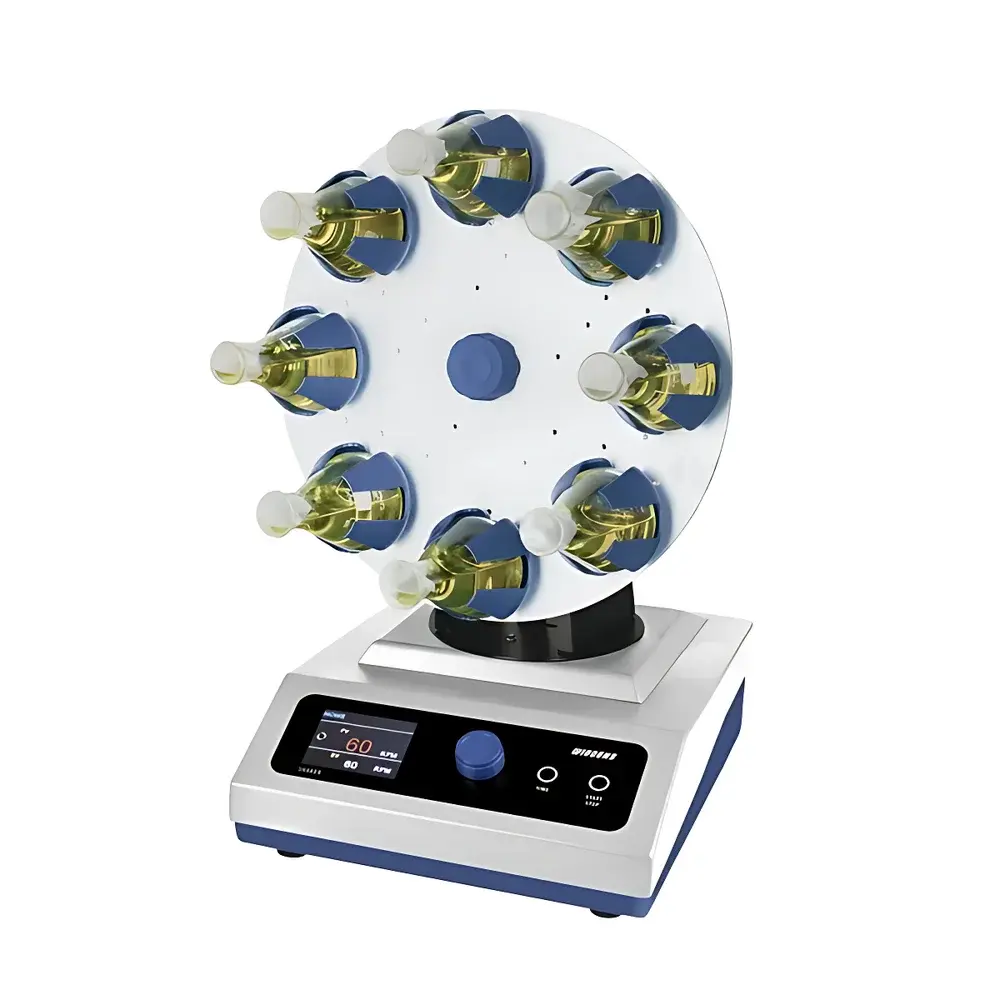
WIGGENS WT-350R Rotational Mixer for Biological Sample Homogenization
| Brand | WIGGENS |
|---|---|
| Origin | Germany |
| Manufacturer Type | Authorized Distributor |
| Product Origin | Imported |
| Model | WT-350R |
| Instrument Type | Tilt-Rotation Mixer |
| Oscillation Frequency | 2–70 rpm |
| Tilt Angle Range | 0–90° |
| Load Capacity | ≤4 kg |
| Display | VFD (Vacuum Fluorescent Display) |
| Control System | PID Feedback Controller |
| Timer Range | 1 min – 99 h 59 min |
| Operating Temperature | 5–40 °C |
| Humidity Limit | ≤80% RH |
| Housing Material | Polypropylene (PP) |
| Footprint (W×D×H, with optional tray) | 320 × 325 × 463 mm |
| Net Weight (with optional tray) | 7.5 kg |
| Power Supply | AC 100–240 V, 50/60 Hz |
Overview
The WIGGENS WT-350R Rotational Mixer is an engineered solution for gentle, reproducible, and programmable mixing of biological samples in tubes, vials, and small flasks. Unlike orbital or reciprocating shakers, the WT-350R employs a precisely controlled tilt-rotation motion—combining continuous axial rotation with adjustable angular inclination (0° to 90°)—to generate laminar, low-shear fluid displacement ideal for sensitive immunoassays, antigen–antibody binding kinetics, latex agglutination diagnostics, and anticoagulant-treated blood sample maintenance. Its core architecture integrates a high-torque stepper motor with closed-loop PID feedback control, ensuring stable rotational velocity even at ultra-low speeds (as low as 2 rpm), critical for preventing cell lysis or aggregate disruption during incubation-coupled protocols.
Key Features
- Gentle, low-shear tilt-rotation mechanism with continuously adjustable inclination (0–90°), enabling both horizontal end-over-end mixing and near-vertical tumbling—optimized for uniform suspension without foaming or splashing.
- PID-controlled stepper motor with built-in self-diagnostic routines, overcurrent protection, and thermal shutdown safeguards—ensuring operational reliability across extended unattended runs.
- Vacuum fluorescent display (VFD) with ambient-light-sensitive capacitive keys for intuitive parameter entry; supports real-time monitoring of speed, angle, elapsed time, and remaining timer duration.
- Modular tray system: interchangeable aluminum sample platforms (sold separately) accommodate diverse vessel formats—including 12×15 mL, 24×13 mm, 32×16 mm, and 54×13 mm tube configurations—with dual-tray support enabling simultaneous processing of up to 108 tubes.
- Chemically resistant polypropylene (PP) housing rated for compatibility with common laboratory solvents, alcohols, and disinfectants; smooth non-porous surface facilitates rapid decontamination and meets ISO 13485-aligned cleaning validation requirements.
- Compact footprint (320 × 325 × 463 mm) and lightweight design (7.5 kg) allow seamless integration into cold rooms (≥5 °C), CO2 incubators, and biosafety cabinets—without compromising structural stability or acoustic performance.
Sample Compatibility & Compliance
The WT-350R is validated for use with standard clinical and research-grade consumables including polypropylene, polycarbonate, and borosilicate glass tubes (5–50 mL), microcentrifuge tubes (0.5–2.0 mL), and diagnostic assay vials. Its low-vibration rubber isolation feet minimize energy transfer to adjacent instrumentation—critical in shared lab environments where microplate readers or spectrophotometers operate concurrently. The device complies with IEC 61010-1:2010 for electrical safety in laboratory equipment and conforms to electromagnetic compatibility standards EN 61326-1:2013. While not FDA 21 CFR Part 11–certified out-of-the-box, its deterministic timer logic, non-volatile parameter storage, and error-log timestamping support GLP/GMP-aligned documentation workflows when integrated with validated LIMS or ELN systems.
Software & Data Management
The WT-350R operates as a standalone instrument with no embedded firmware update capability or PC connectivity. All operational parameters—including speed, tilt angle, and timer duration—are stored in non-volatile memory and retained after power cycling. Error codes (e.g., E01 for motor stall, E02 for temperature threshold breach) are displayed on the VFD with persistent visual indication until acknowledged. For traceability in regulated environments, users may manually record settings and runtime logs per batch; the device’s deterministic behavior ensures high inter-run reproducibility (±0.5 rpm speed accuracy, ±1° angular repeatability), supporting ASTM E2500-13 verification protocols for mixing equipment qualification.
Applications
- Immunoprecipitation assays requiring slow, consistent agitation to maximize antigen–antibody complex formation while minimizing nonspecific binding.
- Maintenance of whole blood specimens with EDTA or citrate anticoagulants—preventing fibrin clot formation during transport or pre-analytical holding.
- Latex agglutination tests in clinical microbiology and serology, where controlled particle collision kinetics directly impact sensitivity and readout clarity.
- Rehydration and homogenization of lyophilized reagents, enzyme conjugates, and antibody stocks prior to ELISA or lateral flow assay preparation.
- Cell culture media supplementation protocols involving viscous additives (e.g., methylcellulose, Ficoll gradients) where shear-sensitive components must remain intact.
FAQ
Can the WT-350R be operated inside a 4 °C cold room?
No—the minimum operating temperature is specified at 5 °C. Prolonged exposure below this threshold may affect VFD responsiveness and stepper motor torque consistency.
Is the aluminum tray chemically compatible with 70% ethanol or 10% bleach solutions?
Yes; the anodized aluminum trays resist corrosion from routine disinfectants. However, prolonged immersion or repeated exposure to undiluted sodium hypochlorite is not recommended.
Does the device support external trigger signals or RS-232 communication?
No—WT-350R lacks digital I/O interfaces. It is designed exclusively for manual, stand-alone operation.
What is the maximum allowable load when using two trays simultaneously?
The total mass must not exceed 4 kg, regardless of tray configuration or number of vessels mounted.
How often does the unit require calibration or preventive maintenance?
No scheduled calibration is required. Routine visual inspection of tray mounting integrity and periodic cleaning of the PP housing with isopropanol are sufficient for long-term performance assurance.