
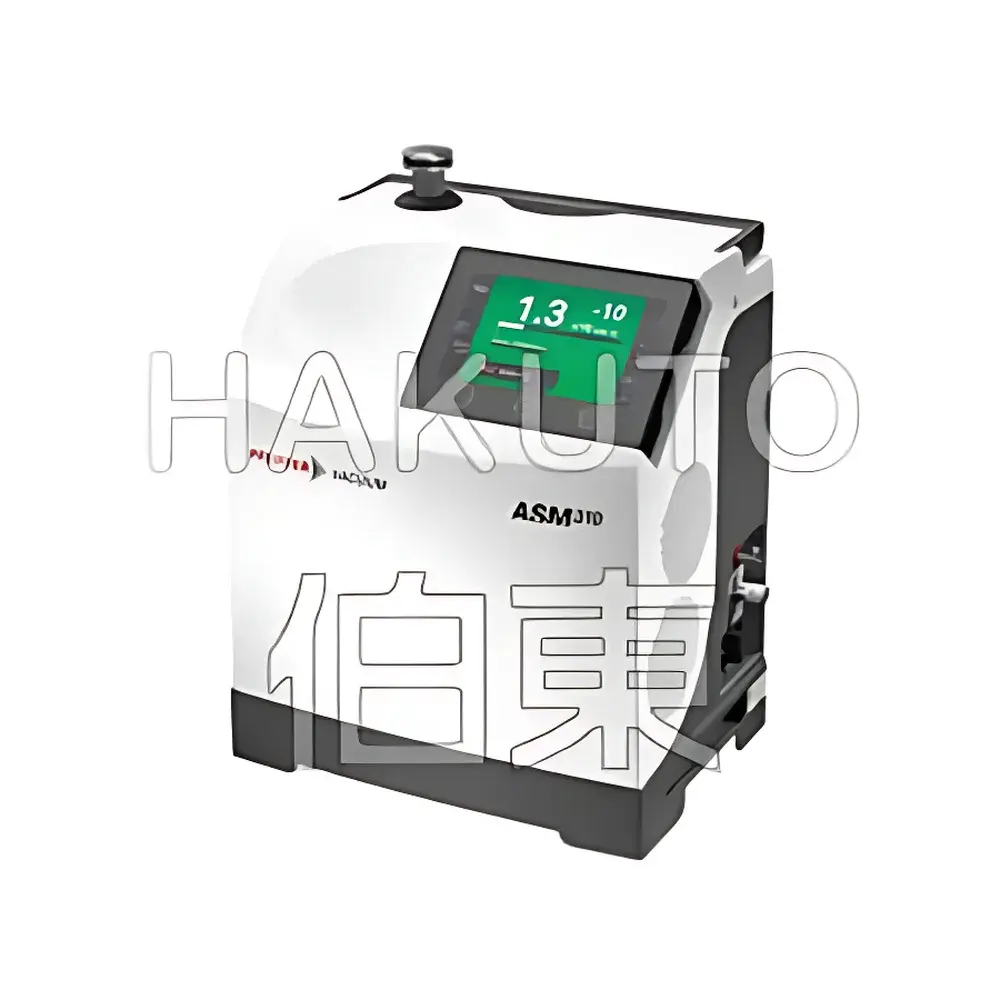
Pfeiffer Vacuum ASM 310 Portable Helium Mass Spectrometer Leak Detector
| Brand | Pfeiffer Vacuum |
|---|---|
| Origin | Germany |
| Model | ASM 310 |
| Minimum Detectable Leak Rate (Vacuum Mode) | 5×10⁻¹³ Pa·m³/s |
| Minimum Detectable Leak Rate (Sniffer Mode) | 1×10⁻⁸ Pa·m³/s |
| Helium Pumping Speed | 1.1 L/s |
| Inlet Pressure Limit | 15 hPa |
| Roughing Pump | MVP 020 Diaphragm Pump (1.7 m³/h) |
| Turbomolecular Pump | ATH Series |
| Inlet Flange | DN 25 ISO-KF |
| Operating Temperature | 10–40 °C |
| Noise Level | <45 dB(A) |
| Power Supply | 90–240 V AC, 50/60 Hz |
| Max. Power Consumption | 300 VA |
| Warm-up Time | <2 min |
| Dimensions (W×H×D) | 350×254×415 mm |
| Weight | 21 kg |
| Interfaces | RS-232, USB, I/O |
| Display | High-brightness color touchscreen with image function, 10 language options |
| Compliance | Designed for ISO 16051, ASTM E1514, and GLP/GMP-aligned operation |
Overview
The Pfeiffer Vacuum ASM 310 Portable Helium Mass Spectrometer Leak Detector is a compact, high-sensitivity instrument engineered for precise quantitative leak detection in vacuum and atmospheric environments. Based on quadrupole mass spectrometry principles, it selectively detects helium (⁴He and optionally ³He or H₂) as a tracer gas with exceptional specificity and signal-to-noise ratio. Its integrated ultra-high vacuum architecture—comprising a dry diaphragm roughing pump (MVP 020, 1.7 m³/h) and an ATH-series turbomolecular pump—ensures oil-free operation critical for contamination-sensitive applications such as semiconductor fabrication, analytical instrumentation, and space-grade cryogenic systems. With a minimum detectable leak rate of 5×10⁻¹³ Pa·m³/s in vacuum mode and 1×10⁻⁸ Pa·m³/s in sniffer (helium accumulation) mode, the ASM 310 meets stringent requirements defined in ISO 16051 for helium leak testing and aligns with ASTM E1514 methodology for sensitivity verification. Its lightweight, ergonomic design (21 kg) and modular interface support rapid deployment across R&D labs, production floors, and field service operations without compromising metrological integrity.
Key Features
- Integrated oil-free vacuum system: MVP 020 diaphragm pump + ATH-series turbomolecular pump ensures clean, particle-free evacuation suitable for UHV (<1×10⁻⁷ mbar) and ultra-clean process environments.
- Dual-mode operation: Seamless switching between vacuum (pressure-rise or residual gas analysis) and sniffer (helium accumulation) detection modes via intuitive touchscreen interface.
- High helium pumping speed: 1.1 L/s at the inlet enables rapid response (<1 s typical) and improved signal stability during dynamic leak surveys.
- Robust mechanical design: Compact footprint (350 × 254 × 415 mm), retractable handle, and multi-orientation capability (horizontal/vertical operation) enhance portability and usability in constrained spaces.
- Comprehensive connectivity: RS-232 serial interface for legacy SCADA integration, USB host port for firmware updates and data export, and digital I/O for external trigger/control synchronization.
- Intuitive human-machine interface: 7-inch high-brightness color touchscreen with graphical display, real-time spectrum visualization, and configurable language support (10 languages including English, German, Chinese, Japanese, and Korean).
Sample Compatibility & Compliance
The ASM 310 is compatible with a wide range of industrial and scientific components—from semiconductor lithography tools and accelerator beamlines to cryogenic Dewar vessels and solar cell deposition chambers. Its DN 25 ISO-KF inlet flange allows direct connection to standard vacuum systems, while optional accessories—including calibrated standard leak sources, RC 10 remote control unit, articulated sniffer probe, and two-wheel transport trolley—extend its adaptability across inspection workflows. The instrument complies with key international standards governing leak testing procedures and equipment validation, including ISO 16051 (leak detection—helium mass spectrometer method), ASTM E1514 (standard practice for calibration of helium mass spectrometer leak detectors), and EN 61326-1 (EMC requirements for laboratory equipment). Its architecture supports audit-ready operation under GLP and GMP frameworks, with timestamped event logging, user-access control, and non-volatile memory for traceable measurement records.
Software & Data Management
Data acquisition and reporting are managed through the embedded firmware, which stores test logs—including date/time stamps, measured leak rates, operating mode, ambient conditions, and operator ID—in internal flash memory. Export is supported via USB mass storage mode to CSV or PDF formats for integration into enterprise quality management systems (QMS). While no external PC software is bundled, the RS-232 and I/O interfaces enable compatibility with third-party automation platforms compliant with Modbus RTU or custom ASCII command protocols. All firmware updates are delivered via signed binary packages validated against Pfeiffer Vacuum’s secure update signature chain. Audit trail functionality includes write-protected system logs, change history for calibration parameters, and configurable password protection for administrative functions—facilitating compliance with FDA 21 CFR Part 11 where electronic records are subject to regulatory review.
Applications
- Semiconductor Manufacturing: Leak verification of photolithography tools requiring base pressures below 1×10⁻¹¹ Pa; detection of micro-leaks at weld seams, feedthroughs, and gate valves using negative-pressure helium spray techniques.
- Space & Cryogenics: Certification of vacuum integrity in Mars mission Dewar assemblies housing infrared detector arrays; validation against ≤1×10⁻⁸ Pa·m³/s acceptance thresholds per NASA-STD-8719.14.
- Research Infrastructure: Commissioning and maintenance of particle accelerator beamlines, synchrotron end stations, and ultra-high vacuum surface science chambers.
- Energy & Industrial Systems: Integrity assessment of turbine condensers, nuclear coolant loops, fuel cell stacks, and solar thin-film coaters where hydrocarbon contamination must be avoided.
- OEM Integration: Embedded use in automated vacuum system builders, leak-test workstations, and turnkey packaging lines requiring compact, low-maintenance helium detection modules.
FAQ
What is the warm-up time required before stable operation?
The ASM 310 achieves full operational readiness—including mass spectrometer stabilization and vacuum system equilibrium—in less than 2 minutes after power-on.
Can the instrument detect gases other than helium?
By default, the ASM 310 is optimized for helium (⁴He) detection at mass-to-charge ratio m/z = 4. Optional firmware configuration supports ³He (m/z = 3) and hydrogen (H₂, m/z = 2) with appropriate calibration and background compensation.
Is the device certified for use in explosive atmospheres?
No—the ASM 310 is not ATEX or IECEx certified. It is intended for use in non-hazardous environments compliant with EN 61010-1 safety standards.
How often does the instrument require recalibration?
Calibration intervals depend on usage intensity and environmental conditions. Pfeiffer Vacuum recommends annual verification using traceable standard leaks per ISO 16051 Annex B, with interim performance checks conducted before critical measurements.
Does the ASM 310 support remote diagnostics or predictive maintenance?
While it lacks built-in IoT telemetry, diagnostic status codes, pump health indicators, and error logs are accessible via RS-232 or USB, enabling integration with facility-wide predictive maintenance platforms using custom middleware.





