
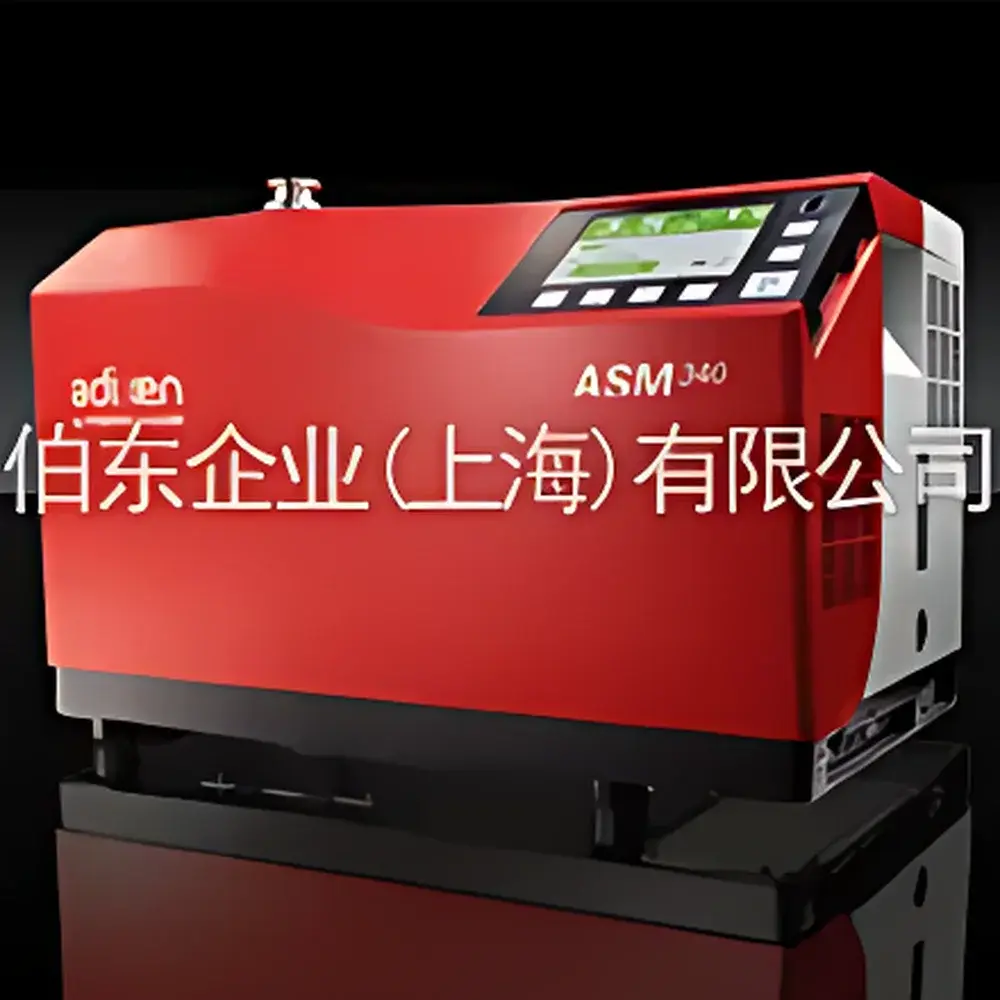
Pfeiffer Vacuum ASM340 WET Helium Mass Spectrometer Leak Detector for Automotive HVAC Evaporator and Condenser Testing
| Brand | Pfeiffer Vacuum |
|---|---|
| Origin | France |
| Model | ASM340 WET |
| Application | Sealed Component Leak Testing in Automotive HVAC Systems |
| Detection Principle | Helium Mass Spectrometry (180° Magnetic Sector Analyzer) |
| Operating Mode | Vacuum Chamber (Accumulation) & Vacuum-Mode (Sniffing-Compatible via External Pumping Interface) |
| Leak Rate Sensitivity | ≤5×10⁻¹² mbar·L/s (He, typical) |
| Pumping Interface | Integrated Dry Scroll Backing Pump + Turbomolecular Pump (WET Configuration) |
| Compliance | CE, RoHS, ISO 9001 Certified |
| Software | VacuGraph® PC-Based Control with Audit Trail, Data Export (CSV, XML), User Access Levels |
Overview
The Pfeiffer Vacuum ASM340 WET Helium Mass Spectrometer Leak Detector is an industrial-grade, vacuum-integrated leak detection system engineered for high-reliability quantitative measurement of minute helium tracer gas ingress in sealed automotive HVAC components. Based on magnetic sector mass spectrometry, the instrument selectively ionizes and separates helium atoms (mass-to-charge ratio m/z = 4) from background gases with high mass resolution and minimal cross-sensitivity to hydrogen or water vapor. Its WET (Water-Cooled Turbomolecular Pump) configuration ensures stable thermal performance during extended production-line operation, supporting continuous vacuum chamber cycling at pressures down to 1×10⁻⁴ mbar. Designed specifically for Tier-1 and OEM supplier environments, the ASM340 WET meets the stringent repeatability (±3% RSD over 8-hour shift) and traceability requirements of automotive quality management systems including IATF 16949. It operates exclusively in vacuum-mode accumulation testing — where the test part is pressurized with 1.5 bar helium and placed inside a sealed test chamber — enabling detection of leaks as small as 5×10⁻¹² mbar·L/s, well below the maximum allowable leakage rate specified in SAE J2722 and ISO 16000-23 for automotive refrigerant circuits.
Key Features
- Integrated dry scroll backing pump and water-cooled turbomolecular pump (WET) for consistent base pressure stability and reduced thermal drift during high-throughput testing
- Dual-stage vacuum architecture: rapid roughing phase followed by automatic transition to high-sensitivity fine-leak detection mode upon reaching <1×10⁻³ mbar
- VacuGraph® control software with configurable test sequences, pass/fail thresholds, and real-time leak rate trending
- Modular chamber interface supporting custom fixtures for evaporator core geometries (tube-fin, plate-fin, and serpentine configurations) and condenser assemblies (parallel-flow and tube-and-fin types)
- Electromagnetic interference (EMI)-hardened design compliant with EN 61326-1 for deployment in factory-floor environments with variable-frequency drives and welding equipment
- Full GLP/GMP support: electronic signatures, 21 CFR Part 11–compliant audit trail, and role-based user access (Operator, Technician, Administrator)
Sample Compatibility & Compliance
The ASM340 WET is validated for testing aluminum and brazed-copper HVAC heat exchangers with internal volumes ranging from 0.8 L to 5.2 L and maximum external dimensions up to 650 × 420 × 180 mm. It accommodates both evaporators (low-side, low-pressure components operating at ~2–3 bar gauge) and condensers (high-side, high-pressure components rated to ≥25 bar). All test protocols align with ASTM E499-22 (Standard Test Method for Leak Testing Using Helium Mass Spectrometers), ISO 10642:2021 (Leak detection — Vocabulary and definitions), and SAE J2043 (Refrigerant Circuit Integrity Requirements for Mobile Air Conditioning Systems). Calibration is performed using NIST-traceable helium permeation standards; certificate of calibration includes uncertainty budget per ISO/IEC 17025.
Software & Data Management
VacuGraph® provides deterministic, script-driven test execution with zero manual intervention required after fixture loading. Each test record captures timestamp, operator ID, chamber pressure curve, integrated helium signal amplitude, calculated leak rate, and final verdict (PASS/FAIL/ABORT). Data is stored locally in encrypted SQLite databases with optional OPC UA or Modbus TCP export for MES integration (e.g., Siemens Opcenter, Rockwell FactoryTalk). Raw spectral data (m/z 4 peak intensity vs. time) is retained for root-cause analysis. Batch reporting supports statistical process control (SPC) charting — including X̄-R charts for leak rate distribution across production lots — and auto-generation of ISO/IEC 17025–compliant test reports with digital signature fields.
Applications
Primary deployment includes 100% inline leak verification of automotive HVAC evaporators post-brazing and pre-coating, and final acceptance testing of condensers prior to compressor integration. Secondary use cases include R&D validation of new fin-pack designs under thermal cycling stress, failure analysis of field-return units (via residual helium mapping), and qualification of alternative refrigerants (e.g., R1234yf, R744) where lower permissible leak rates (<1×10⁻¹⁰ mbar·L/s) demand higher instrument sensitivity. The system also supports service-center applications for certified repair verification per OEM workshop standards (e.g., BMW Group ISTA, Mercedes-Benz WIS).
FAQ
What is the minimum detectable leak rate for an evaporator tested in accumulation mode?
Typical detection limit is 5×10⁻¹² mbar·L/s under standard test conditions (1.5 bar He, 300 s integration, chamber volume ≤2.5 L). Actual performance depends on background helium contamination, chamber outgassing rate, and pumping speed.
Can the ASM340 WET be used for sniffer-mode testing of condensers?
No — the ASM340 WET is configured exclusively for vacuum-chamber accumulation testing. For localized sniffer-mode detection, Pfeiffer’s ASM380 mobile unit is recommended.
Is helium recovery supported?
Not natively; however, third-party helium recapture modules compatible with the ASM340 WET’s exhaust port are available and commonly deployed in high-volume facilities to reduce operational helium consumption by >70%.
How often does the mass spectrometer require recalibration?
Annual calibration is recommended per ISO/IEC 17025; interim verification using certified permeation standards is performed daily or per shift in production environments.
Does the system support automated pass/fail decision logic based on component-specific thresholds?
Yes — VacuGraph® allows defining up to 16 independent test recipes, each with unique pressure ramp profiles, dwell times, integration windows, and pass/fail criteria aligned with part number-level specifications.
Related Products





