
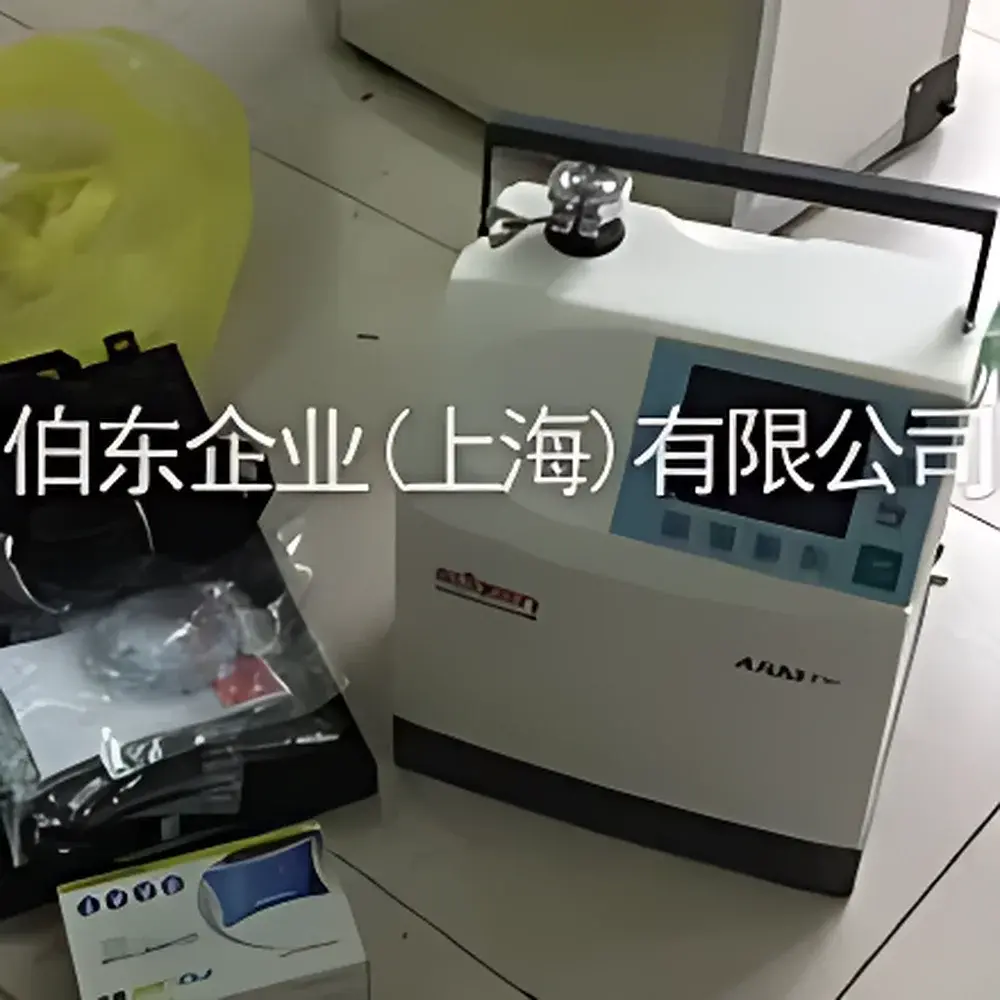
Pfeiffer ASM 310 Helium Mass Spectrometer Leak Detector for Power Plant Turbine Vacuum Systems
| Brand | Pfeiffer Vacuum |
|---|---|
| Origin | France |
| Model | ASM 310 |
| Application | In-service turbine vacuum system leak detection |
| Compliance | CE, RoHS, ISO 9001-certified manufacturing |
Overview
The Pfeiffer ASM 310 Helium Mass Spectrometer Leak Detector is an industrial-grade, high-sensitivity residual gas analyzer engineered specifically for quantitative leak detection in large-scale, pressurized, and vacuum-critical infrastructure—most notably thermal power plant steam turbine vacuum systems. Operating on the principle of magnetic sector mass spectrometry, the ASM 310 selectively ionizes and separates helium atoms (mass-to-charge ratio m/z = 4) from background gases with exceptional discrimination against hydrogen, water vapor, nitrogen, and hydrocarbons. Its detection limit reaches ≤5 × 10⁻¹² mbar·L/s under optimized conditions, enabling identification of sub-micron leaks in complex, high-volume vacuum networks without system shutdown. Unlike pressure-rise or halogen-based methods, helium-based detection provides non-invasive, real-time, and trace-level quantification—critical for maintaining condenser vacuum integrity in 300–1000 MW coal- or gas-fired generating units.
Key Features
- High-resolution magnetic sector mass spectrometer with quadrupole-assisted ion optics for enhanced signal-to-noise ratio and long-term stability
- Dual-mode operation: Sniffer (probe-based) mode for localized leak pinpointing and vacuum-integrated (connection-based) mode for system-wide sensitivity calibration
- Integrated turbomolecular pumping stage with active cooling, achieving base pressure <1 × 10⁻⁷ mbar in <60 seconds
- Real-time helium partial pressure monitoring with automatic background subtraction and drift compensation algorithms
- Ruggedized industrial enclosure rated IP54, designed for ambient temperatures from 5 °C to 40 °C and relative humidity up to 80% non-condensing
- Modular interface architecture supporting analog 4–20 mA output, RS-232/RS-485 serial communication, and optional Ethernet TCP/IP for SCADA integration
Sample Compatibility & Compliance
The ASM 310 is validated for use across diverse turbine vacuum subsystems—including condensers, low-pressure cylinders, air ejectors, gland steam systems, and air-cooled condenser (ACC) tube bundles—regardless of geometry complexity or surface temperature (tested up to 80 °C at probe tip). It complies with IEC 61000-6-2 (EMC immunity) and IEC 61000-6-4 (EMC emission) standards. For regulated power generation environments, its data logging functionality supports audit-ready traceability per ISO/IEC 17025 requirements when paired with time-stamped event records. While not intrinsically certified for Zone 1 hazardous areas, it may be deployed in classified zones using certified purge enclosures meeting ATEX Directive 2014/34/EU.
Software & Data Management
The instrument operates with Pfeiffer’s proprietary LeakTest Pro v4.2 software, which delivers configurable pass/fail thresholds, multi-point leak mapping visualization, and CSV-exportable reports compliant with NIST-traceable documentation protocols. All measurement sessions include embedded metadata: operator ID, timestamp (UTC), ambient pressure/temperature, helium injection duration, and integrated leak rate integral (in mbar·L/s). Audit trails record user login/logout events, parameter modifications, and firmware updates—fully satisfying FDA 21 CFR Part 11 electronic record requirements when deployed in nuclear or regulated fossil-fuel facilities undergoing GLP/GMP-aligned maintenance audits.
Applications
- Routine in-service leak surveillance of steam turbine condenser shells, expansion joints, and flanged connections during full-load operation
- Commissioning verification of weld integrity in air-cooled condenser (ACC) finned-tube arrays post-installation
- Troubleshooting unexplained vacuum decay (>0.13 kPa/min) correlated with elevated exhaust temperature or LP rotor vibration spectra
- Quantitative comparison of leak rates before/after sealant application or mechanical re-torquing—supporting root cause analysis per IEEE 100 Standard
- Integration into predictive maintenance programs via API-driven data ingestion into CMMS platforms such as IBM Maximo or SAP PM
FAQ
Can the ASM 310 detect leaks while the turbine is online and under vacuum?
Yes. The sniffer-probe configuration allows helium tracing without breaking vacuum or interrupting generation—enabling continuous monitoring during normal load operation.
What helium concentration is required for reliable detection in ambient air?
The system detects helium at concentrations ≥5 ppm in atmospheric sampling mode; optimal sensitivity is achieved using pulsed helium spray (1–3 s duration) near suspected leakage points.
Is calibration required before each test?
A full factory calibration is recommended annually; however, a quick-response zero/gain check using built-in reference leak (1 × 10⁻⁹ mbar·L/s) takes <90 seconds and is advised prior to critical inspections.
How does the ASM 310 differentiate helium from hydrogen interference?
Magnetic sector mass filtering physically separates m/z = 4 (⁴He⁺) from m/z = 2 (H₂⁺) and m/z = 3 (H₃⁺), eliminating cross-sensitivity common in quadrupole-only detectors.
Does the system support remote diagnostics or firmware updates?
Yes—via secure SSH-enabled Ethernet connection, authorized service engineers can perform health checks, log analysis, and version-controlled firmware upgrades without on-site presence.





