
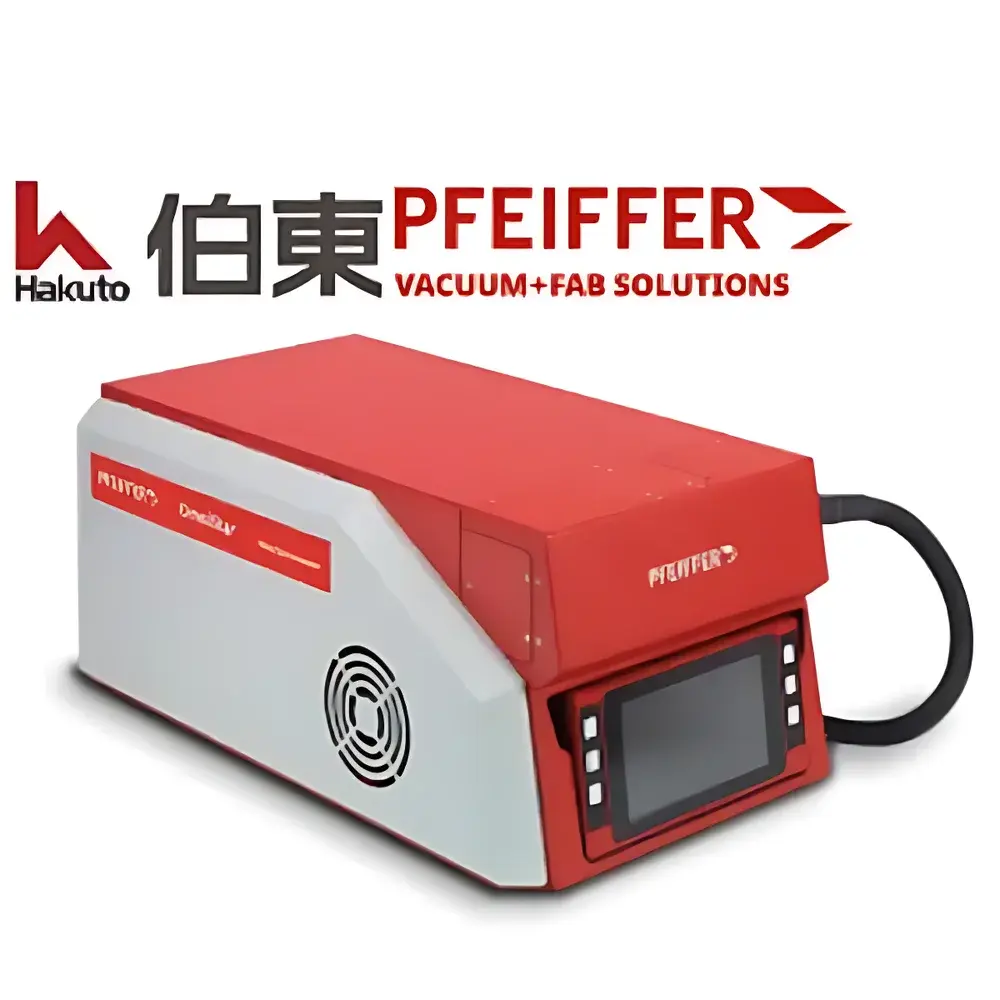
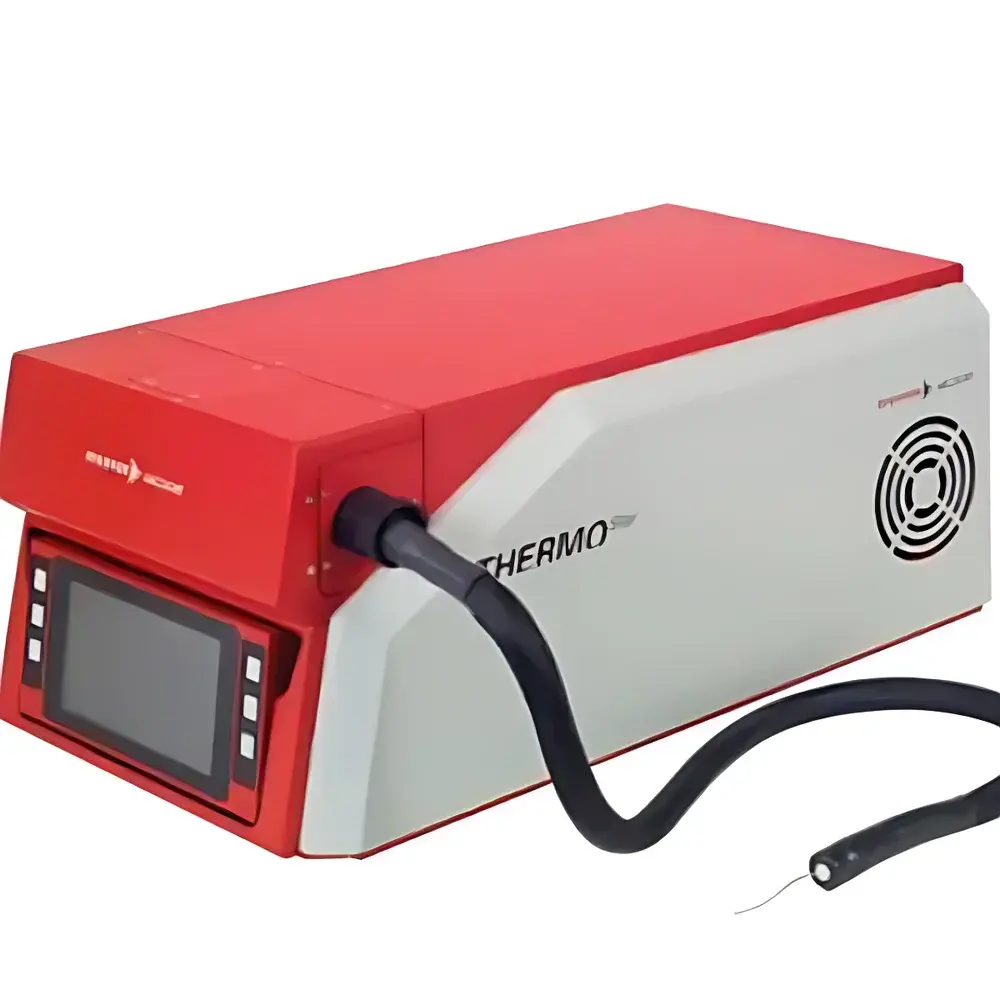
Pfeiffer Vacuum GSD 350 Online Mass Spectrometer
| Brand | Pfeiffer Vacuum |
|---|---|
| Origin | Germany |
| Model | GSD 350 |
| Mass Range | 1–100 / 1–200 / 1–300 amu (selectable) |
| Inlet Type | Heated stainless-steel capillary (OmniStar®) or heated quartz capillary with Pt gasket (ThermoStar®) |
| Capillary Heating Temperature | Up to 350 °C |
| Gas Flow Rate | 1–2 sccm |
| Sample Pressure Range | ≤1000 hPa |
| Detection Limit (C-SEM) | <100 ppb |
| Resolution | 0.5–2.5 amu (at 10% peak height, adjustable) |
| Analysis Speed | Down to 1 ms/amu |
| Dimensions (L×W×H) | 615 × 358 × 274 mm |
| Weight | ~23 kg |
| Power Supply | 85–265 VAC |
Overview
The Pfeiffer Vacuum GSD 350 Online Mass Spectrometer is a fully integrated, high-performance quadrupole mass spectrometry system engineered for real-time, in-situ gas analysis in demanding industrial and research environments. Based on electron ionization (EI) and quadrupole mass filtering principles, the GSD 350 delivers quantitative and qualitative molecular identification across a selectable mass range of 1–100, 1–200, or 1–300 amu. Its core architecture comprises a two-stage differential pumping inlet system, a PrismaPro® high-stability quadrupole mass analyzer, and a compact, all-in-one vacuum manifold integrating an MVP dry diaphragm backing pump and a HiPace turbomolecular pump—ensuring continuous, contamination-free high-vacuum operation (<1×10⁻⁶ hPa) without oil vapor backstreaming. Designed for direct process integration, the GSD 350 operates under variable sample pressures up to 1000 hPa and accommodates gas flow rates from 1 to 2 sccm, enabling representative sampling from reactors, exhaust streams, thermal analyzers, or environmental chambers with minimal fractionation or memory effects.
Key Features
- Two application-optimized configurations: OmniStar® for flexible multi-point process monitoring and ThermoStar® for seamless TGA-MS and catalytic reaction coupling.
- Dual-stage pressure reduction inlet with temperature-controlled capillary (up to 350 °C), eliminating condensation artifacts for volatile, polar, or thermally labile species.
- PrismaPro® quadrupole detector with C-SEM (continuous dynode electron multiplier) achieving sub-100 ppb detection limits and adjustable mass resolution (0.5–2.5 amu at 10% valley).
- Real-time acquisition speed down to 1 ms per atomic mass unit—enabling transient gas release tracking during rapid thermal events or catalytic turnover.
- Integrated 7-inch detachable color touchscreen with intuitive UI; full remote control via Ethernet or RS-232 supported.
- Modular hardware design: interchangeable filaments (including Y–Ir long-life option), field-replaceable ion sources, and configurable mass range kits for future scalability.
Sample Compatibility & Compliance
The GSD 350 maintains compatibility with corrosive, reactive, and condensable gases—including H₂S, NH₃, HF, Cl₂, silanes, and organic vapors—through chemically inert inlet paths (quartz + Pt gasket in ThermoStar®, electropolished stainless steel in OmniStar®). All wetted materials comply with ASTM F519 and ISO 8502-3 standards for surface cleanliness and outgassing control. The system meets CE marking requirements per EU Machinery Directive 2006/42/EC and EMC Directive 2014/30/EU. When operated with PV MassSpec software configured for audit trail, electronic signatures, and data integrity protocols, the GSD 350 supports GLP and GMP workflows aligned with FDA 21 CFR Part 11 and ISO/IEC 17025 traceability frameworks—particularly relevant for pharmaceutical fermentation monitoring and catalyst qualification studies.
Software & Data Management
PV MassSpec is a Windows-based, modular software platform providing instrument control, spectral acquisition, calibration management, quantitative library matching (NIST-compatible), and time-resolved trend analysis. It supports automated sequence execution—including multi-point valve switching, scheduled calibrations, and leak-check routines—with raw data stored in vendor-neutral .tdf format. Export options include CSV, ASCII, and XML for integration into LIMS, MES, or SCADA systems. Advanced features include dynamic background subtraction, isotopic pattern deconvolution, and real-time partial pressure calculation using pre-loaded response factors. Software validation packages (IQ/OQ documentation templates) and 21 CFR Part 11 compliance modules are available upon request for regulated environments.
Applications
- Chemical Process Monitoring: Real-time tracking of reactants, intermediates, and by-products in continuous flow reactors, distillation columns, or hydrogenation units.
- Semiconductor Manufacturing: In-line chamber gas composition verification, residual gas analysis (RGA) post-plasma etch, and dopant gas purity assessment.
- Thermal Analysis Coupling: Direct TGA-MS or DSC-MS hyphenation for mechanistic study of polymer degradation, battery electrode decomposition, or metal oxide reduction pathways.
- Biopharmaceutical Processes: Fermentation off-gas profiling (O₂, CO₂, ethanol, acetate), lyophilization endpoint detection, and bioreactor headspace monitoring.
- Environmental & Emission Testing: Quantification of VOCs, greenhouse gases (CH₄, N₂O), and halogenated compounds in ambient air, stack emissions, or soil vapor extraction streams.
- Metallurgy & Materials Science: In-situ analysis of furnace atmospheres, decarburization kinetics, and hydrogen embrittlement gas evolution during tensile testing.
FAQ
What vacuum level does the GSD 350 require for stable operation?
The PrismaPro® analyzer requires a base pressure below 1×10⁻⁶ hPa, maintained continuously by the integrated HiPace turbomolecular pump backed by the MVP dry diaphragm pump.
Can the GSD 350 be used for isotope ratio measurements?
While optimized for fast qualitative/quantitative process analysis, the GSD 350 is not designed for high-precision isotope ratio determination; its resolution and mass stability are suited for relative abundance tracking rather than delta-value metrology.
Is remote diagnostics and firmware updates supported?
Yes—via secure Ethernet connection, PV MassSpec enables remote instrument health monitoring, log file retrieval, and over-the-air firmware upgrades validated per IEC 62443-3-3 cybersecurity guidelines.
How is calibration performed for quantitative analysis?
Calibration uses certified gas mixtures introduced via a dedicated reference port; multi-point linear or polynomial response curves can be generated for up to 32 masses simultaneously, with drift compensation enabled during extended runs.
Does the system support hazardous area installation?
The standard GSD 350 is rated for non-hazardous locations (IP20); ATEX/IECEx-certified versions with explosion-proof enclosures and intrinsically safe interfaces are available as custom-engineered variants.




