
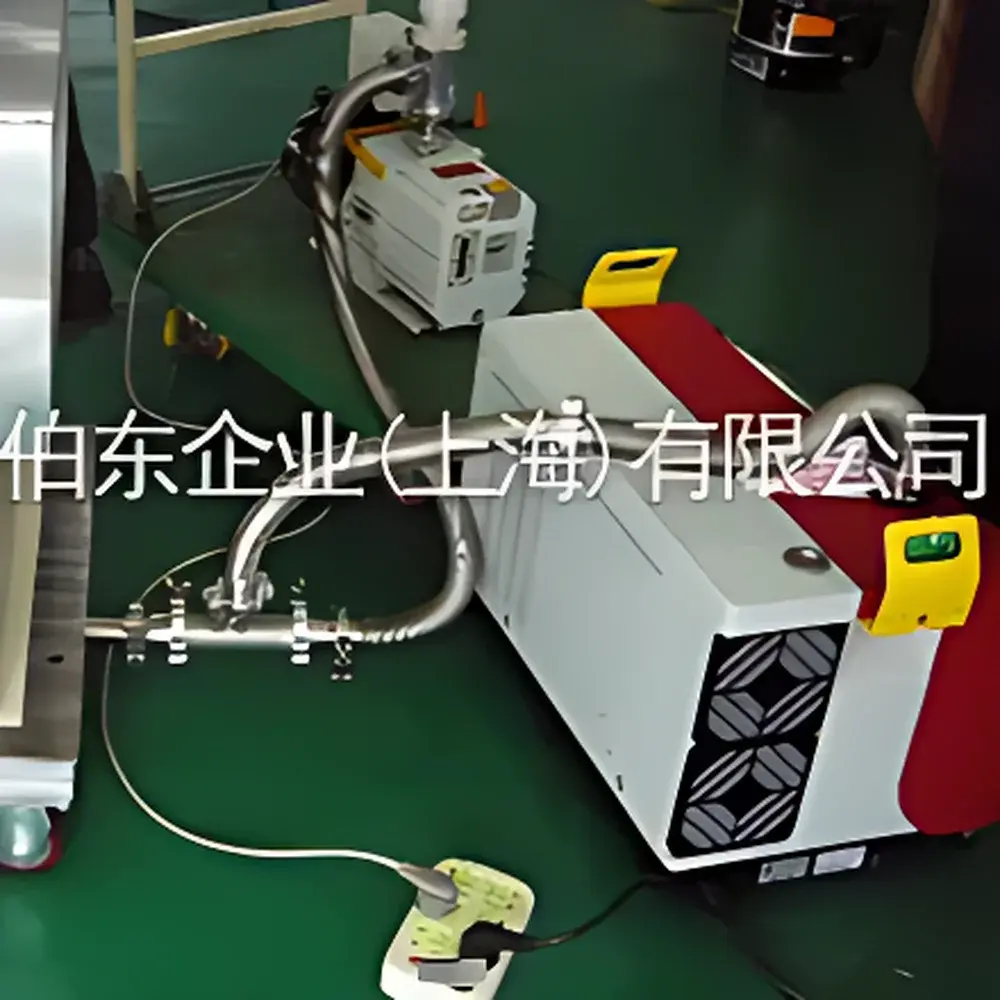
Pfeiffer Vacuum ASM 340 Helium Mass Spectrometer Leak Detector for Fuel Cell Enclosure Integrity Testing
| Brand | Pfeiffer Vacuum |
|---|---|
| Origin | France |
| Model | ASM 340 |
| Detection Principle | Helium-Specific Quadrupole Mass Spectrometry |
| Operating Mode | Vacuum (Sniffer & Vacuum Chamber) |
| Typical Sensitivity | ≤5 × 10⁻¹² mbar·L/s (He) |
| Pumping Configuration | Integrated with Duo 2.5 Dual-Stage Rotary Vane Pump |
| Compliance | CE, RoHS, ISO 9001 Manufacturing Environment |
| Software Interface | Pfeiffer Vacuum ControlSuite (PC-based, USB/Ethernet) |
| Data Logging | Timestamped leak rate records with user-defined pass/fail thresholds |
Overview
The Pfeiffer Vacuum ASM 340 is a high-sensitivity helium mass spectrometer leak detector engineered for quantitative integrity verification of hermetically sealed enclosures in advanced energy systems—particularly proton exchange membrane (PEM) and solid oxide fuel cell (SOFC) housings. It operates on the principle of quadrupole mass spectrometry, selectively ionizing and detecting helium atoms (mass-to-charge ratio m/z = 4) introduced as a tracer gas. Unlike pressure decay or bubble testing—which lack resolution below 10⁻⁶ mbar·L/s—the ASM 340 achieves detection limits down to 5 × 10⁻¹² mbar·L/s under optimized vacuum conditions. This sensitivity is critical for identifying micro-leaks at laser-welded seams, brazed joints, and feedthrough interfaces in thin-gauge stainless steel or titanium fuel cell casings, where even sub-micron discontinuities compromise long-term stack performance, hydrogen crossover safety margins, and electrolyte membrane hydration stability.
Key Features
- Quadrupole mass filter with magnetic sector-free design, enabling stable helium ion transmission across extended operational cycles without recalibration drift.
- Dual-mode operation: vacuum chamber mode (for pressurized or evacuated test parts) and sniffer probe mode (for localized leak localization post-assembly).
- Integrated Duo 2.5 dual-stage rotary vane pump provides base pressure <1 × 10⁻³ mbar within 60 seconds, minimizing preconditioning time prior to mass spec analysis.
- Real-time analog output (0–10 V) and digital communication (USB 2.0 + Ethernet) support integration into automated production line control systems (e.g., PLC-triggered cycle start/stop, MES data upload).
- Front-panel touchscreen interface with multilingual firmware (English, German, French, Chinese), configurable alarm thresholds, and automatic zero-point compensation during pump-down phases.
- Ruggedized chassis rated IP42, designed for cleanroom-adjacent environments (ISO Class 7/8) and compatible with nitrogen-purged glove boxes for inert-atmosphere fuel cell handling.
Sample Compatibility & Compliance
The ASM 340 accommodates fuel cell enclosures up to Ø450 mm × H300 mm in standard vacuum chamber configurations; custom fixtures—including Viton-sealed inverted mounting plates—are routinely deployed for cylindrical tank geometries. Its measurement protocol aligns with ASTM E499-21 (“Standard Test Method for Leak Testing by the Mass Spectrometer Leak Detector Method”) and supports traceable calibration per ISO/IEC 17025 requirements when paired with certified helium standard leaks (e.g., 1 × 10⁻⁹ mbar·L/s reference source). For regulated R&D facilities operating under GLP or pre-commercial GMP frameworks, the instrument’s audit trail functionality—logging operator ID, test timestamp, helium background level, peak response amplitude, and final leak rate—meets FDA 21 CFR Part 11 electronic record integrity expectations when used with validated ControlSuite software versions.
Software & Data Management
Pfeiffer Vacuum ControlSuite v3.2+ provides full remote instrument control, real-time spectral visualization, and batch-wise result archiving in CSV and XML formats. Each test record includes metadata such as ambient temperature, chamber pressure ramp rate, helium injection timing, and integrated leak integral (mbar·L/s·s). Exported datasets are structured for direct ingestion into LIMS platforms or statistical process control (SPC) dashboards (e.g., JMP, Minitab). Optional PDF report generation embeds signature fields for QA sign-off and supports digital watermarking for internal document control policies.
Applications
- Final acceptance testing of welded fuel cell end caps and manifold housings prior to MEA insertion.
- Root cause analysis of field-failure units via comparative leak mapping using sniffer probe raster scans.
- Process validation of laser welding parameters (power, speed, shielding gas flow) through correlation of seam geometry (via cross-section SEM) and measured leak rates.
- Qualification of epoxy-sealed sensor feedthroughs and bipolar plate cooling channel interfaces.
- Supporting DOE Hydrogen Program milestones requiring <1 × 10⁻⁹ mbar·L/s maximum allowable leakage for Class A stationary power systems.
FAQ
What vacuum level must be achieved before initiating helium scanning?
Base pressure ≤5 × 10⁻⁴ mbar is recommended; the system automatically inhibits mass spec acquisition until this threshold is confirmed.
Can the ASM 340 detect leaks in hydrogen-filled enclosures without helium introduction?
No—helium is required as the tracer gas; the instrument does not detect H₂ directly due to interference from background water vapor fragments at m/z = 2 and 3.
Is bake-out capability included for ultra-high-vacuum conditioning?
The ASM 340 is not equipped with internal heating elements; external chamber bake-out requires integration with a separate UHV-compatible oven and cold trap.
How frequently must the filament be replaced under continuous fuel cell production use?
Typical filament lifetime exceeds 12,000 hours when operated below 10% of full emission current; replacement is indicated only upon signal degradation >15% relative to baseline calibration.
Does the system support multi-point sequential testing of large-format fuel cell stacks?
Yes—via programmable I/O triggers and external multiplexer modules (sold separately), enabling automated scanning across up to 16 discrete weld zones per cycle.




