
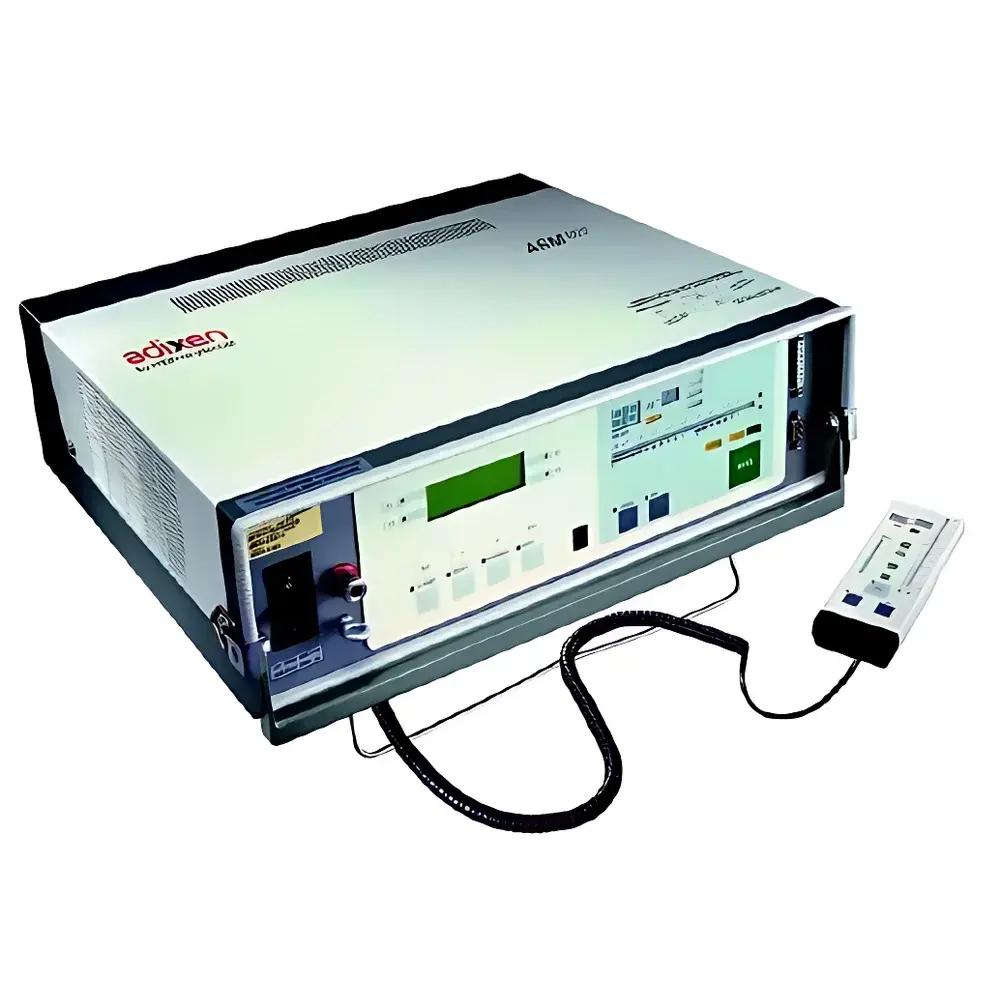
Pfeiffer ASM 102 S Portable Helium Mass Spectrometer Leak Detector
| Brand | Pfeiffer Vacuum |
|---|---|
| Origin | Germany |
| Model | ASM 102 S |
| Minimum Detectable Leak Rate (He) | 1×10⁻⁸ Pa·m³/s (7.5×10⁻⁸ Torr·L/s, 1×10⁻⁷ mbar·L/s) |
| Measurement Range (He) | 1×10⁻⁷ to 1 mbar·L/s |
| Detection Gas | ⁴He |
| Forevacuum Pump | Oil-free dry scroll pump |
| Operating Temperature | 0–45 °C |
| Warm-up Time | 1.5 min |
| Detection Mode | Sniffer Probe (Handheld) |
| Weight | 18 kg |
| Probe Cable Length | 5 m |
| Nozzle Diameter | 9 mm |
| Power Supply Options | 110/130 V AC or 200/240 V AC |
| Display Language Options | English, French, German |
| Remote Control | Integrated handheld controller |
Overview
The Pfeiffer ASM 102 S is a compact, battery-ready portable helium mass spectrometer leak detector engineered for high-sensitivity, on-site leak localization in vacuum systems, semiconductor tooling, HVAC components, medical devices, and aerospace assemblies. Based on quadrupole mass filter technology with optimized ion optics and a high-transmission electron multiplier detector, the ASM 102 S operates exclusively on helium (⁴He) as the tracer gas—leveraging its low natural background concentration (<5.2 ppm in ambient air) and favorable ionization cross-section to achieve exceptional signal-to-noise performance. Unlike fixed-station benchtop units, the ASM 102 S integrates a dedicated sniffer probe mode with real-time analog and digital leak rate display, enabling rapid qualitative screening and semi-quantitative assessment without system evacuation. Its modular architecture separates the analyzer head from the forepump and electronics, minimizing thermal drift and maximizing measurement stability during field operation.
Key Features
- Ultra-sensitive helium detection down to 1×10⁻⁸ Pa·m³/s—validated per ISO 20486:2021 Annex B for sniffer-mode performance verification
- Oil-free dry scroll forepump ensures clean, maintenance-light operation with no hydrocarbon contamination risk
- Integrated handheld remote control with tactile feedback buttons and LED status indicators for one-handed operation
- 5-meter flexible probe hose with interchangeable 9 mm stainless-steel nozzle—optimized for access into confined geometries and vertical/horizontal orientations
- Multi-language UI (English, French, German) supporting global technical teams and multilingual QA documentation workflows
- Wide-input power supply (110/130 V or 200/240 V, 50/60 Hz) compliant with IEC 61000-6-3 EMC standards for industrial environments
- Robust aluminum-magnesium alloy chassis rated IP42 for dust resistance and incidental splash protection
Sample Compatibility & Compliance
The ASM 102 S is designed for non-destructive, external leak detection on sealed or partially evacuated components where internal pressurization with helium is impractical or prohibited. It complies with ISO 9001-certified manufacturing protocols at Pfeiffer’s factory in Asslar, Germany. All firmware and calibration routines adhere to traceable NIST-traceable reference standards (NIST SRM 1921b). The instrument meets CE marking requirements under the EU Machinery Directive 2006/42/EC and Electromagnetic Compatibility Directive 2014/30/EU. For regulated industries—including medical device manufacturing (ISO 13485), pharmaceutical packaging (USP ), and aerospace component certification (SAE AS9100)—the ASM 102 S supports audit-ready operation logs when paired with optional data export via USB or RS-232, including timestamps, operator ID fields, and pass/fail thresholds aligned with internal SOPs.
Software & Data Management
While the ASM 102 S operates autonomously via its front-panel interface, optional Pfeiffer Vacuum Control Software (v4.2+) enables full remote configuration, real-time spectral monitoring, and automated report generation (PDF/CSV). Data logging includes leak rate values, probe position tags (via manual annotation), ambient temperature/humidity inputs, and user-defined test IDs. Audit trails comply with FDA 21 CFR Part 11 requirements when deployed with electronic signature modules and role-based access controls. Calibration history, sensor aging diagnostics, and pump runtime counters are stored internally with tamper-evident checksums—ensuring GLP/GMP traceability without third-party middleware.
Applications
- Leak localization on cryogenic vacuum chambers and superconducting magnet housings
- In-process verification of hermetic seals in MEMS sensors, laser diode packages, and implantable electronics
- Field validation of vacuum integrity in particle accelerator beamline components
- Post-repair leak checking of HVAC refrigerant lines and heat exchangers using helium charge + sniffer mapping
- QA/QC screening of automotive EV battery enclosures and fuel cell stack manifolds
- Support for ISO 15848-2 Type Testing of valve stem and flange emissions in process plants
FAQ
What is the warm-up time required before stable measurement?
The ASM 102 S achieves thermal and electronic equilibrium within 90 seconds after power-on, enabling immediate sniffer-mode use without extended stabilization delays.
Can the instrument detect gases other than helium?
No—the ASM 102 S is configured exclusively for ⁴He detection (mass-to-charge ratio m/z = 4) and does not support multi-gas analysis or alternative tracer gases.
Is the dry scroll pump serviceable in the field?
Yes—the pump module features user-replaceable scroll elements with documented torque specifications and alignment procedures included in the service manual (Pfeiffer Doc. No. ASM102-S-MA-EN Rev. 3.1).
Does the ASM 102 S meet ASTM E1002 standard requirements?
It satisfies the sensitivity and response time criteria defined in ASTM E1002–22 Section 6.2 for portable helium leak detectors used in sniffer mode, provided calibration is performed annually using certified helium permeation standards.
How is measurement repeatability ensured across different operators?
Consistent probe standoff distance, nozzle orientation, and sweep speed are enforced via built-in acoustic feedback tones and visual rate-of-change indicators—reducing inter-operator variability in qualitative surveys.






