
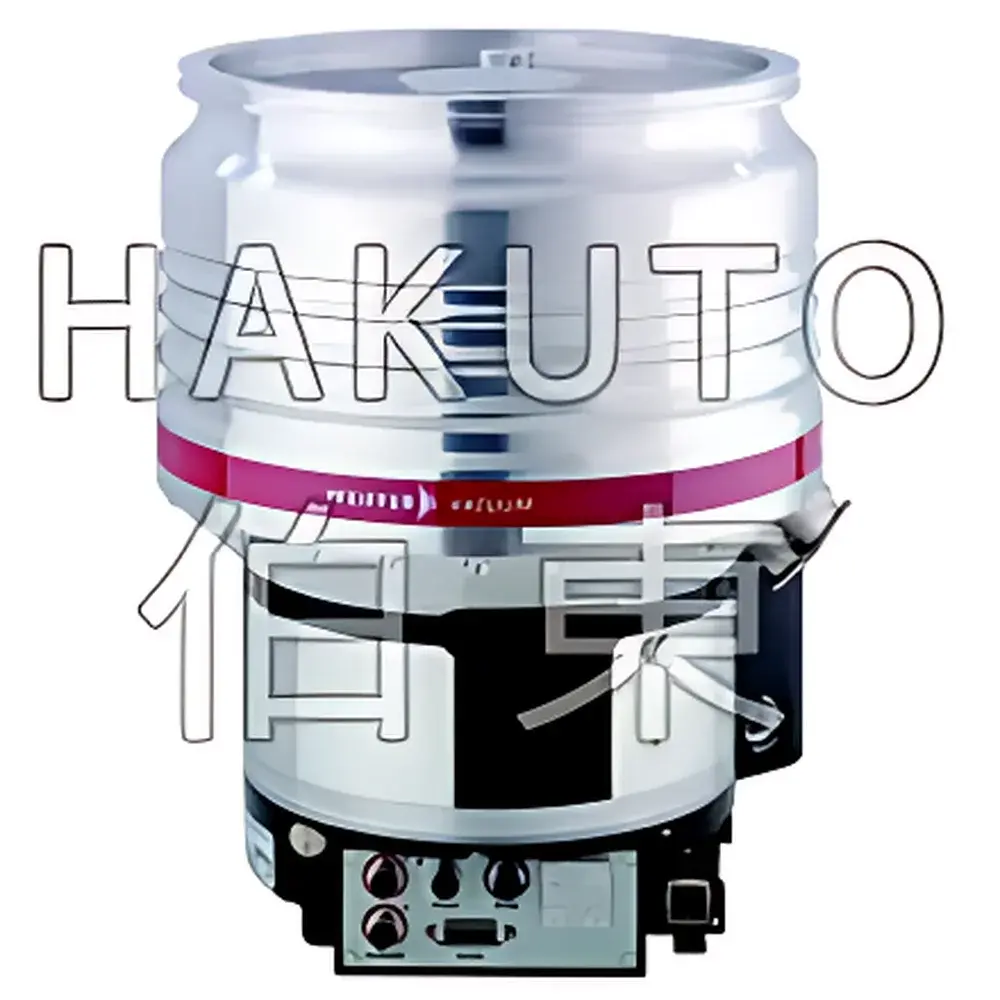
Pfeiffer HiPace 2300 Turbo Molecular Pump
| Brand | Pfeiffer Vacuum |
|---|---|
| Origin | Germany |
| Pump Type | Oil-Free Turbo Molecular Pump |
| Model | HiPace 2300 |
| Pumping Speed (N₂) | 1900 L/s |
| Pumping Speed (He) | 2000 L/s |
| Ultimate Pressure (N₂) | 1 × 10⁻⁷ hPa |
| Ultimate Pressure (Ar) | 5 × 10⁻¹⁰ hPa |
| Rotational Speed | 31,500 rpm ±2% |
| Starting Time | ≤4 min |
| IP Rating | IP54 |
| Cooling | Integrated Water-Cooling System |
| Weight | 36.6 kg |
| Certifications | SEMI S2, UL, CSA, TÜV |
| Compliance | Fully Compatible with GLP/GMP Environments and FDA 21 CFR Part 11–Ready Data Logging Systems |
Overview
The Pfeiffer HiPace 2300 is a high-performance, oil-free turbo molecular pump engineered for ultra-high vacuum (UHV) and extreme high vacuum (XHV) applications in demanding industrial and research environments. Operating on the principle of momentum transfer—where rapidly rotating titanium or stainless-steel blades impart directional kinetic energy to gas molecules—the HiPace 2300 achieves exceptional compression ratios across a broad molecular weight spectrum. Its rotor spins at 31,500 rpm (±2%) with aerodynamic stability ensured by active magnetic bearing technology and precision-balanced rotor dynamics. Designed for continuous duty in semiconductor fabrication, thin-film deposition (PVD/CVD), surface science instrumentation (e.g., XPS, AES, LEED), and particle accelerator beamline systems, the pump delivers reproducible base pressures down to 5 × 10⁻¹⁰ hPa (Ar) and maintains stable throughput under variable gas loads—including aggressive process gases such as CF₄, Cl₂, and O₂.
Key Features
- Integrated drive electronics with real-time diagnostics and adaptive motor control for optimized acceleration, deceleration, and stall protection
- IP54-rated enclosure for reliable operation in cleanroom-adjacent industrial settings and vibration-prone production floors
- Modular mounting configuration supporting orientation angles from 0° to 180°, including vertical-up, horizontal, and inverted (U-type) installations
- Factory-integrated water-cooling circuit compatible with standard industrial coolant loops (flow rate: 4–6 L/min, ΔT ≤ 5 K)
- Corrosion-resistant variant (HiPace 2300 C) featuring nickel-plated rotor blades and fluoropolymer-sealed bearings for extended service life in halogen-rich or acidic gas environments
- Comprehensive safety architecture: automatic overtemperature shutdown, phase-loss detection, rotor imbalance monitoring, and emergency coast-down protocol
- SEMI S2-compliant electromagnetic compatibility (EMC) and electrical safety design validated per UL 61010-1 and CSA C22.2 No. 61010-1
Sample Compatibility & Compliance
The HiPace 2300 exhibits uniform pumping performance across light (H₂, He) and heavy (Ar, Xe, SF₆) gases, with measured compression ratios exceeding 1 × 10⁸ for N₂ and Ar, and ≥3 × 10⁵ for He. Its gas throughput capacity remains stable under dynamic load conditions typical of sputtering, etching, and reactive ion etching (RIE) processes. The pump meets ISO 27001-aligned cybersecurity prerequisites when interfaced with Pfeiffer’s TCP/IP-enabled TPG36x controllers. All firmware revisions comply with IEC 62443-4-2 requirements for secure embedded devices. Documentation packages include full traceable calibration records, material declarations (RoHS/REACH), and audit-ready validation protocols aligned with GMP Annex 15 and ISO 14644-1 Class 5 cleanroom integration standards.
Software & Data Management
Operation and monitoring are managed via Pfeiffer’s proprietary Vacuum Control Suite (VCS) v4.x, a Windows-based application supporting local HMI and remote Ethernet (TCP/IP) access. VCS enables real-time plotting of rotational speed, bearing temperature, power consumption, and inlet pressure trends. Audit trails capture all user-initiated commands—including start/stop sequences, parameter adjustments, and firmware updates—with timestamped, digitally signed entries compliant with FDA 21 CFR Part 11 Subpart B (electronic records and signatures). Optional OPC UA server integration allows seamless data exchange with SCADA, MES, and LabVantage platforms. Firmware updates are delivered via cryptographically signed packages verified through SHA-256 checksums and X.509 certificate chain validation.
Applications
- Semiconductor front-end manufacturing: cluster tool vacuum chambers, load locks, and ion implantation beamlines
- Optical and decorative coating systems: magnetron sputtering, electron-beam evaporation, and plasma-enhanced ALD reactors
- Research infrastructure: synchrotron beamline end stations, ultra-low-temperature cryo-STM systems, and atomic beam interferometers
- Space simulation chambers requiring long-term XHV stability and minimal outgassing contribution
- Analytical instrumentation: time-of-flight mass spectrometers (TOF-MS), residual gas analyzers (RGAs), and helium leak detectors operating below 1 × 10⁻⁹ mbar
FAQ
What is the maximum allowable inlet pressure during pump-down?
The HiPace 2300 requires pre-vacuum conditions ≤1.8 hPa (N₂) before reaching full rotational speed. A two-stage roughing system (e.g., dry scroll or diaphragm pump) must achieve this threshold prior to auto-start sequence initiation.
Can the HiPace 2300 operate continuously at full speed under high gas load?
Yes—its thermal management system and reinforced rotor dynamics permit sustained operation at rated speed under gas loads up to 28 L·s⁻¹ (N₂) at 1 hPa, provided coolant flow and ambient temperature remain within specified limits (15–30 °C).
Is remote diagnostics supported without physical controller hardware?
Yes—when connected to a Pfeiffer TPG362 or TPG366 controller with Ethernet interface, full diagnostic telemetry—including vibration spectra, bearing health metrics, and historical fault logs—is accessible via web browser or VCS client without local display hardware.
Does the corrosion-resistant (C-type) variant require different maintenance intervals?
No—maintenance schedules (bearing inspection, rotor balancing verification, and seal integrity checks) remain identical across standard and C-type configurations; however, C-type units demonstrate ≥3× longer mean time between failures (MTBF) in Cl₂- or F-based plasma environments.
How is compliance with ISO 20000-1 (IT service management) addressed for firmware updates?
All firmware releases undergo formal change control per ISO/IEC 20000-1 Clause 8.2.3, including impact assessment, version-controlled testing in representative UHV test benches, and documented rollback procedures included in release notes.



