
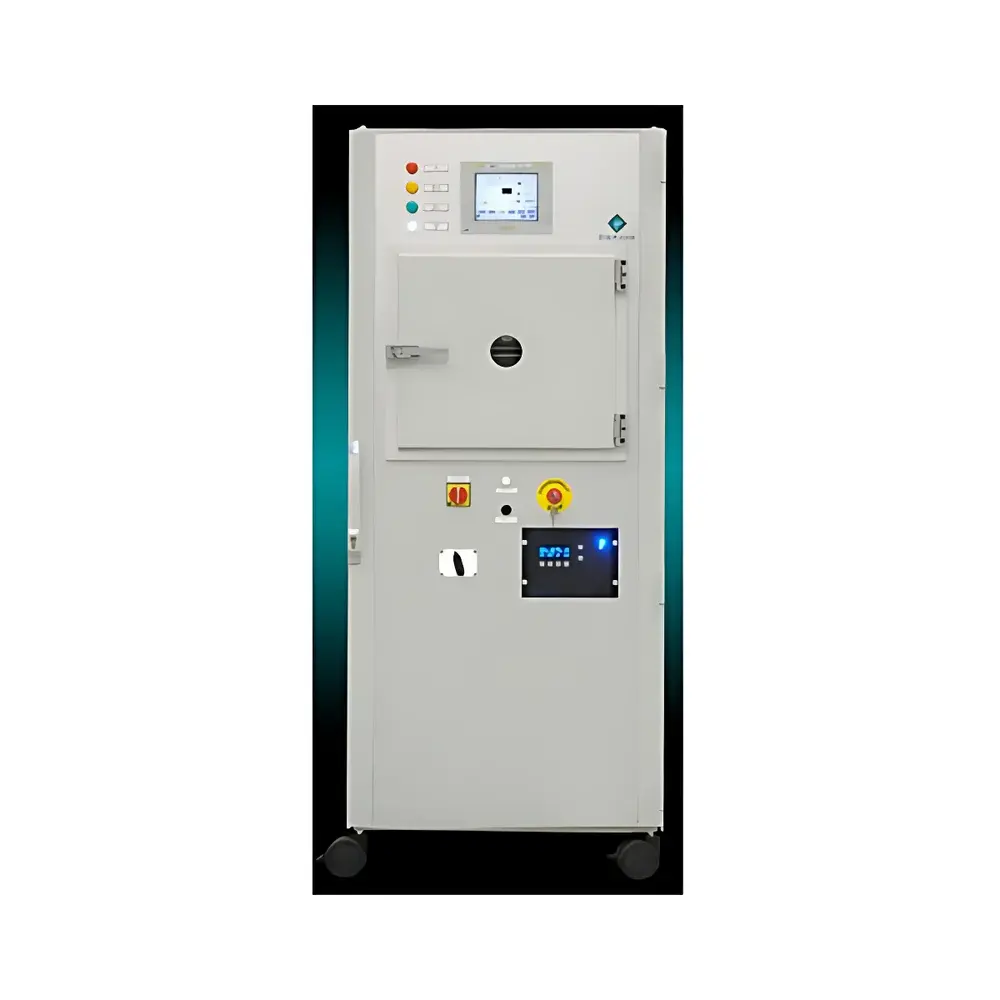
Europlasma CD400PLC Low-Pressure Plasma Surface Treater
| Brand | Europlasma |
|---|---|
| Origin | Belgium |
| Model | CD400PLC |
| RF Frequency | 100 kHz |
| Power Range | 0–600 W |
| Vacuum System | Rotary Vane Pump (30 m³/h) with Pirani Gauge |
| Chamber Dimensions | 400 × 400 × 400 mm |
| Chamber Volume | 64 L |
| Chamber Material | Anodized Aluminum |
| Tray Configuration | 4 × (305 × 360 × 40 mm) |
| Control System | PLC-based Automated Controller |
| Input Gas | Single-port MFC-controlled (1/4″ BSP, max. 1 bar inlet pressure) |
| Exhaust Port | 28 mm OD |
| Electrical Supply | 380 V AC, 3-phase, 50 Hz, 40 A |
| Safety Features | Emergency Stop, Vacuum Interlock, Overtemperature Lockout, CE Certified |
Overview
The Europlasma CD400PLC is a benchtop low-pressure plasma surface treatment system engineered for precise, repeatable, and non-thermal modification of material surfaces in R&D and quality control laboratories. Operating under controlled vacuum conditions (typically 0.1–10 Pa), it utilizes radio-frequency (RF) capacitively coupled plasma generated at 100 kHz to activate inert or reactive process gases (e.g., O₂, Ar, N₂, air, or custom gas mixtures). This enables highly controllable surface functionalization—including removal of organic contaminants (ashing), enhancement of wettability, improvement of adhesion for coating or bonding, and introduction of polar functional groups—without altering bulk material properties. With a maximum operating temperature below 40 °C, the system ensures thermal sensitivity of polymers, elastomers, composites, and biological substrates is preserved throughout treatment.
Key Features
- Robust aluminum reaction chamber (400 × 400 × 400 mm, 64 L volume) with anodized interior for corrosion resistance and stable plasma impedance
- Integrated PLC-based automation platform supporting fully programmable process sequences: vacuum evacuation, gas dosing, plasma ignition, dwell time, venting, and cycle repetition
- Adjustable RF power output (0–600 W) with real-time monitoring of forward/reflected power, enabling impedance matching optimization for diverse substrates
- Four standardized sample trays (305 × 360 × 40 mm) allowing parallel or sequential processing of multiple specimens with uniform exposure geometry
- Front-mounted transparent viewport (quartz-reinforced acrylic) for visual plasma observation and process validation without breaking vacuum
- Comprehensive safety architecture: hardware-enforced emergency stop, vacuum interlock preventing RF activation below threshold pressure, overtemperature cutoff, and CE-compliant electrical design
Sample Compatibility & Compliance
The CD400PLC accommodates a broad range of non-conductive and conductive substrates—including thermoplastics (PP, PE, PET, PC), silicone elastomers, glass, ceramics, metal foils, printed circuit boards (PCBs), and biomedical devices—without requiring electrode contact or masking. Its low-temperature operation (<40 °C) prevents warping, outgassing, or degradation of heat-sensitive materials. The system complies with IEC 61000-6-2 (EMC immunity) and IEC 61000-6-4 (EMC emissions), and meets CE marking requirements for machinery (2006/42/EC) and electromagnetic compatibility (2014/30/EU). While not inherently GLP/GMP-certified, its deterministic PLC logic, parameter logging, and password-protected operator access support audit-ready documentation when integrated into validated laboratory workflows per ISO/IEC 17025 or FDA 21 CFR Part 11 guidelines.
Software & Data Management
The embedded PLC controller records all critical process parameters—including chamber pressure (via Pirani gauge), pump-down time, gas flow rate (MFC-controlled), RF power delivery, treatment duration, and chamber temperature—at 1 Hz resolution. All data are timestamped and stored locally on non-volatile memory; export is supported via USB interface in CSV format for traceability and statistical analysis. User-defined recipes can be saved with descriptive names and version tags, and each execution is logged with operator ID (via password authentication), start/stop timestamps, and pass/fail status based on parameter deviation thresholds. No proprietary software installation is required—data review and recipe management are performed directly through the front-panel HMI interface.
Applications
- Pre-treatment of polyolefin films prior to inkjet printing or adhesive lamination to achieve dyne level >42 mN/m
- Surface activation of PDMS microfluidic chips to enable stable protein immobilization and reduce nonspecific binding
- Cleaning of optical components and sensor housings to eliminate sub-micron hydrocarbon residues without solvent use
- Modification of implant-grade titanium surfaces to enhance hydrophilicity and early-stage osteoblast attachment
- Improving bond strength between composite layups in aerospace prototyping by increasing interfacial energy prior to epoxy application
- Decontamination of reusable labware (e.g., Petri dishes, cuvettes) via oxygen plasma ashing of biofilms and residual organics
FAQ
What vacuum level is required to initiate and sustain plasma in the CD400PLC?
Plasma ignition typically occurs between 0.5–5 Pa, depending on gas type and RF power setting. The integrated Pirani gauge provides continuous readout across 1 × 10⁻³ to 1 × 10³ Pa.
Can the system operate with mixed gas chemistries?
Yes—though the standard configuration includes one MFC port, users may integrate external gas mixing manifolds upstream of the inlet to deliver binary or ternary gas blends (e.g., O₂/Ar for enhanced oxidation kinetics).
Is remote monitoring or Ethernet connectivity available?
No native Ethernet or TCP/IP interface is included; however, the USB data export function supports integration with third-party LabVIEW or Python-based monitoring scripts via serial emulation.
What maintenance intervals are recommended for the rotary vane pump?
Vacuum pump oil should be replaced every 500 operational hours or semiannually—whichever occurs first—to maintain pumping speed and ultimate vacuum performance.
Does the system support batch processing with load/unload automation?
The CD400PLC is manually loaded; automated loading/unloading is not part of the base configuration but can be implemented externally using compatible robotic handlers interfaced via dry-contact I/O signals.



