
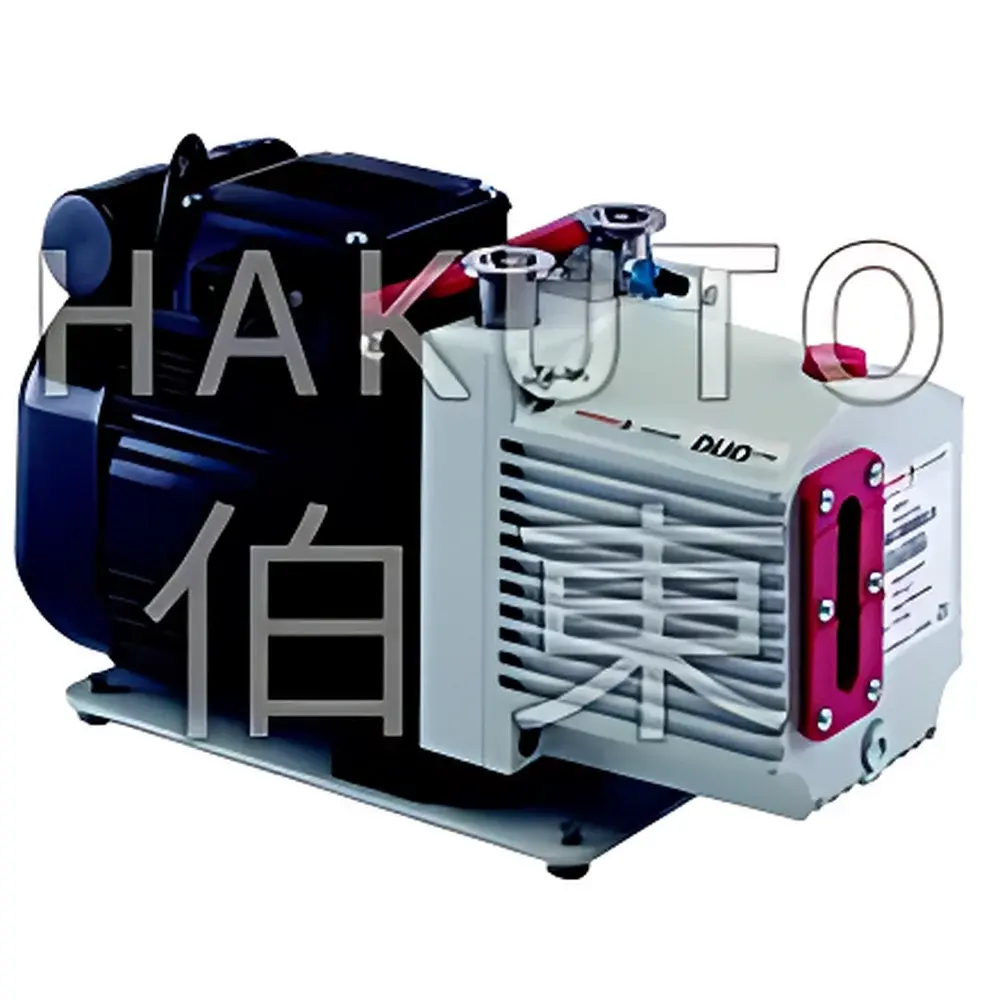
Pfeiffer Vacuum DUO 35 Dual-Stage Rotary Vane Pump
| Brand | Pfeiffer Vacuum |
|---|---|
| Origin | Germany |
| Pump Type | Oil-Lubricated Rotary Vane |
| Pumping Speed | 32–36 m³/h (50/60 Hz) |
| Ultimate Pressure | 2 × 10⁻³ hPa (with gas ballast open) |
| Noise Level | ≤ 61 dB(A) |
| Weight | 68 kg |
| Motor Power | 3.7 kW |
| Inlet/Outlet Flange | DN 40 ISO-KF |
| Dimensions (L×W×H) | 1000 × 320 × 320 mm |
Overview
The Pfeiffer Vacuum DUO 35 is a high-performance, dual-stage oil-lubricated rotary vane pump engineered for reliable and continuous operation in medium to low vacuum applications ranging from 10⁵ Pa down to 2 × 10⁻³ hPa. Based on proven Couette-flow compression principles, the DUO 35 utilizes two counter-rotating vanes within a precisely machined stator chamber to achieve progressive gas compression across two stages—enabling stable base pressure generation and robust tolerance to condensable vapors such as water or solvents. Designed and manufactured in Germany under strict ISO 9001-certified production protocols, the DUO 35 serves as both a standalone roughing pump and an essential fore-vacuum stage for high-vacuum systems including turbomolecular pumps and Roots booster configurations. Its rugged mechanical architecture, integrated gas ballast valve, and corrosion-resistant internal coatings make it particularly suitable for demanding industrial environments—including freeze-drying, vacuum metallurgy, resin impregnation, and vacuum drying—where long-term stability, chemical resilience, and minimal maintenance downtime are critical operational requirements.
Key Features
- Dual-stage rotary vane design with optimized vane geometry for enhanced volumetric efficiency and extended service life
- Magnetic coupling option (DUO 35 M) eliminates radial shaft seals—preventing oil leakage and eliminating cross-contamination risks in ultra-clean or analytical applications
- Integrated gas ballast valve enables effective removal of condensable vapors without compromising ultimate vacuum performance
- High-tolerance cast iron housing with precision-ground rotor assembly ensures dimensional stability under thermal cycling and load variation
- Low-noise operation (≤ 61 dB(A)) achieved through vibration-damped motor mounting and acoustic enclosure design
- Standard DN 40 ISO-KF inlet and outlet flanges facilitate rapid integration into existing vacuum manifolds and OEM equipment platforms
- Optional corrosion-resistant configuration (DUO 35 MC) available for aggressive process gases including halogenated compounds and acidic vapors
- Compliant with CE, UL, and RoHS directives; designed to meet electromagnetic compatibility (EMC) Class A requirements per EN 61000-6-3
Sample Compatibility & Compliance
The DUO 35 demonstrates broad compatibility with chemically diverse process environments. Its standard configuration handles air, nitrogen, argon, and common organic solvent vapors encountered in lyophilization, vacuum distillation, and thin-film deposition. For applications involving chlorine, HF, HCl, or other corrosive media, the DUO 35 MC variant features fluoropolymer-coated internal surfaces and stainless-steel wetted parts compliant with ASTM F2251 and ISO 15730 standards. All models support GLP/GMP-compliant operation when deployed with optional analog/digital I/O modules enabling real-time status monitoring and audit-trail-capable control logging—fully compatible with FDA 21 CFR Part 11 requirements when integrated with validated SCADA or LIMS platforms.
Software & Data Management
While the DUO 35 operates as a standalone electromechanical device without embedded firmware, it supports seamless integration via industry-standard 0–10 V analog inputs and relay-based dry-contact outputs. Optional Pfeiffer Vacuum ControlBox modules enable remote start/stop, vacuum level feedback, oil temperature monitoring, and fault diagnostics through Modbus RTU or Ethernet/IP interfaces. When connected to Pfeiffer’s HiCube or VacuumManager software suite, the DUO 35 contributes to centralized vacuum system health monitoring—including predictive maintenance alerts based on runtime accumulation, temperature deviation thresholds, and cycle count analytics. All communication protocols adhere to IEC 61158 and IEC 61784-2 specifications for interoperability in multi-vendor laboratory automation infrastructures.
Applications
- Roughing pump for turbomolecular and cryogenic high-vacuum systems in semiconductor metrology and surface science instrumentation
- Primary vacuum source for freeze-dryers (lyophilizers), vacuum ovens, and desiccators in pharmaceutical and biotech manufacturing
- Process pump in physical vapor deposition (PVD), sputtering, and optical coating systems requiring stable base pressure below 10⁻² hPa
- Fore-pump in vacuum brazing, diffusion bonding, and heat treatment furnaces operating under inert or reducing atmospheres
- Vacuum source for mass spectrometry sample introduction systems, residual gas analyzers (RGAs), and leak detection setups
- Core vacuum component in analytical instrumentation OEMs including Agilent, Thermo Fisher Scientific, Bruker, and ABB—validated for use in GC-MS, ICP-MS, and TOF-SIMS platforms
FAQ
What is the recommended oil change interval for the DUO 35 under continuous operation?
Under typical clean-air conditions and 8-hour daily usage, Pfeiffer recommends oil replacement every 3,000 operating hours or annually—whichever occurs first. Extended intervals may be permitted with oil analysis and approval under ISO 4406 cleanliness certification.
Can the DUO 35 be operated vertically or at an angle?
No. The DUO 35 must be installed horizontally on a rigid, level surface to ensure proper oil distribution and vane lubrication. Deviation beyond ±2° may cause premature wear or loss of sealing integrity.
Is the DUO 35 compatible with variable-frequency drives (VFDs)?
Yes—when specified with the optional three-phase motor variant (DUO 35 M), the pump supports VFD control within the 40–60 Hz range. Operation below 40 Hz requires additional cooling assessment per Pfeiffer Technical Bulletin TB-DUO-VFD-2023.
Does the DUO 35 meet explosion-proof requirements for Zone 1 hazardous areas?
Not by default. Explosion-proof versions (e.g., DUO 35 Ex d IIB T4) require factory modification and ATEX/IECEx certification—available upon request with full documentation package.
How does the gas ballast function affect ultimate pressure performance?
With the gas ballast valve open, ultimate pressure degrades to ~2 × 10⁻³ hPa to allow continuous vapor purge; closing the valve restores the optimal 2 × 10⁻³ hPa limit while increasing susceptibility to condensation-induced oil emulsification.



