
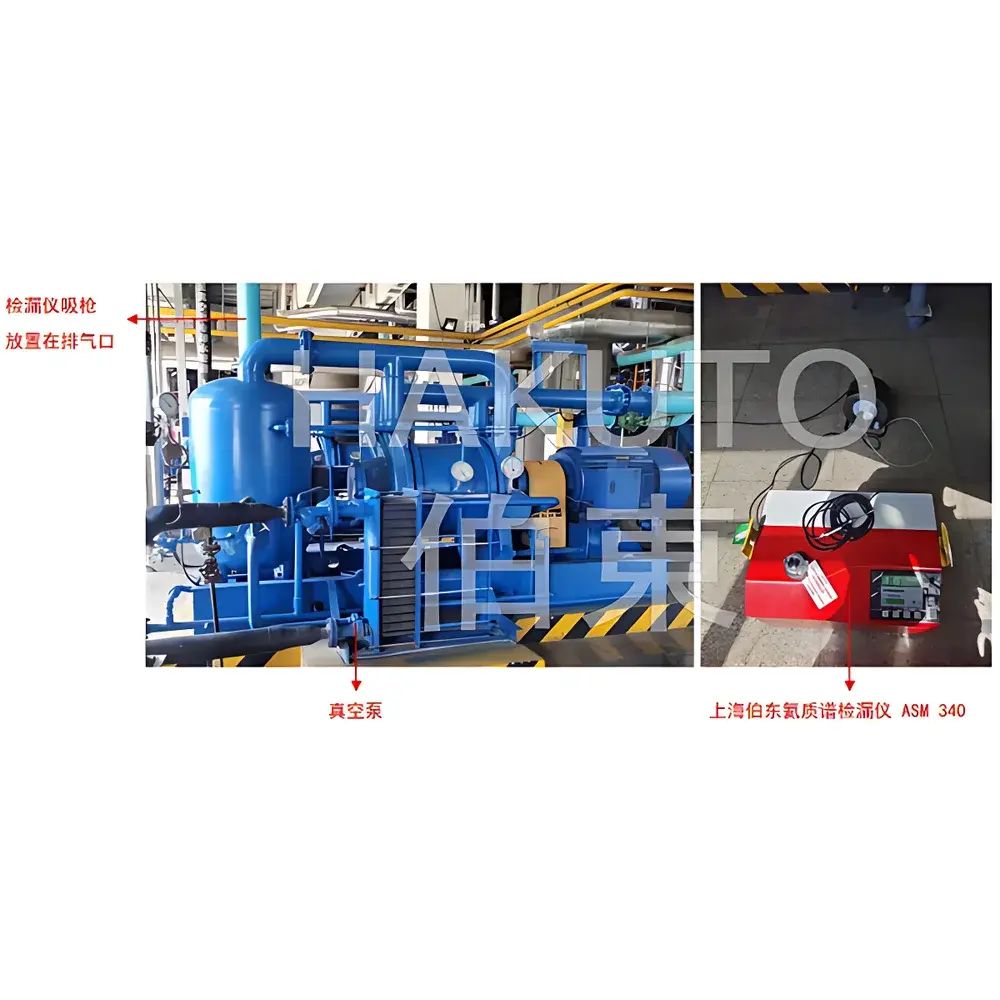
Pfeiffer Vacuum ASM 340 Helium Mass Spectrometer Leak Detector
| Brand | Pfeiffer Vacuum |
|---|---|
| Origin | Germany |
| Model | ASM 340 |
| Detection Sensitivity | ≤5×10⁻¹² mbar·L/s (He) |
| Operating Modes | Vacuum Mode, Sniffer Mode, Accumulation Mode |
| Minimum Detectable Leak Rate | 1×10⁻⁶ mbar·L/s (typical field performance in power plant vacuum systems) |
| Pumping Configuration | Integrated turbomolecular pump with backing pump |
| Compliance | CE, RoHS, ISO 9001 certified manufacturing |
| Interface | RS232, Ethernet, analog output (0–10 V) |
Overview
The Pfeiffer Vacuum ASM 340 Helium Mass Spectrometer Leak Detector is a high-sensitivity, industrial-grade residual gas analyzer engineered for quantitative leak detection in pressurized and vacuum systems. It operates on the principle of magnetic sector mass spectrometry, selectively ionizing helium atoms (mass-to-charge ratio m/z = 4) and separating them from background gases via electromagnetic deflection. This enables unambiguous identification and quantification of helium tracer gas ingress—critical for integrity verification of low-leakage-rate infrastructure. In thermal power generation facilities, the ASM 340 is deployed to validate the hermeticity of steam turbine condenser shells, vacuum extraction lines, gland steam seals, and auxiliary vacuum systems—components where even sub-10⁻⁶ mbar·L/s leaks compromise condenser pressure, increase turbine backpressure, reduce Rankine cycle efficiency, and elevate auxiliary power consumption.
Key Features
- Integrated high-vacuum architecture: Combines a compact turbomolecular pump (pumping speed ≥280 L/s for N₂) with an oil-free dry backing pump, eliminating hydrocarbon contamination risks in sensitive nuclear or turbine environments.
- Dual-mode operational flexibility: Supports vacuum-integrated testing (test piece connected directly to detector inlet) and external sniffer probe operation—enabling both system-level and localized leak localization without process interruption.
- Real-time leak rate quantification: Delivers calibrated leak rate values in mbar·L/s (He), traceable to national metrology institutes (PTB, NIST), with logarithmic display resolution down to 10⁻¹² mbar·L/s and linear readout stability over 72-hour continuous operation.
- Ruggedized industrial design: IP54-rated enclosure, shock-mounted internal optics, and temperature-compensated ion source ensure stable performance across ambient ranges of 5–40 °C—suitable for turbine hall, control room, and outdoor auxiliary building deployments.
- Automated calibration and diagnostics: Built-in filament life monitoring, auto-zero routines, and spectral baseline correction algorithms minimize operator dependency and support GLP-compliant documentation requirements.
Sample Compatibility & Compliance
The ASM 340 is compatible with all standard helium-based leak testing protocols defined in ASTM E499-21 (Standard Practice for Leak Testing by the Mass Spectrometer Leak Detector Method) and ISO 10648-2:1994 (Leak detection — Vocabulary — Part 2: Leak detection methods). It meets EN 61000-6-2 (industrial immunity) and EN 61000-6-4 (emission) standards. For nuclear island applications, optional firmware packages support 21 CFR Part 11 audit trails and electronic signature workflows. No sample preparation is required; helium is introduced externally as a tracer gas, making it non-destructive and fully reversible. The instrument does not require carrier gases or consumables beyond standard filament replacement intervals (≥10,000 hours typical service life).
Software & Data Management
Pfeiffer’s VacuGraph® PC software provides full remote control, real-time trend logging, and CSV/Excel export of time-stamped leak rate data—including timestamped event markers for sniffer probe trigger points. All measurement sessions are stored with metadata (operator ID, system ID, test location tag, ambient T/P), enabling traceability per IEC 62443-3-3 cybersecurity guidelines. Optional database integration supports SQL Server or Oracle backends for enterprise-level QA/QC archival. Calibration certificates, maintenance logs, and alarm histories are automatically embedded into PDF reports compliant with ISO/IEC 17025 clause 7.8.2.
Applications
- Thermal power plant vacuum system certification: Condenser shell welds, expansion joint bellows, air ejector nozzles, and vacuum pump casing seals.
- Steam turbine auxiliary systems: Gland steam piping, LP turbine casing flanges, and deaerator vent lines.
- Nuclear balance-of-plant: Secondary-side heat exchanger tube sheets, feedwater heater shells, and turbine lube oil tank breather filters.
- Renewable hybrid systems: Geothermal binary cycle condensers and concentrated solar power (CSP) thermal oil loop isolation valves.
- Pre-commissioning acceptance testing: As-built verification against ASME Section V, Article 10 requirements for vacuum integrity prior to hot functional testing.
FAQ
What vacuum level is required for reliable detection in condenser systems?
Optimal sensitivity is achieved when the ASM 340 inlet pressure is maintained below 1×10⁻³ mbar—typically ensured by connecting downstream of the final-stage liquid ring or rotary vane backing pump.
Can the ASM 340 detect leaks in wet or humid environments?
Yes; its helium-specific mass filtering rejects H₂O⁺ (m/z = 18) and O₂⁺ (m/z = 32) interference. However, excessive moisture may accelerate filament oxidation—use of the optional cold trap or desiccant filter is recommended for long-term deployment in high-humidity turbine halls.
Is helium recovery supported?
The ASM 340 does not include built-in helium recycling; however, its low helium consumption (<5 mL/min during sniffer scanning) and compatibility with external helium recovery skids (e.g., Pfeiffer HRS-100) enable closed-loop operation in large-scale outage scenarios.
How is measurement uncertainty validated per ISO/IEC 17025?
Each unit ships with a factory calibration certificate referencing PTB-traceable leak standards (e.g., calibrated capillary leaks at 1×10⁻⁹ and 1×10⁻¹⁰ mbar·L/s), and users may perform in-house verification using certified reference leaks per ISO 16063-32.
Related Products




