
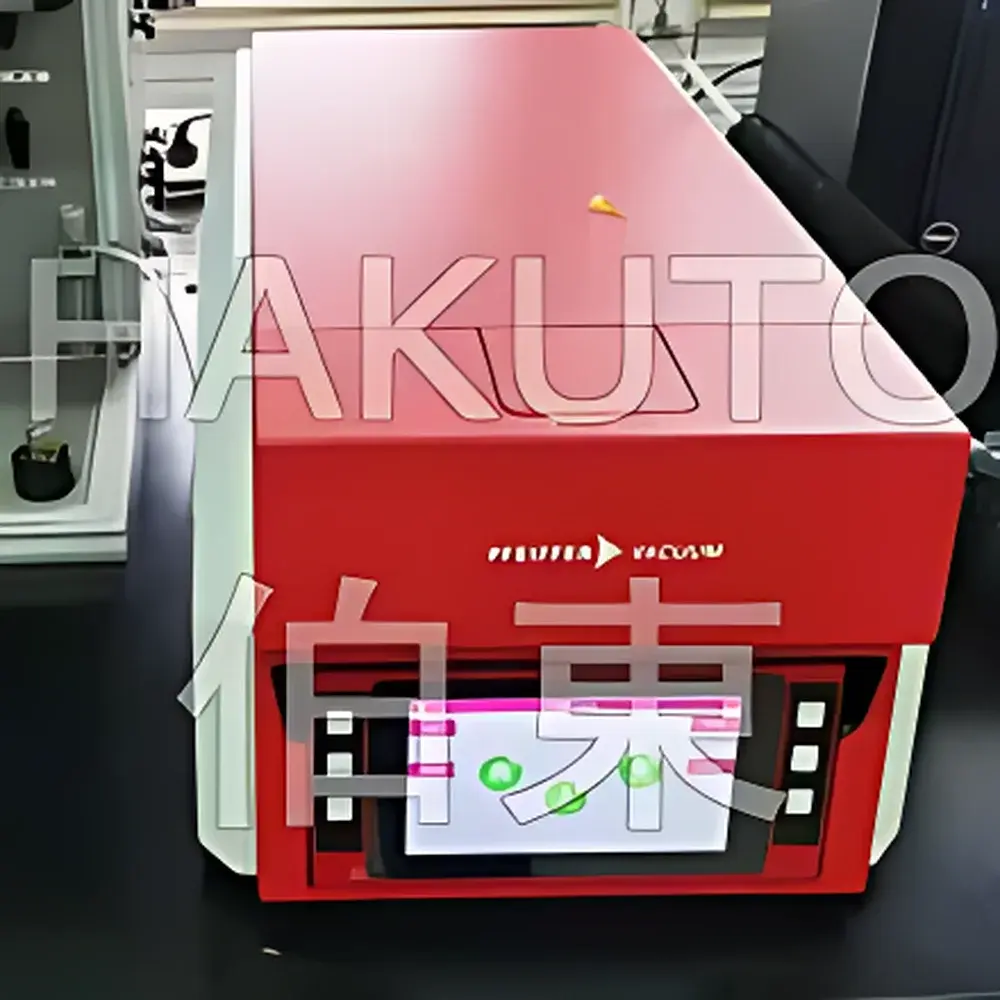
Pfeiffer Vacuum Omnistar GSD350 O1 Online Mass Spectrometer for Catalyst Adsorption Analysis
| Brand | Pfeiffer Vacuum |
|---|---|
| Origin | Germany |
| Model | GSD350 O1 |
| Mass Range | 1–100 amu |
| Maximum Inlet Pressure | 1200 hPa |
| Detection Limit | < 100 ppb |
| Gas Flow Rate | 1–2 sccm (0 °C) |
| Analog Inputs | 5 × (−10 to +10 V, 14/16 bit) |
| Capillary | Stainless Steel, 1 m |
| Inlet Heating Temperature | Up to 200 °C |
| Filament | Dual Iridium with Y₂O₃ coating |
Overview
The Pfeiffer Vacuum Omnistar GSD350 O1 is a compact, high-sensitivity quadrupole mass spectrometer engineered for real-time, in situ gas-phase analysis in catalytic research environments. Operating on the principle of electron ionization (EI) coupled with mass-filtered ion detection, it delivers rapid, quantitative monitoring of gaseous species evolving during temperature-programmed desorption (TPD), reduction (TPR), oxidation (TPO), and chemisorption experiments. Its robust vacuum architecture—integrated with a turbomolecular pumping system and differential pressure stages—enables stable operation under variable inlet pressures up to 1200 hPa, making it uniquely suited for direct coupling with catalytic reactors, pulse chemisorption analyzers, and fixed-bed flow systems. Designed for laboratory flexibility rather than industrial process control, the GSD350 O1 bridges the gap between benchtop catalyst characterization and dynamic reaction monitoring, supporting mechanistic studies where temporal resolution and trace-level speciation are critical.
Key Features
- Quadrupole mass analyzer with mass range 1–100 amu, optimized for light gases (H₂, CO, CO₂, NH₃, O₂, N₂, CH₄, H₂O) and common reaction intermediates.
- Dual iridium filaments coated with yttria (Y₂O₃) for extended operational lifetime and enhanced stability under reactive gas environments, including NH₃-rich or reducing atmospheres.
- Heated stainless-steel capillary inlet (1 m length, up to 200 °C) minimizes condensation and surface adsorption artifacts, preserving integrity of transient species such as surface-bound intermediates or labile fragments.
- Integrated analog input module (5 channels, ±10 V, 14/16-bit resolution) enables synchronized acquisition of auxiliary sensor data—including thermocouple signals, mass flow controller outputs, and reactor pressure transducers—ensuring time-correlated multi-parameter analysis.
- Compact monoblock design (dimensions: 490 × 380 × 270 mm; weight: ~25 kg) facilitates relocation between gloveboxes, fume hoods, and reactor test benches without recalibration or vacuum break.
- Front-panel touchscreen interface and Ethernet-based remote control support both standalone operation and integration into automated experimental workflows.
Sample Compatibility & Compliance
The GSD350 O1 interfaces seamlessly with standard catalyst characterization platforms—including Micromeritics AutoChem, Thermo Scientific TPD/TPR systems, and custom-built fixed-bed reactors—via heated transfer lines and pressure-matched sampling valves. It accommodates gas mixtures containing corrosive species (e.g., NH₃, H₂S, Cl₂) when operated within recommended thermal and pressure limits. The instrument complies with CE marking requirements (2014/30/EU EMC Directive, 2014/35/EU LVD Directive) and meets essential safety provisions per IEC 61010-1 for laboratory electrical equipment. While not certified for hazardous area use (ATEX/IECEx), its design supports GLP-compliant operation when paired with audit-trail-enabled software configurations and documented calibration protocols per ISO/IEC 17025 guidelines.
Software & Data Management
Controlled by Pfeiffer’s PV MassSpec software (Windows-based), the system provides real-time spectral acquisition, peak integration, background subtraction, and multi-component quantification using internal or external calibration curves. The software includes built-in spectral libraries (NIST MS Search, Pfeiffer Gas Library) and supports user-defined compound databases for catalyst-specific fragment patterns (e.g., NO⁺ at m/z 30, NH₂⁺ at m/z 16). All raw data files (.raw) retain full metadata—including timestamp, filament emission current, detector gain, and analog channel traces—ensuring traceability for regulatory review. Export options include CSV, ASCII, and MATLAB-compatible formats. When configured with optional validation packages, PV MassSpec supports 21 CFR Part 11-compliant electronic signatures, audit trails, and role-based access control for regulated QC/QA laboratories.
Applications
- Quantitative tracking of NH₃ desorption profiles in Brønsted acid site characterization (NH₃-TPD).
- Monitoring H₂ consumption and H₂O formation during temperature-ramped reduction (H₂-TPR) of metal oxides.
- Identifying surface oxygen mobility and lattice oxygen participation via O₂-TPD and CO-TPR-O₂ co-feed experiments.
- Real-time detection of coke formation markers (e.g., benzene, toluene, ethylene) during hydrocarbon conversion over zeolites or supported metals.
- In situ verification of selective catalytic reduction (SCR) mechanisms through simultaneous measurement of NOₓ, NH₃, N₂, and N₂O.
- Validation of kinetic models by correlating transient product evolution with reactor temperature, pressure, and feed composition.
FAQ
Can the GSD350 O1 be directly connected to a high-pressure catalytic reactor?>
Yes—its differential pumping stage and pressure-tolerant inlet allow direct coupling to reactors operating up to 1200 hPa, provided gas streams are pre-conditioned (filtered, dried, and thermally stabilized) to avoid condensate ingress.
What is the typical response time for detecting transient gas pulses?>
With optimized capillary heating and detector gain settings, the system achieves < 1-second time resolution for step changes in partial pressure above 1 ppm.
Does the instrument require routine filament replacement?>
Dual filament redundancy extends service intervals; under normal chemisorption use, filaments typically last 6–12 months depending on gas composition and duty cycle.
Is mass calibration traceable to NIST standards?>
Yes—calibration routines use reference peaks from residual air (N₂⁺ at m/z 28, O₂⁺ at m/z 32) and optional perfluorotributylamine (PFTBA) tuning, with documentation aligned to ISO/IEC 17025 traceability requirements.
Can PV MassSpec export data for kinetic modeling software (e.g., MATLAB, Python, Aspen)?>
Yes—time-stamped concentration vs. time datasets export in comma-separated format with header metadata, enabling direct import into numerical solvers and parameter estimation tools.



