
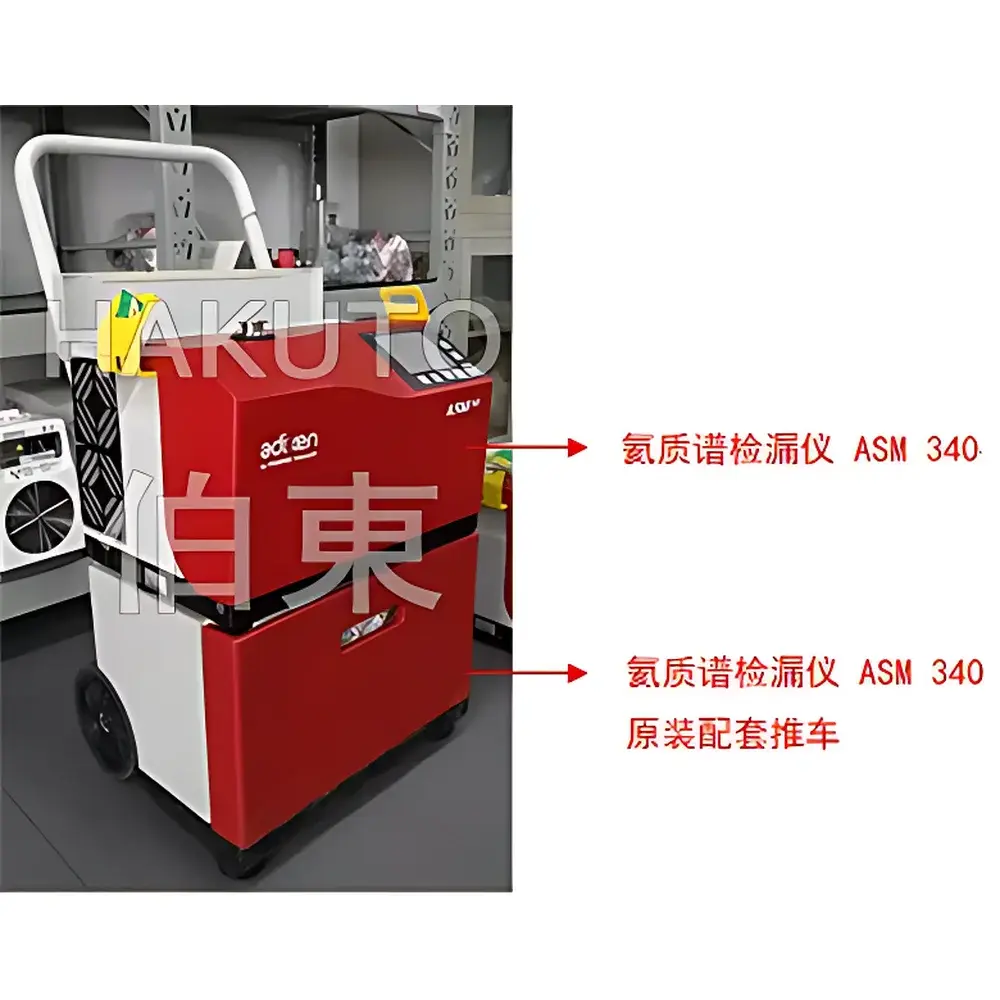
Pfeiffer Vacuum ASM340wet Helium Mass Spectrometer Leak Detector for Large-Diameter Metal Pipelines
| Brand | Pfeiffer Vacuum |
|---|---|
| Origin | Germany |
| Model | ASM340wet |
| Detection Principle | Helium-Specific Quadrupole Mass Spectrometry |
| Minimum Detectable Leak Rate | ≤5×10⁻¹³ Pa·m³/s |
| Operating Mode | Sniffer (Absorption) Mode |
| Integrated Vacuum Pump Type | Wet Rotary Vane Pump |
| Max. Suction Flow Rate | 2.5 L/s (at inlet) |
| Helium Partial Pressure Sensitivity | 1×10⁻¹³ A/Pa |
| Response Time (T₉₀) | <1.5 s |
| Compliance | CE, RoHS, ISO 9001 certified design |
| Interface | RS-232, Analog Output (0–10 V), Digital I/O for PLC Integration |
| Power Supply | 100–240 V AC, 50/60 Hz |
Overview
The Pfeiffer Vacuum ASM340wet is a high-sensitivity, benchtop-integrated helium mass spectrometer leak detector engineered specifically for quantitative and localized leak detection in large-scale industrial metal pipeline systems. It employs quadrupole mass spectrometry to selectively detect helium ions (mass-to-charge ratio m/z = 4) with exceptional specificity and signal-to-noise ratio. Unlike pressure decay or bubble testing methods, the ASM340wet operates on the tracer gas principle: helium is introduced into the pressurized or evacuated test object, and any escaping helium atoms are drawn into the spectrometer’s ion source via an external sniffer probe. The instrument quantifies leakage rates down to 5×10⁻¹³ Pa·m³/s—enabling compliance with stringent integrity requirements in critical infrastructure applications such as petrochemical piping, power plant steam lines, and metallurgical process conduits where diameters exceed 1.5 m and structural access is constrained.
Key Features
- Integrated wet rotary vane vacuum pump ensures stable base pressure (<1×10⁻³ hPa) without requiring external roughing pumps—ideal for mobile or workshop-based pipeline inspection.
- Optimized sniffer mode architecture supports extended probe lengths (up to 5 m standard), coupled with low-dead-volume flexible tubing and ergonomic wheeled trolley for rapid scanning of vertical, horizontal, or overhead pipe sections.
- Real-time analog and digital outputs (0–10 V, RS-232, discrete I/O) allow seamless integration into automated test stations or PLC-controlled maintenance workflows.
- Helium-specific mass filtering eliminates interference from nitrogen, water vapor, or hydrocarbons—ensuring unambiguous identification even in ambient industrial environments with fluctuating background gas composition.
- Rugged aluminum chassis and IP54-rated front panel meet EN 61000-6-2/6-4 for electromagnetic compatibility in factory-floor deployment.
Sample Compatibility & Compliance
The ASM340wet is validated for use on ferrous and non-ferrous metal pipelines—including stainless steel corrugated hoses, carbon steel process lines, and alloyed heat-exchanger manifolds—with nominal diameters ranging from 1.5 m to 3.0 m. Its methodology aligns with ASTM E499-22 (“Standard Practice for Leak Testing Using Helium Mass Spectrometry”) and ISO 1087-2:2021 (“Leak detection — Vocabulary — Part 2: Methods”). When operated under controlled pressurization (1.1–1.3 bar absolute helium or helium-air mixtures ≥5% He), it satisfies traceability requirements per ISO/IEC 17025 for accredited calibration laboratories. Full audit trails—including operator ID, timestamp, leak rate value, and probe position metadata—can be logged via optional software modules compliant with FDA 21 CFR Part 11 electronic record provisions.
Software & Data Management
The instrument supports Pfeiffer’s proprietary HiLase™ control software (Windows-based), enabling real-time spectral visualization, multi-point leak mapping, and automated report generation in PDF or CSV format. All measurement sessions are time-stamped and stored with checksum-verified integrity. For enterprise-level deployment, the ASM340wet can interface with LIMS or MES platforms through OPC UA or Modbus TCP protocols. Raw data export includes ion current traces, background-subtracted helium peak integrals, and system status logs—facilitating root-cause analysis during QA/QC audits or regulatory submissions.
Applications
- Pre-commissioning verification of welded joints, flange gaskets, and expansion bellows in refinery piping networks.
- In-service integrity assessment of insulated or buried metallic conduits without disassembly or surface preparation.
- Validation of vacuum jacket integrity in cryogenic LNG transfer lines.
- Periodic preventive maintenance of boiler feedwater piping in thermal power generation facilities.
- Leak benchmarking and threshold validation against ISO 14644-1 Class 5 cleanroom utility lines.
FAQ
What is the recommended helium concentration for large-diameter pipeline testing?
For cost-effective operation, a 5–10% helium-in-nitrogen mixture is optimal; higher concentrations do not improve sensitivity but increase operational expense.
Can the ASM340wet operate in high-humidity environments?
Yes—the integrated wet pump tolerates up to 80% RH ambient conditions; however, condensation in the sniffer line must be avoided via heated probe options or desiccant filtration.
Is calibration traceable to national standards?
Factory calibration uses NIST-traceable helium permeation standards (e.g., DCG-200 series); field recalibration kits are available with documented uncertainty budgets per ISO/IEC 17025.
How does sniffer-mode sensitivity compare to vacuum-mode testing?
Sniffer mode achieves ≤5×10⁻¹³ Pa·m³/s under ideal conditions—approximately one order of magnitude less sensitive than vacuum-mode, but uniquely suited for non-evacuable, large-volume objects.
Does the system support remote diagnostics?
Via optional Ethernet module and HiLase™ Remote Access, engineers can monitor live spectra, adjust gain settings, and download logs without physical access to the instrument.
Related Products




