
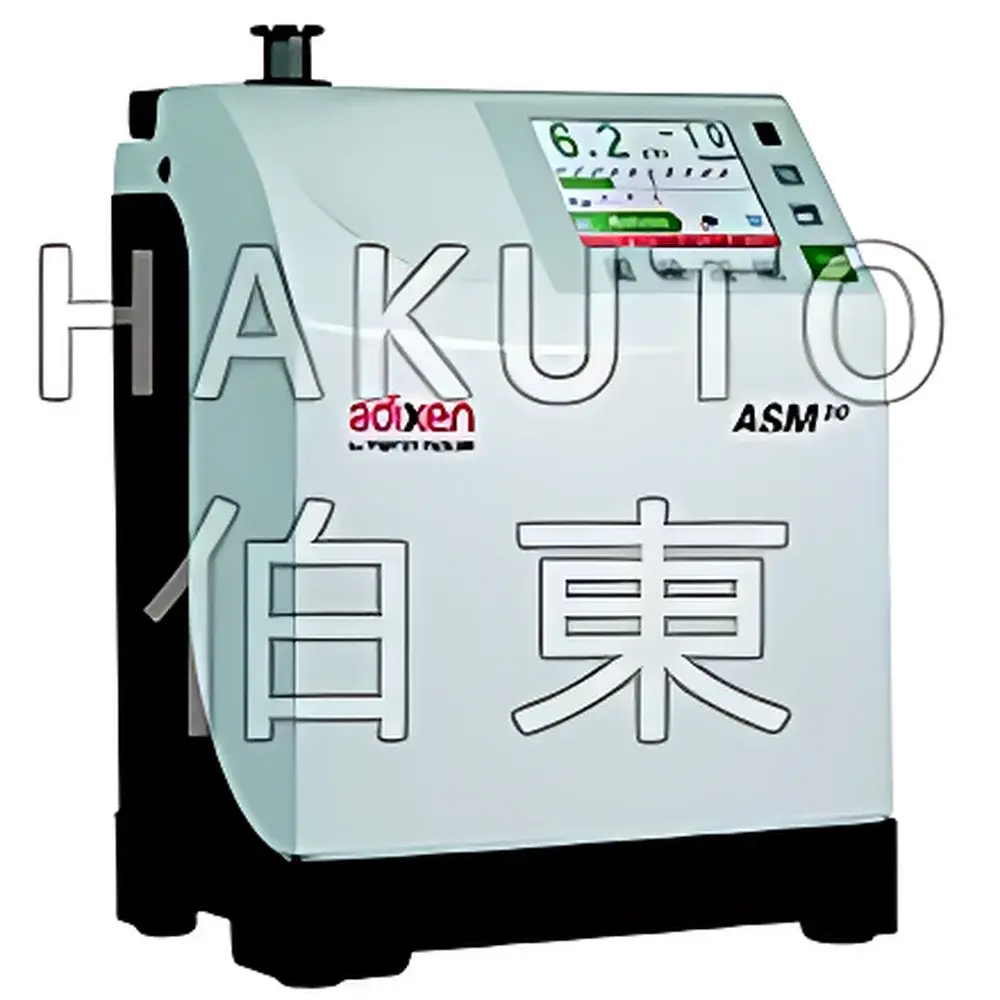
Pfeiffer Vacuum ASM310 Portable Helium Mass Spectrometer Leak Detector for Dewar-Encapsulated Infrared Detectors
| Brand | Pfeiffer Vacuum |
|---|---|
| Origin | France |
| Model | ASM310 |
| Minimum Detectable Leak Rate (Vacuum Mode) | 5×10⁻¹³ Pa·m³/s |
| Helium Pumping Speed | 1.1 L/s |
| Weight | 21 kg |
| Power Supply | Universal AC Input (100–240 V, 50/60 Hz) |
Overview
The Pfeiffer Vacuum ASM310 is a portable, oil-free helium mass spectrometer leak detector engineered for high-sensitivity vacuum-mode leak detection in ultra-high-vacuum (UHV) critical components—particularly dewar-encapsulated infrared (IR) detectors used in spaceborne remote sensing, astronomical instrumentation, and cryogenic scientific payloads. Operating on the principle of magnetic sector mass spectrometry, the ASM310 selectively ionizes and separates helium atoms (mass-to-charge ratio m/z = 4) from background gases, enabling quantitative measurement of helium partial pressure rise within evacuated test objects. Its detection limit of 5×10⁻¹³ Pa·m³/s meets stringent requirements for long-term vacuum integrity in IR detector dewars—where sustained internal pressures below 1×10⁻⁷ mbar are essential to maintain operating temperatures below 80 K and prevent thermal noise degradation. Unlike pressure-rise or bubble-test methods, helium mass spectrometry provides non-destructive, traceable, and repeatable quantification of leak rates without compromising hermeticity or introducing contaminants.
Key Features
- Compact, fully integrated portable design weighing only 21 kg—optimized for field deployment at cleanroom integration stations, satellite assembly facilities, and cryogenic test labs.
- Oil-free turbomolecular pumping system with Hicube 700 Classic (base pressure < 1×10⁻⁷ mbar) and MVP-070 diaphragm forepump (pumping speed: 3.8 m³/h), eliminating hydrocarbon backstreaming risks in UHV-sensitive dewar cavities.
- Dual-mode operation: vacuum mode (sensitivity 5×10⁻¹³ Pa·m³/s) for sealed-component testing; sniffer mode (1×10⁻⁸ Pa·m³/s) for localized leak tracing during assembly or repair.
- Real-time analog and digital output (RS-232, Ethernet) compatible with SCADA systems and automated test benches—enabling integration into GMP-compliant qualification workflows per ISO 13485 and NASA-STD-8739.7.
- Self-diagnostic firmware with automatic calibration verification, ion source lifetime monitoring, and built-in leak rate trending—supporting audit-ready documentation for GLP and ESA ECSS-Q-ST-70-02C compliance.
Sample Compatibility & Compliance
The ASM310 is validated for direct vacuum-mode testing of stainless steel, aluminum, and Kovar-alloy dewar housings ranging from 50 mL to 5 L internal volume—common configurations for HgCdTe, InSb, and superconducting nanowire IR detector modules. Its helium-specific detection architecture avoids interference from residual hydrogen, water vapor, or CO₂ typically present in cryogenic vacuum environments. The system conforms to ISO 20484:2021 (leak detection terminology), ASTM E1884-22 (standard practice for helium leak testing of vacuum devices), and supports traceability under ISO/IEC 17025:2017 when operated with certified reference leaks (e.g., 1×10⁻¹⁰ Pa·m³/s). All electronics meet CE, UL 61010-1, and RoHS directives.
Software & Data Management
Equipped with Pfeiffer’s proprietary LeakTest Pro software (v4.2+), the ASM310 delivers configurable pass/fail thresholds, multi-point sequential testing routines, and timestamped CSV export with full metadata—including ambient temperature, chamber pressure history, pump-down time, and helium background baseline. Audit trails include operator ID, instrument serial number, calibration certificate expiry, and electronic signatures compliant with FDA 21 CFR Part 11 requirements. Data files support direct import into LabArchives ELN and SAP QM modules for lifecycle traceability across detector qualification, flight unit acceptance, and post-launch reliability analysis.
Applications
- Quantitative leak verification of IR detector dewars prior to mechanical cooler integration in Mars rovers, Earth observation satellites (e.g., Sentinel series), and James Webb Space Telescope (JWST)-class instruments.
- In-process validation of brazed, welded, and glass-metal seals in cryogenic sensor assemblies—detecting sub-micron cracks undetectable by dye penetrant or ultrasonic methods.
- Root-cause analysis of vacuum decay in long-duration orbital missions via comparative leak rate trending across thermal cycling tests (per ECSS-E-ST-10-03C).
- Supporting failure mode and effects analysis (FMEA) for cryocooler-dewar interfaces in next-generation quantum-limited mid-wave IR focal plane arrays.
FAQ
What vacuum level must the dewar reach before initiating helium leak testing?
The dewar cavity must be evacuated to ≤1×10⁻⁶ mbar using the Hicube 700 system to ensure optimal signal-to-noise ratio and minimize helium background interference.
Can the ASM310 detect leaks in actively cooled dewars?
Yes—provided the cold stage is thermally isolated during testing and the external surface temperature remains above -40°C to prevent helium condensation or cryopumping artifacts.
Is helium gas supply included with the system?
No—helium (≥99.999% purity) must be supplied externally via regulated cylinder with calibrated flow controller (recommended: 1–5 sccm sweep rate).
Does the ASM310 support automated pass/fail reporting for regulatory submissions?
Yes—LeakTest Pro generates PDF reports with embedded digital signatures, calibration traceability, and deviation logs required for ESA, NASA, and CNES mission certification packages.





