
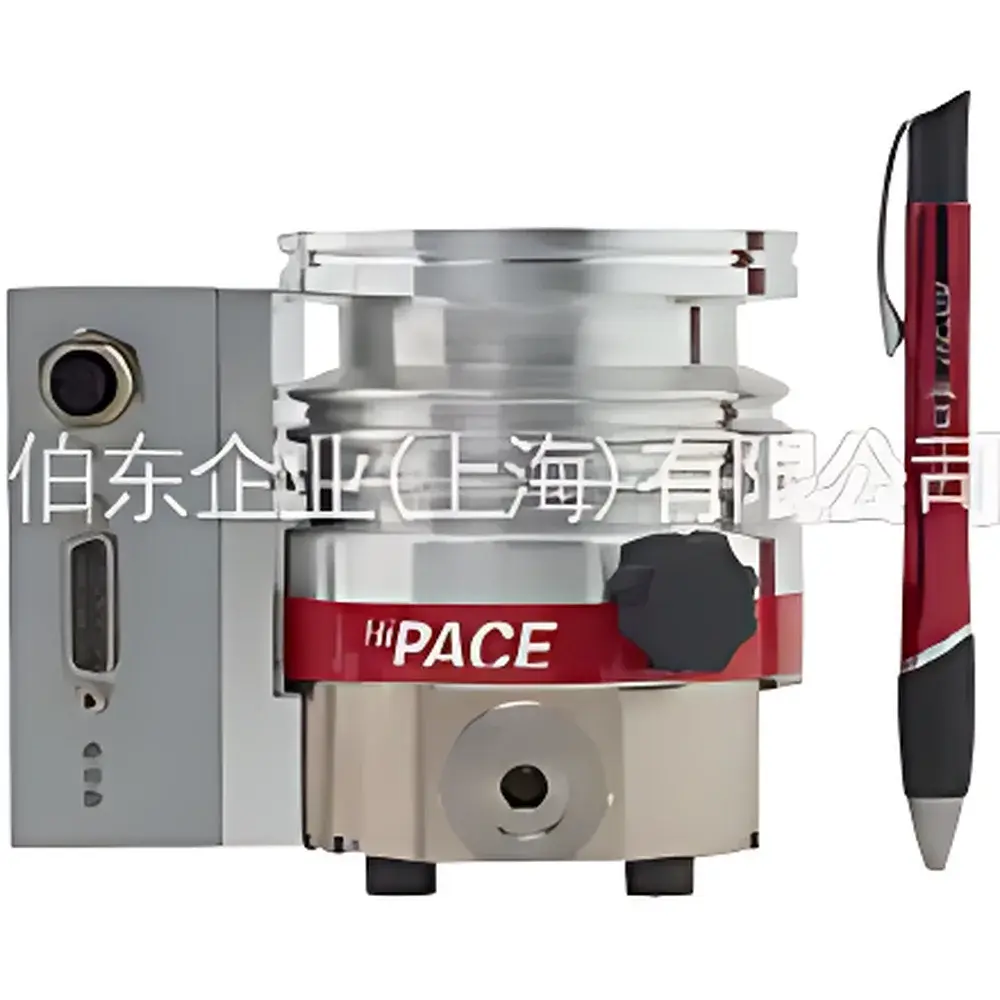
Pfeiffer HiPace 30 Turbo Molecular Pump
| Brand | Pfeiffer Vacuum |
|---|---|
| Origin | Germany |
| Pump Type | Turbo Molecular Pump |
| Model | HiPace® 30 |
| Pumping Speed (N₂) | 32 L/s |
| Ultimate Pressure (N₂) | < 5 × 10⁻¹⁰ hPa |
| Weight | 3.2 kg |
| Operating Voltage | 24 V DC (±5%) |
| Maximum Rotational Speed | 90,000 rpm |
| Startup Time | 1.7 min |
| Bearing System | Hybrid Ceramic Ball Bearings |
| Compression Ratio (N₂) | > 1 × 10¹¹ |
| Compression Ratio (H₂) | 3 × 10⁷ |
| Compression Ratio (He) | 3 × 10⁷ |
| Inlet Flange Options | DN 63 ISO-K, DN 63 CF-F, DN 40 ISO-KF |
| Exhaust Flange | DN 16 ISO-KF, G ¼" |
| Cooling | Convection (standard), Optional Air or Water Cooling (75 L/h, 5–25 °C) |
| Communication Interface | RS-485, Remote Control |
| Protection Rating | IP 54 / IP 30 (depending on configuration) |
| Magnetic Field Tolerance | ≤ 3 mT |
| Installation Orientation | Any Position |
Overview
The Pfeiffer HiPace® 30 is a compact, high-performance turbo molecular pump engineered for precision vacuum generation in space-constrained and mobile laboratory environments. Operating on the principle of momentum transfer—where high-speed rotating blades impart directional kinetic energy to gas molecules—the HiPace 30 achieves ultra-high vacuum (UHV) conditions through multi-stage rotor-stator cascades optimized for molecular flow regimes. Its design targets applications requiring rapid pump-down, exceptional base pressure stability, and minimal mechanical perturbation—critical for electron optics, residual gas analysis, and portable helium leak detection systems. With a physical height of only 12 cm and a mass of 3.2 kg, the pump integrates seamlessly into benchtop instruments without compromising structural rigidity or thermal management. The hybrid ceramic ball bearing system ensures low vibration (< 0.5 µm RMS), essential for maintaining beam coherence in SEM and TEM columns, while delivering proven operational lifetimes exceeding 100,000 hours under continuous duty cycles compliant with ISO 20816-1 vibration severity standards.
Key Features
- Ultra-compact footprint (12 cm height) and lightweight construction (3.2 kg) enabling flexible integration into OEM instruments and portable analytical platforms
- Hybrid ceramic ball bearings providing low-vibration operation (< 0.5 µm RMS at full speed) and extended service intervals per ISO 15243
- High compression ratios: >1 × 10¹¹ for N₂ and Ar; 3 × 10⁷ for He; 3 × 10⁷ for H₂—enabling effective differential pumping and backstreaming suppression
- Standard convection cooling with optional forced-air or water-cooling (75 L/h, 5–25 °C inlet temperature) for sustained performance under variable ambient loads
- RS-485 digital interface supporting remote start/stop, speed control, status monitoring, and fault logging—compatible with LabVIEW™, EPICS, and custom SCADA architectures
- IP 54-rated housing (standard configuration) ensuring protection against dust ingress and water splashes during routine lab handling and maintenance
- Full rotational speed of 90,000 rpm ±2%, achieving nominal N₂ pumping speed of 32 L/s at inlet pressure ≤10⁻² hPa
Sample Compatibility & Compliance
The HiPace 30 is designed for use with inert, non-corrosive, and non-condensable gases typical of UHV and HV applications—including N₂, Ar, He, H₂, and residual atmospheric species. It is not intended for vapors, reactive halogens, or solvent-laden process streams without upstream cold traps or chemical scrubbers. The pump complies with EU Machinery Directive 2006/42/EC and Low Voltage Directive 2014/35/EU. Electromagnetic compatibility meets EN 61326-1:2013 Class A requirements for laboratory equipment. All configurations adhere to ISO 286-1 (geometric tolerances), ISO 10816-3 (vibration acceptance criteria), and ASTM E575-21 (vacuum system performance verification protocols). When integrated into regulated analytical workflows—such as USP analytical instrument qualification or FDA 21 CFR Part 11-compliant data acquisition systems—the HiPace 30 supports audit-trail-capable drive firmware and deterministic response timing for IQ/OQ validation documentation.
Software & Data Management
The TC 110 electronic drive unit provides embedded firmware with real-time telemetry including rotational speed, bearing temperature, motor current, vacuum status, and error codes (e.g., overtemperature, overspeed, communication timeout). Through the RS-485 interface, users can implement programmable logic controllers (PLCs) or host PCs to log time-stamped operational parameters at configurable intervals (1–60 s resolution). Data export formats include CSV and Modbus RTU, facilitating import into LIMS or MES platforms. Firmware updates are performed via secure USB-to-RS485 bridges with SHA-256 signature verification, satisfying IEC 62443-3-3 SL2 cybersecurity requirements for industrial control devices. No proprietary cloud services or vendor-hosted dashboards are required—full local control and data sovereignty are maintained by default.
Applications
- Benchtop scanning electron microscopes (SEM) and focused ion beam (FIB) systems requiring stable <1 × 10⁻⁷ hPa operating pressure
- Compact mass spectrometers (e.g., residual gas analyzers, portable GC-MS) where low-mass, low-vibration pumping minimizes spectral drift
- Mobile helium leak detection units deployed in field service, semiconductor fab tool maintenance, or aerospace component testing
- Differential pumping stages in surface science chambers (XPS, AES, LEED) interfaced with turbomolecular backing pumps
- Research-scale atomic physics setups involving laser-cooled atoms, where magnetic field tolerance (<3 mT) and vibration isolation are critical
FAQ
What pre-vacuum level is required before starting the HiPace 30?
The pump must be started only after the foreline pressure reaches ≤24 hPa (N₂ equivalent), typically achieved using a compatible rotary vane or dry scroll backing pump.
Can the HiPace 30 operate continuously at full speed?
Yes—continuous operation at 90,000 rpm is rated for indefinite duration when ambient temperature remains within 15–35 °C and cooling conditions meet specification (convection, air, or water).
Is the HiPace 30 compatible with aggressive process gases such as Cl₂ or NH₃?
No—exposure to corrosive, condensable, or polymerizing gases will degrade rotor coatings and bearing surfaces. Chemical compatibility must be verified case-by-case with Pfeiffer’s Material Compatibility Guide (Ref. PFE-DOC-MCG-2023).



