
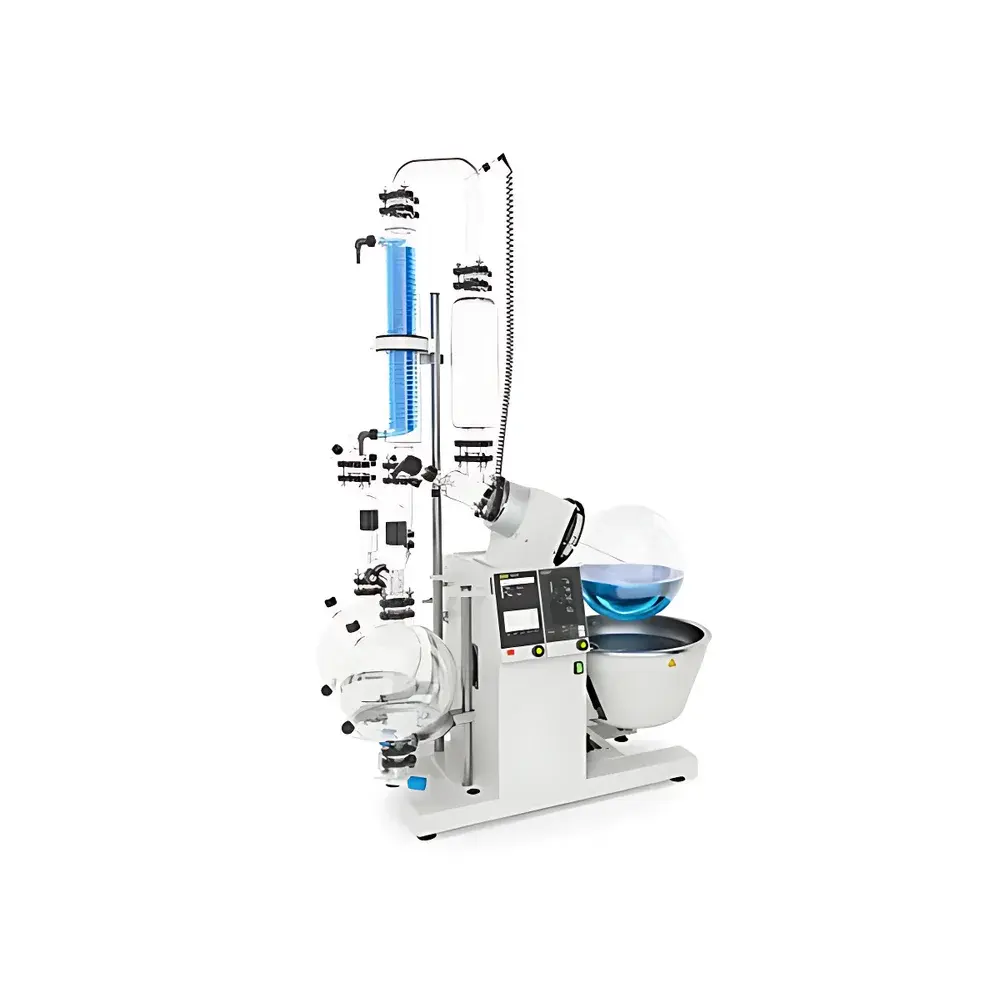
BUCHI R-220 Pro Industrial-Grade Rotary Evaporator
| Brand | BUCHI |
|---|---|
| Origin | Switzerland |
| Manufacturer | BUCHI AG |
| Product Type | Imported |
| Model | R-220 Pro |
| Capacity | 20 L |
| Ultimate Vacuum | 1.5 mbar |
| Rotation Speed | 5–150 rpm |
| Heating Temperature Range | Ambient to 180 °C |
| Temperature Control Accuracy | ±2 °C |
| Cooling Surface Area | Configurable per glass assembly |
Overview
The BUCHI R-220 Pro Industrial-Grade Rotary Evaporator is an engineered solution for high-throughput, reproducible solvent removal in pharmaceutical development, fine chemical synthesis, and industrial R&D laboratories. As the original inventor of rotary evaporation technology, BUCHI has refined decades of thermal vacuum distillation expertise into this modular, process-robust platform. The R-220 Pro operates on the fundamental principle of reducing solvent boiling points under controlled vacuum while rotating the sample to increase surface area and promote uniform thin-film evaporation. Its stainless-steel construction, chemically resistant materials, and continuous-duty architecture support 24/7 operation in regulated environments—making it suitable for GLP-compliant scale-up studies, batch processing validation, and multi-shift production support.
Key Features
- Industrial-grade stainless-steel frame with corrosion-resistant surface treatment for long-term stability in aggressive chemical environments
- Modular platform architecture supporting four configuration variants: MaxFlex (for multi-parameter optimization), MaxPerf (for highest evaporation rate), MaxVol (for 20 L capacity handling), and Base (for cost-optimized routine use)
- Patented BUCHI Evaporation Flask Coupler and ergonomic flask support system enabling single-hand flask mounting/dismounting without tooling or alignment effort
- Programmable SOP-driven operation with pre-defined distillation sequences—including automatic foam detection, adaptive rotation ramping, and vacuum pressure profiling
- Integrated remote monitoring via BUCHI LabX™ software: real-time parameter tracking, push notifications to mobile devices, and audit-trail-enabled event logging compliant with FDA 21 CFR Part 11 requirements
- Plastic-coated glass (P+G) components combined with dual-layer safety shielding (mesh guard + polycarbonate hood) meet IEC 61010-1 safety standards for Class II laboratory equipment
- Heating bath with PID-controlled temperature regulation (±2 °C accuracy across 0–180 °C range) and rapid thermal response for precise endpoint control
Sample Compatibility & Compliance
The R-220 Pro accommodates a wide spectrum of sample types—from low-surface-tension solvents (e.g., dichloromethane, ethyl acetate) to high-viscosity mixtures (e.g., polymer solutions, crude natural product extracts) and foaming-prone formulations (e.g., surfactant-containing APIs, fermentation broths). Its compatibility extends to all seven standard BUCHI glass assemblies, including anti-foam condensers, vertical reflux units, and low-profile configurations for height-constrained fume hoods. The system complies with ISO 9001-certified manufacturing practices and conforms to CE marking directives (2014/30/EU EMC, 2014/35/EU LVD), EN 61010-1:2010 safety standards, and ASTM E2656–22 guidelines for rotary evaporation performance verification.
Software & Data Management
Control and data integrity are ensured through seamless integration with BUCHI LabX™ software. LabX provides role-based user access, electronic signature capability, and full traceability of method parameters, runtime events, and environmental conditions. All distillation logs—including vacuum setpoints, rotation profiles, bath temperature history, and endpoint triggers—are stored in encrypted, tamper-evident format. Audit trails comply with ALCOA+ principles (Attributable, Legible, Contemporaneous, Original, Accurate, Complete, Consistent, Enduring, Available) and support regulatory submissions under USP , EU Annex 11, and ICH GCP. Optional add-ons include automated cooling fluid flow control (via integrated mass flow sensor), real-time vapor temperature monitoring (with Pt100 probe), and external PLC interfacing for plant-level MES integration.
Applications
- Pharmaceutical: Isolation of active pharmaceutical ingredients (APIs) from reaction mixtures; solvent exchange in lyophilization pre-processing; residual solvent analysis sample prep
- Chemical Manufacturing: Recovery and recycling of high-purity solvents (e.g., THF, toluene, DMF); concentration of catalyst slurries; workup of Grignard and organolithium reactions
- Academic & Government Labs: Scalable purification workflows for natural product isolation; teaching platforms for process chemistry labs requiring GMP-aligned instrumentation
- Food & Flavor: Concentration of volatile aroma compounds without thermal degradation; ethanol removal from botanical extracts
- Materials Science: Solvent casting of polymer films; removal of dispersants from nanoparticle suspensions
FAQ
What vacuum level can the R-220 Pro achieve, and how is it maintained during extended runs?
The system achieves a stable ultimate vacuum of ≤1.5 mbar using a chemically resistant diaphragm vacuum pump (optional) or compatible external vacuum source. Integrated vacuum regulation maintains setpoint tolerance within ±0.1 mbar over 8+ hour continuous operation.
Is the heating bath compatible with silicone oil and other high-temperature heat transfer media?
Yes—the bath chamber accepts standard silicone oils rated up to 200 °C and features overflow protection, leak detection, and dry-run prevention logic.
Can the R-220 Pro be validated for use in GMP environments?
Absolutely. IQ/OQ documentation packages are available upon request, and the system supports 21 CFR Part 11 compliance when used with LabX™ and configured user access controls.
How does the R-220 Pro handle foaming samples without manual intervention?
It employs a combination of real-time foam sensing (via capacitive probe), automatic rotation speed reduction, and programmable vacuum stepping—eliminating carryover and ensuring consistent distillate quality.
What maintenance intervals are recommended for uninterrupted 24/7 operation?
Routine inspection every 500 operating hours; vacuum seal replacement every 2,000 hours; annual calibration of temperature and pressure sensors by BUCHI-certified service engineers.



