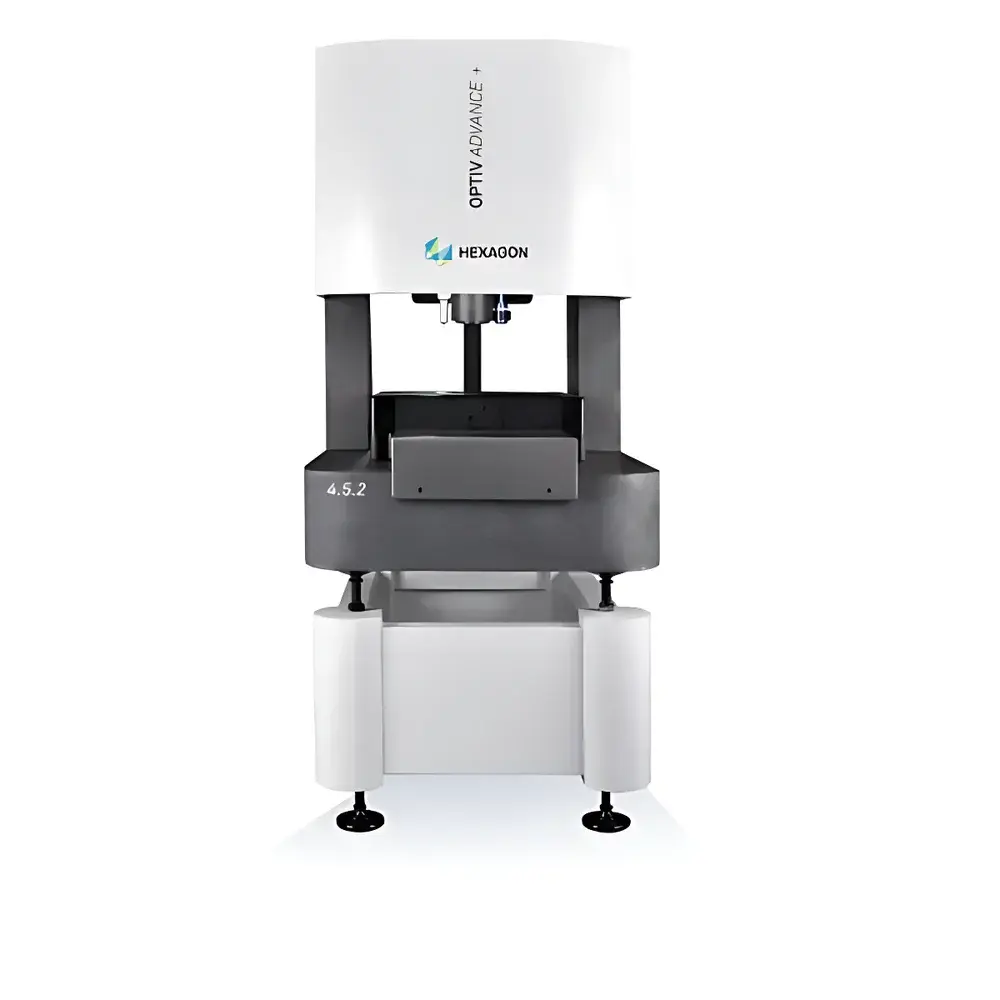
Hexagon Metrology OPTIV ADVANCE PLUS/F Hybrid Image Measuring System
| Brand | Hexagon Metrology |
|---|---|
| Origin | Germany |
| Model | OPTIV ADVANCE PLUS/F |
| Operation Mode | Fully Automatic |
| Measurement Volume (X×Y×Z) | 300×200×200 mm to 800×700×200 mm |
| Scale Resolution | High-precision open-frame optical encoder system |
| Zoom Lens | Motorized high-accuracy auto-focus zoom lens |
| Camera | High-resolution color CCD/CMOS sensor |
| Illumination | Programmable 6-ring, 8-sector LED ring light |
| Structural Frame | Granite-based fixed bridge architecture |
| Drive Configuration | Central drive on all three axes |
| Optional Probes | Touch-trigger probe, laser line scanner, confocal white-light sensor |
| Software Platform | PC-DMIS Vision with AI-assisted edge detection |
Overview
The Hexagon Metrology OPTIV ADVANCE PLUS/F is a high-stability hybrid image measuring system engineered for precision geometric metrology in demanding industrial environments. Built upon a fixed bridge architecture with a monolithic granite base, column, and crossbeam, the system delivers exceptional thermal stability and mechanical rigidity—critical for sub-micron repeatability across extended measurement cycles. Unlike cantilever or moving-bridge configurations, the fixed bridge design minimizes dynamic deflection and ensures consistent volumetric accuracy throughout the full working envelope. The OPTIV ADVANCE PLUS/F integrates non-contact optical imaging with optional tactile and optical scanning probes, enabling true multimodal measurement of form, position, profile, and surface texture within a single platform. Its core measurement principle relies on high-magnification digital image acquisition, calibrated pixel-to-real-world mapping via traceable optical encoders, and sub-pixel edge detection algorithms compliant with ISO 10360-7 and VDI/VDE 2634 Part 2 standards for optical coordinate measuring machines.
Key Features
- Granite-based fixed bridge structure ensuring long-term geometric stability and minimal thermal drift
- Central linear motor drive on X, Y, and Z axes for uniform force distribution and reduced mechanical hysteresis
- High-resolution open-frame optical encoder system with sub-100 nm interpolation capability, traceable to national metrology institutes
- Motorized auto-focus zoom lens with programmable magnification range (typically 0.7x–4.5x), maintaining telecentricity and distortion correction across all zoom positions
- Progressive-scan color camera with ≥5 MP effective resolution and global shutter operation to eliminate motion blur during high-speed stage movement
- Programmable 6-ring, 8-sector LED illumination system supporting independent intensity control per segment—enabling adaptive lighting strategies for challenging features such as low-contrast edges, specular surfaces, or deep cavities
- Built-in thermal compensation algorithm using real-time ambient and structural temperature monitoring
- Modular sensor interface supporting seamless integration of touch-trigger probes (e.g., TP20/TP200), laser line scanners (e.g., LSP-X1), and confocal white-light sensors (e.g., ChromaFocus) without mechanical recalibration
Sample Compatibility & Compliance
The OPTIV ADVANCE PLUS/F accommodates a broad spectrum of part geometries—from microelectromechanical systems (MEMS) components with feature sizes down to 10 µm to large-format consumer electronics assemblies (e.g., display frames, mid-frames, and battery housings). Its configurable Z-axis travel (up to 200 mm) and large worktable load capacity (up to 40 kg) support both thin-walled sheet metal parts and rigid machined castings. All optical and mechanical subsystems conform to ISO 17025-accredited calibration protocols. The system supports audit-ready documentation aligned with FDA 21 CFR Part 11 requirements when deployed in regulated manufacturing environments, including electronic signatures, user access controls, and immutable measurement history logs. It is routinely validated against ASTM E2923 (Standard Guide for Digital Imaging Systems in Dimensional Metrology) and meets essential requirements of the EU Machinery Directive 2006/42/EC.
Software & Data Management
PC-DMIS Vision serves as the native metrology software environment, offering a unified interface for programming, execution, reporting, and statistical process control (SPC). The software embeds AI-assisted edge detection routines trained on diverse material finishes—including anodized aluminum, polished stainless steel, and matte polymer surfaces—to improve contour extraction robustness under variable lighting conditions. Measurement routines are fully scriptable via VB.NET or Python APIs, enabling integration into factory MES/SCADA systems. All measurement data—including raw images, coordinate point clouds, GD&T results, and illumination configuration metadata—are stored in vendor-neutral XML-based formats compliant with ISO 10303-238 (STEP AP238) for long-term archival and cross-platform interoperability. Audit trails record operator identity, timestamp, software version, calibration status, and environmental parameters for every measurement sequence.
Applications
The OPTIV ADVANCE PLUS/F is extensively deployed in Tier-1 suppliers and OEMs serving consumer electronics, automotive powertrain, medical device manufacturing, and precision optics industries. Typical use cases include: verification of critical GD&T callouts (e.g., position, concentricity, profile of a surface) on smartphone camera modules; measurement of solder paste deposit height and area in SMT stencil inspection; validation of micro-milled fluidic channels in diagnostic cartridges; dimensional analysis of injection-molded plastic housings for wear resistance and fit; and first-article inspection of aerospace fasteners requiring simultaneous evaluation of thread geometry and head flatness. Its hybrid capability enables comprehensive characterization of hybrid components—such as ceramic-on-metal substrates—where optical methods assess surface topology while tactile probing verifies internal bore geometry.
FAQ
What is the maximum permissible error (MPE) specification for the OPTIV ADVANCE PLUS/F series?
MPE values follow ISO 10360-7 Annex A and are certified per model variant—e.g., E0,MPE ≤ (2.5 + L/250) µm for the 4.5.2 F configuration (L in mm). Full calibration certificates are issued by Hexagon-certified labs.
Can the system perform measurements under controlled environmental conditions?
Yes—the base frame includes provisions for integration with HVAC-controlled metrology rooms (ISO 14644 Class 7 or better) and optional vibration isolation tables meeting ISO 230-2 requirements.
Is GD&T evaluation fully automated in PC-DMIS Vision?
All ASME Y14.5-2018 and ISO 1101-compliant GD&T symbols—including composite position, profile of a line, and runout—are evaluated automatically with tolerance zone visualization and deviation heatmaps.
How is traceability maintained across sensor modalities?
A unified spatial reference frame is established during system commissioning using artifact-based multi-sensor alignment (e.g., calibrated step gauges, sphere plates, and grid plates), with residual registration uncertainty documented per ISO 15530-3.
Does the system support automated report generation for quality audits?
Yes—customizable PDF/Excel reports with embedded images, statistical summaries, and compliance statements can be triggered via scheduled tasks or API calls, with digital signature support for Part 11 compliance.