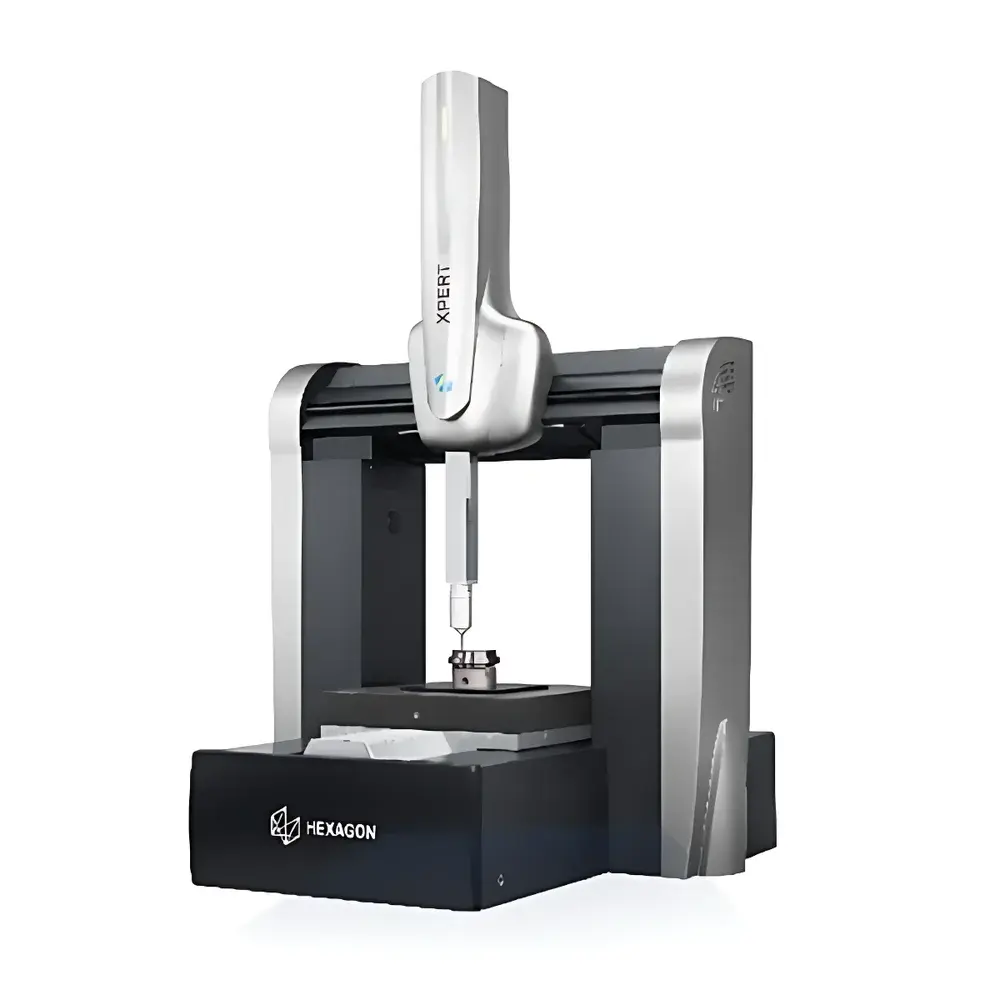
Hexagon XPERT High-Precision Bridge Coordinate Measuring Machine (CMM)
| Brand | Hexagon |
|---|---|
| Origin | Shandong, China |
| Manufacturer Type | Authorized Distributor |
| Product Category | Domestic |
| Model | XPERT |
| Configuration | Bridge-Type |
| Operation Mode | Automatic |
| Instrument Orientation | Vertical |
| Measurement Method | Contact & Non-Contact Hybrid |
| Measurement Volume | 600 × 500 × 500 mm to 600 × 800 × 600 mm |
| Volumetric Accuracy | Starting from 0.5 µm |
| Standard Ambient Temperature | 19–21 °C |
| Minimum Air Supply Pressure | 0.6 MPa |
| Application Sectors | Mechanical Manufacturing, Automotive, Aerospace, Mold & Die, Electronics, Medical Devices |
Overview
The Hexagon XPERT is a domestically engineered, high-precision bridge-type coordinate measuring machine (CMM) designed for metrological-grade inspection of geometric features—both fundamental and complex—in production and R&D environments. Built upon Hexagon’s four-decade legacy in localized CMM development in China—including the landmark ZC8645 (1988), the first domestically developed high-accuracy bridge CMM—the XPERT represents the current pinnacle of indigenous precision metrology. It operates on the principle of Cartesian coordinate measurement, integrating tactile probing, optical scanning, and non-contact imaging modalities within a thermally stable, rigid mechanical architecture. Its core mission is to deliver traceable, repeatable, and ISO/IEC 17025-aligned dimensional verification under controlled environmental conditions (19–21 °C, ≤0.6 MPa clean dry air), serving as a foundational tool for quality assurance systems compliant with ASME Y14.5, ISO 1101, and GD&T standards.
Key Features
- Rigid Granite Monocoque Frame: A fully enclosed, stress-relieved granite structure ensures long-term dimensional stability and minimizes thermal drift across the full measurement volume.
- Precision Triangular Beam Design: Low center-of-gravity beam geometry enhances dynamic rigidity, while optimized air-bearing guideways maintain consistent float stiffness and sub-micron directional repeatability.
- Enhanced Moving Bridge Assembly: Reinforced balance bracket and slider casting undergo rigorous aging treatment to neutralize residual stresses; modular outer shrouding reduces vibration coupling without compromising serviceability.
- Center-Driven Moving Table: Dual dovetail air-bearing rails and centrally located ball-screw drive eliminate torsional deflection during motion, enabling high-speed positioning with minimal pitch/yaw error.
- VFT-Enabled Multi-Rib Belt Drive: Replaces traditional timing belts with vibration-free poly-V belts coupled via elastic mounts—eliminating periodic transmission artifacts that degrade scanning fidelity.
- Patented Air-Bearing System: Precision-regulated air supply (via calibrated pressure-reducing valves) and leaf-spring/diaphragm preload mechanisms ensure uniform lift force and damping across all axes.
- Electromagnetic Interference Mitigation: Full chassis grounding, thermally isolated motor housings, shielded cabling, and embedded temperature sensor shielding collectively suppress noise in shop-floor deployments.
- Fixed Bridge Architecture: Enables unrestricted part loading from any direction and accommodates extended probe configurations—maximizing volumetric utilization and minimizing probe change frequency.
Sample Compatibility & Compliance
The XPERT supports a broad spectrum of part geometries—from miniature semiconductor components (<1 mm feature size) to large aerospace structural assemblies (up to 600 mm height). Its hybrid probe system accommodates low-force stylus tips (≤0.02 N trigger force), chromatic confocal sensors, and structured-light scanners—making it suitable for thin-walled electronics housings, turbine blades with freeform surfaces, gear teeth with involute profiles, and RV reducer components requiring tight runout and tooth flank deviation control. The platform conforms to ISO 10360-2 (CMM acceptance testing), ISO 10360-5 (scanning performance), and supports audit-ready data capture per FDA 21 CFR Part 11 when integrated with compatible metrology software. Environmental compliance includes CE marking and adherence to ISO 14644-1 Class 8 cleanroom compatibility (with optional filtration).
Software & Data Management
The XPERT integrates seamlessly with Hexagon’s PC-DMIS metrology software suite, supporting GD&T evaluation per ASME Y14.5–2018 and ISO 1101:2017. All measurement routines include full audit trail logging—recording operator ID, timestamp, probe configuration, calibration status, environmental readings, and raw point-cloud metadata. Data export formats include ASCII, STEP AP214, QIF (ISO 10303-235), and XML-based inspection reports compatible with MES and PLM platforms. Optional modules enable statistical process control (SPC) charting, multi-part family programming, and automated report generation aligned with IATF 16949 clause 8.6.2 requirements.
Applications
- RV Reducer Inspection: Full-geometry verification of crankshafts, cycloidal discs, and needle bearing carriers—including position, orientation, and profile tolerances critical to robotic joint repeatability.
- Gear Metrology: Comprehensive evaluation of spur/helical gear sets—pitch deviation, lead error, total composite error (TCE), and tooth-to-tooth variation—using both single-point probing and continuous scanning modes.
- Turbine Blade Measurement: Surface extraction, airfoil profile matching, thickness mapping, and root contour analysis using adaptive scanning strategies and custom fixturing interfaces.
- Semiconductor Component Verification: Sub-µm form and position assessment of wafer chucks, MEMS actuators, and ceramic substrates—leveraging low-contact-force probes and thermal-compensated algorithms.
- Mold & Die Validation: Core/cavity surface fidelity checks, draft angle verification, and ejection pin positional accuracy—all traceable to national metrology institute (NIM)-certified artifacts.
FAQ
What environmental conditions are required for optimal volumetric accuracy?
The XPERT achieves its stated accuracy (starting from 0.5 µm) only within a temperature-controlled environment maintained at 19–21 °C ±0.5 °C, with humidity between 40–60% RH and airflow velocity <0.2 m/s. Thermal gradient across the granite base must not exceed 0.5 °C/m.
Is the system compatible with third-party probing hardware?
Yes—via standardized I++ DME interface and open SDK support, the XPERT accepts certified tactile and optical probes from major suppliers including Renishaw, Zeiss, and Nikon Metrology, subject to firmware version compatibility.
How is calibration traceability maintained?
Each unit ships with NIST-traceable (or CNAS-accredited equivalent) calibration certificates for linear scale, volumetric performance, and probe qualification—valid for 12 months under documented environmental and usage conditions.
Can the XPERT be integrated into an automated production line?
Yes—equipped with industrial Ethernet (PROFINET/ETHERNET/IP), safety-rated E-stop circuits, and PLC-compatible I/O, the system supports lights-out operation when paired with robotic part handling and automated fixturing solutions.
What maintenance intervals are recommended for air-bearing systems?
Daily visual inspection of air filters and pressure gauges; quarterly replacement of coalescing filter elements; annual recalibration of pressure regulators and full guideway surface inspection by certified Hexagon Field Service Engineers.