
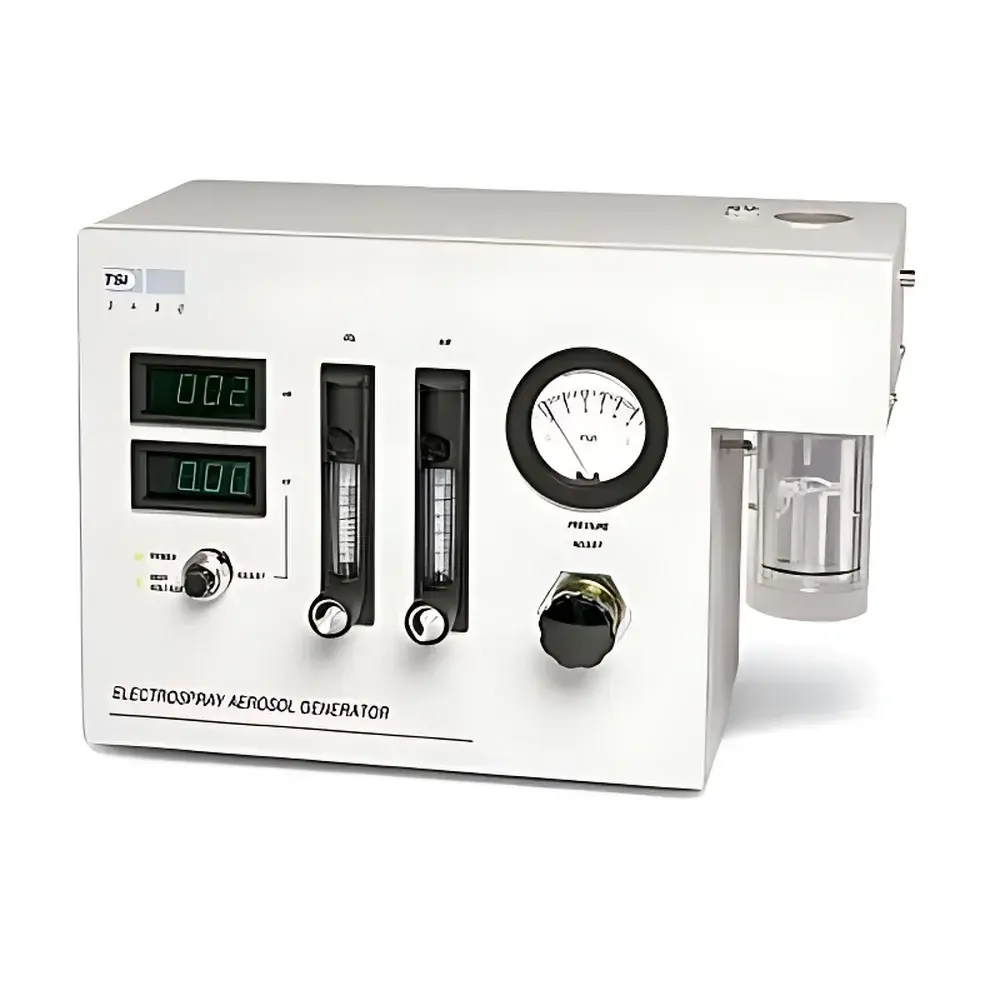
TSI 3480-ES Electrospray Aerosol Generator
| Origin | USA |
|---|---|
| Manufacturer Type | Authorized Distributor |
| Origin Category | Imported |
| Model | 3480 |
| Pricing | Upon Request |
| Particle Size Range | 2–100 nm |
| Particle Generation Rate | >10⁸ #/cm³ |
| Liquid Conductivity | 0.2 S/m |
| Liquid Flow Rate | 50–100 nL/min |
| Sheath Air Flow Rate | 0.2–0.5 L/min |
| CO₂ Flow Rate | 0.05–0.5 L/min |
Overview
The TSI 3480-ES Electrospray Aerosol Generator is an engineered precision instrument designed for the controlled, repeatable production of monodisperse nanoparticles in the sub-100 nm range. Operating on the principle of electrospray ionization (ESI), it enables stable generation of charged nanodroplets from conductive liquid solutions or suspensions—followed by solvent evaporation and charge neutralization—to yield neutral, non-volatile, solid-phase aerosol particles. This physical process avoids thermal degradation, making it uniquely suited for fragile macromolecules, polymers, and functionalized nanomaterials. Unlike thermal or atomization-based generators, the 3480-ES delivers high-fidelity particle size control down to 2 nm, supporting traceable calibration of scanning mobility particle sizers (SMPS), differential mobility analyzers (DMA), condensation particle counters (CPC), and nanoparticle surface area monitors (NSAM). Its design conforms to fundamental aerosol physics principles described in ISO 15900 and ASTM D8196, ensuring metrological relevance in laboratory and regulatory environments.
Key Features
- Stable electrospray operation across a validated 2–100 nm particle diameter range, with demonstrated reproducibility under constant fluidic and electrical conditions
- Integrated dual-gas sheath system (compressed air + CO₂) enabling precise control over droplet drying kinetics and residual solvent removal
- Microfluidic capillary delivery with programmable liquid flow (50–100 nL/min) and calibrated conductivity tolerance (0.2 S/m) for consistent Taylor cone formation
- Modular high-voltage power supply (0–5 kV DC) with real-time current monitoring to prevent arcing and ensure process stability
- Compact, benchtop form factor with ESD-safe enclosure and CE-compliant electromagnetic compatibility per EN 61326-1
- No moving parts in the aerosol generation zone—minimizing maintenance and enhancing long-term operational reliability
Sample Compatibility & Compliance
The 3480-ES accommodates a broad spectrum of precursor materials, including water-soluble non-volatile solids (e.g., ammonium sulfate, sucrose, PEG standards), insoluble particulates suspended in polar solvents (e.g., TiO₂, SiO₂ colloids), and low-volatility organic liquids (e.g., dioctyl sebacate, squalane). It does not support highly viscous (>10 mPa·s) or non-conductive (<0.01 S/m) feedstocks without formulation adjustment. All aerosol output meets ISO 27427 requirements for reference aerosol generators used in instrument verification. When operated with traceable calibration fluids and documented SOPs, data generated using the 3480-ES supports GLP-compliant reporting and satisfies traceability requirements outlined in ISO/IEC 17025:2017 Clause 7.7. Instrument logs—including voltage, flow rates, and runtime—are timestamped and exportable to support FDA 21 CFR Part 11 audit trails when integrated with compliant LIMS or data acquisition software.
Software & Data Management
The 3480-ES operates as a standalone hardware module with analog/digital I/O interfaces (0–10 V, RS-232, optional Ethernet) for integration into automated test benches. While no proprietary GUI is bundled, its control signals are fully compatible with LabVIEW™, MATLAB® Data Acquisition Toolbox, and Python-based automation frameworks (e.g., PySerial, NI-DAQmx). Flow controllers and high-voltage supplies can be synchronized with SMPS or DMA scan cycles to enable closed-loop size distribution targeting. Raw operational parameters are logged at 1 Hz resolution and stored in CSV format; metadata fields include operator ID, batch number, fluid lot code, and environmental ambient (T/RH via optional external sensor input). Exported datasets comply with MIAME and ISA-TAB conventions for interoperability with aerosol data repositories such as the NIST Aerosol Measurement Database.
Applications
- Primary calibration of nanoparticle sizing instruments including DMAs, CPCs, and nano-SMPS systems
- Generation of monodisperse challenge aerosols for filter efficiency testing (EN 1822, ISO 29463)
- In situ validation of airborne nanoparticle monitors deployed in occupational hygiene and cleanroom monitoring
- Delivery platform for inhalation toxicology studies requiring chemically defined, low-agglomeration aerosols
- Model system for studying nucleation, coagulation, and surface charging dynamics in dilute nanoscale aerosols
- Preparation of reference materials for interlaboratory comparison exercises coordinated by EUROLAB or CCQM
FAQ
What types of liquids are compatible with the 3480-ES?
Aqueous or polar organic solutions with conductivity ≥0.2 S/m and viscosity ≤5 mPa·s. Suspensions must be sonicated and filtered (≤0.2 µm) prior to loading.
Can the 3480-ES generate particles below 2 nm?
No—the validated lower limit is 2 nm under standard operating conditions. Sub-2 nm generation requires custom electrode geometry and ultra-low flow optimization not supported by the commercial 3480-ES configuration.
Is CO₂ required for operation?
CO₂ is optional but recommended for rapid, complete solvent evaporation—especially with higher-boiling-point solvents. Compressed air alone may suffice for volatile solvents like methanol or acetone.
How often does the capillary require cleaning or replacement?
Under continuous use with filtered, particle-free solutions, capillaries typically remain functional for >200 hours. Routine cleaning with isopropanol and ultrasonication every 24–48 hours maintains optimal performance.
Does TSI provide NIST-traceable calibration certificates?
TSI does not issue factory calibration certificates for the 3480-ES itself; however, users may obtain third-party certification per ISO/IEC 17025 through accredited laboratories using reference methods described in ISO 15900 Annex C.







