
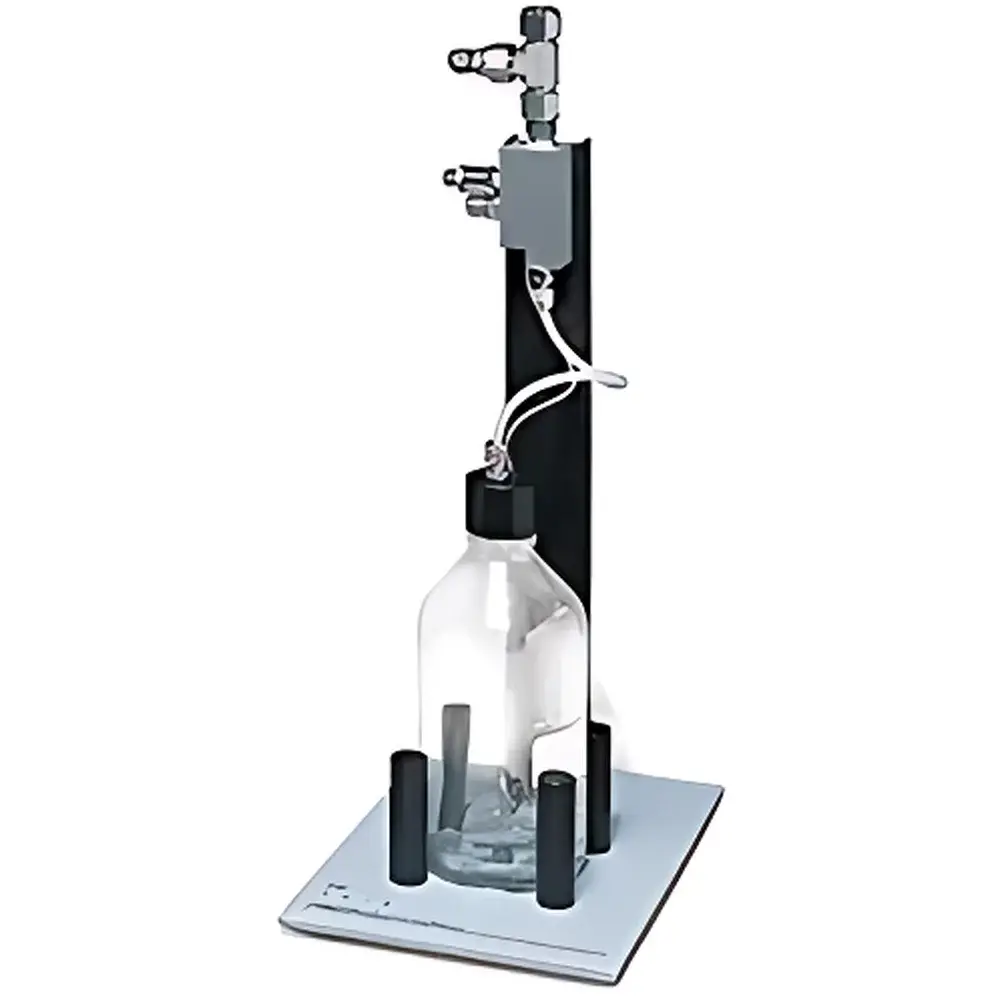
TSI Model 3076 Constant-Flow Aerosol Atomizer
| Brand | TSI |
|---|---|
| Origin | USA |
| Model | 3076 |
| Aerosol Generation Principle | Collison-type nebulization |
| Nominal Aerosol Flow Rate | 3.0 L/min |
| Maximum Aerosol Concentration | ≥1 × 10⁷ particles/cm³ |
| Particle Size Range | 0.01–2 µm (multimodal, adjustable via solution formulation and operational parameters) |
| Aerosol Precursors | PSL, DOP, silicone oil, NaCl, sucrose, and other soluble or colloidal suspensions |
| Construction | All-stainless-steel nozzle assembly, borosilicate glass reservoir, integrated low-noise diaphragm compressor |
| Compliance | Designed for ISO 14644-3, ISO 21501-4, ASTM F2894, and EN 1822 test protocols |
Overview
The TSI Model 3076 Constant-Flow Aerosol Atomizer is a precision-engineered Collison-type nebulizer designed to generate stable, reproducible, high-concentration multimodal aerosols for laboratory and industrial validation applications. Operating on the principle of pneumatic atomization—where compressed air shears liquid or colloidal solutions into fine droplets that subsequently evaporate or dry to form solid or liquid-phase particles—the Model 3076 delivers controlled aerosol output under constant-flow conditions. Its core architecture integrates a proprietary all-stainless-steel multi-jet nozzle housed within a sealed, hinged borosilicate glass reservoir, ensuring chemical compatibility, mechanical durability, and minimal particle loss due to surface deposition. The built-in low-noise diaphragm compressor eliminates external air supply dependencies, enabling standalone operation with consistent pressure delivery (±2% regulation) across extended runtimes. Unlike variable-output generators, the Model 3076 maintains a nominal volumetric aerosol output of 3.0 L/min at steady-state, facilitating direct integration into challenge ducts, filter test rigs, and calibration manifolds without flow compensation.
Key Features
- Stable output of ≥1 × 10⁷ particles/cm³ at 3.0 L/min nominal flow—validated using calibrated condensation particle counters (CPCs) traceable to NIST standards
- Full stainless-steel nozzle assembly resistant to corrosion from organic solvents (e.g., DOP), saline solutions (NaCl), and aqueous sugar suspensions
- Modular reservoir design with quick-release hinged lid for rapid solution exchange and cleaning—reducing cross-contamination risk between test campaigns
- Integrated diaphragm compressor delivering regulated airflow (60–80 psi) with acoustic emission <45 dBA at 1 m, suitable for quiet laboratory environments
- Adjustable aerosol size distribution achieved through precursor selection (e.g., PSL for monodisperse reference generation; salt/sucrose for hygroscopic growth studies) and dilution staging
- No consumable nozzles or disposable components—designed for >10,000 hours of maintenance-free operation under GLP-compliant usage protocols
Sample Compatibility & Compliance
The Model 3076 supports a broad spectrum of aerosol precursors including polystyrene latex (PSL) suspensions, dioctyl phthalate (DOP), silicone oils, sodium chloride (NaCl), ammonium sulfate, and sucrose solutions—enabling generation of both non-volatile solid particles and semi-volatile organic aerosols. Its materials-of-construction comply with USP for extractables profiling and meet FDA-recommended criteria for equipment used in pharmaceutical environmental monitoring. The generator is routinely deployed in ISO 14644-3 cleanroom certification, EN 1822-3 filter efficiency testing (HEPA/ULPA), and ASTM F2894 respirator filtration validation. Its output stability (<±5% CV over 60 min) satisfies data integrity requirements for 21 CFR Part 11–compliant audit trails when paired with TSI’s AM520 or SidePak logging systems.
Software & Data Management
While the Model 3076 operates as a hardware-only aerosol source, it is fully interoperable with TSI’s TrakPro™ Lite v6 and Aeronet™ software suites for synchronized logging of upstream/downstream particle counts, pressure differentials, and temperature/humidity metadata. When integrated with a scanning mobility particle sizer (SMPS) or optical particle counter (OPC), the system supports automated size-resolved concentration reporting aligned with ISO 21501-4 counting efficiency corrections. All calibration records—including nozzle flow verification, CPC zero-check logs, and compressor pressure decay tests—are exportable in CSV/PDF formats with embedded timestamps and operator ID fields to support GLP/GMP documentation workflows.
Applications
- Filter penetration testing per ISO 16890, EN 1822, and ASME AG-1 Section FC
- Calibration and challenge aerosol generation for optical particle counters, condensation particle counters, and aerodynamic particle sizers
- Aerosol exposure studies in inhalation toxicology and pulmonary drug delivery research
- Synthesis of nanostructured metal oxide particles via solvent evaporation routes (e.g., TiO₂ from titanium isopropoxide precursors)
- Validation of real-time airborne pathogen detection platforms using bioaerosol surrogates (e.g., MS2 bacteriophage in saline suspension)
- Development and benchmarking of computational fluid dynamics (CFD) models for indoor aerosol dispersion
FAQ
What aerosol size distributions can the Model 3076 produce?
The generator yields multimodal distributions spanning 0.01–2 µm by default; monodisperse outputs are achievable using narrow-size-distribution PSL suspensions and post-generation classification (e.g., DMA selection).
Is the unit compatible with corrosive precursors such as sulfuric acid or hydrogen peroxide solutions?
No—while stainless steel resists NaCl and DOP, strong oxidizers or low-pH acids require custom Hastelloy®-nozzle variants (TSI P/N 3076-HA), available under engineering consultation.
Does the Model 3076 require external compressed air?
No—it contains an integrated diaphragm compressor; external air sources are neither required nor recommended to preserve flow consistency.
How frequently must the nozzle be cleaned?
Under standard use with filtered, particle-free solutions, cleaning is recommended after every 40 hours of cumulative operation or before switching precursor chemistries.
Can output concentration be modulated during operation?
Concentration is primarily adjusted via solution concentration and dilution ratio; real-time modulation is not supported—flow rate remains fixed at 3.0 L/min to ensure metrological stability.







