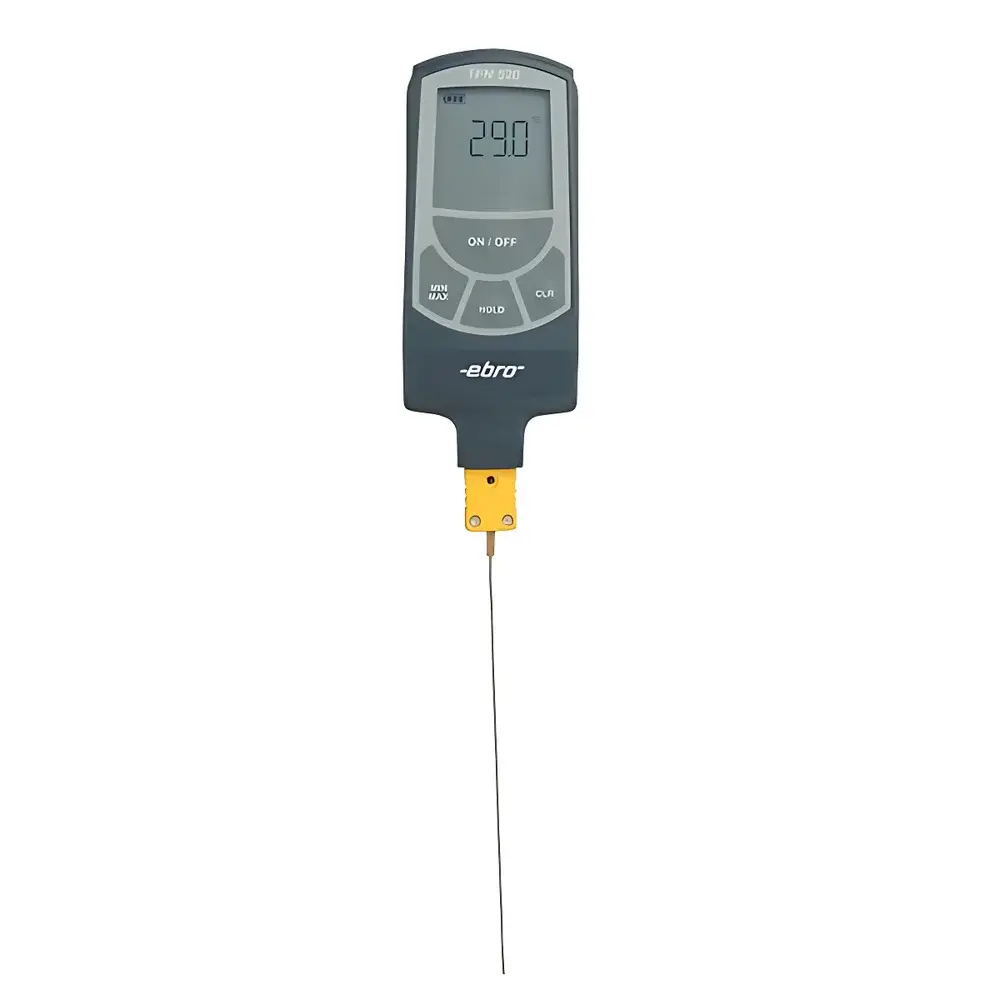
ChemTron TFN 520/530 High-Precision Thermocouple Temperature Meter
| Brand | ChemTron |
|---|---|
| Origin | Germany |
| Model | TFN 520 / TFN 530 |
| Temperature Range | −200 °C to +1200 °C (K-type) |
| Accuracy | ±0.1 °C (−99.9 °C to +250 °C), ±1 °C (outside specified range) |
| Thermocouple Types Supported | K, J, T, E |
| Power Supply | Replaceable 3.0 V lithium battery (5-year typical service life) |
| Sampling Interval | 0.5–15 s |
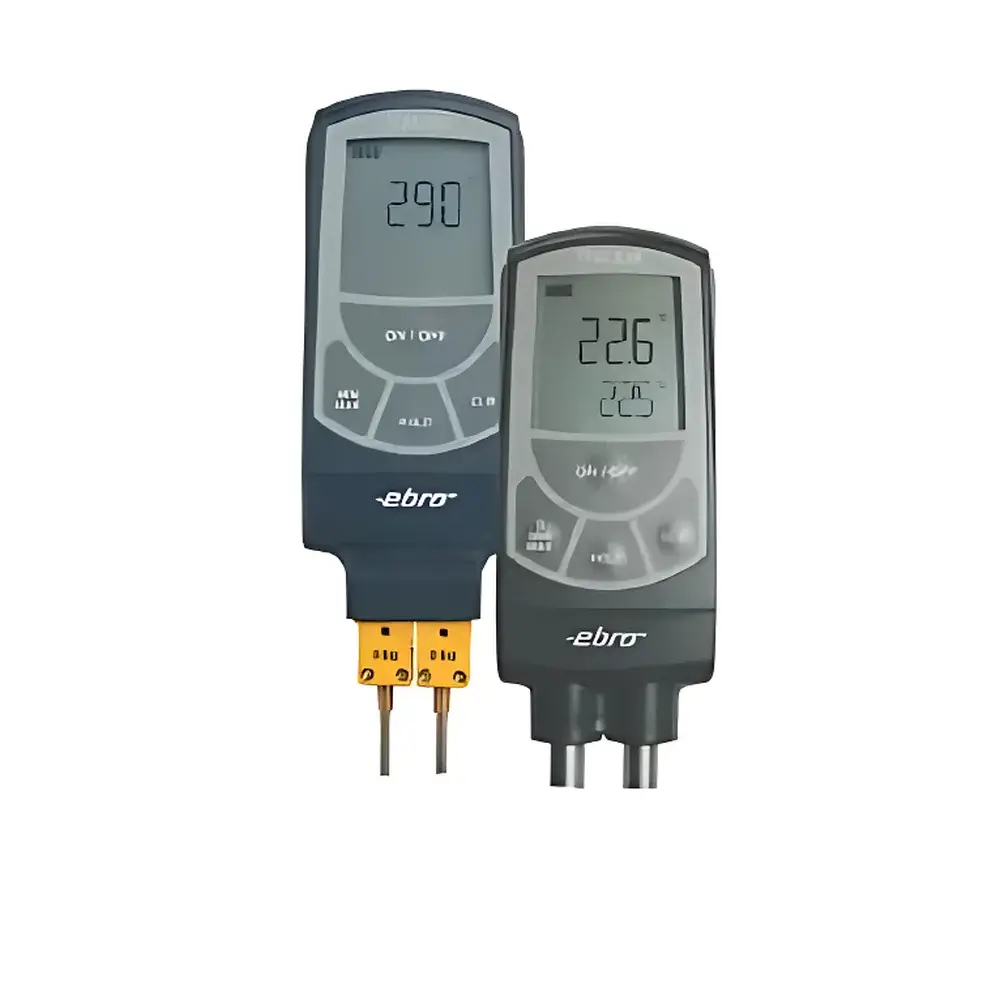
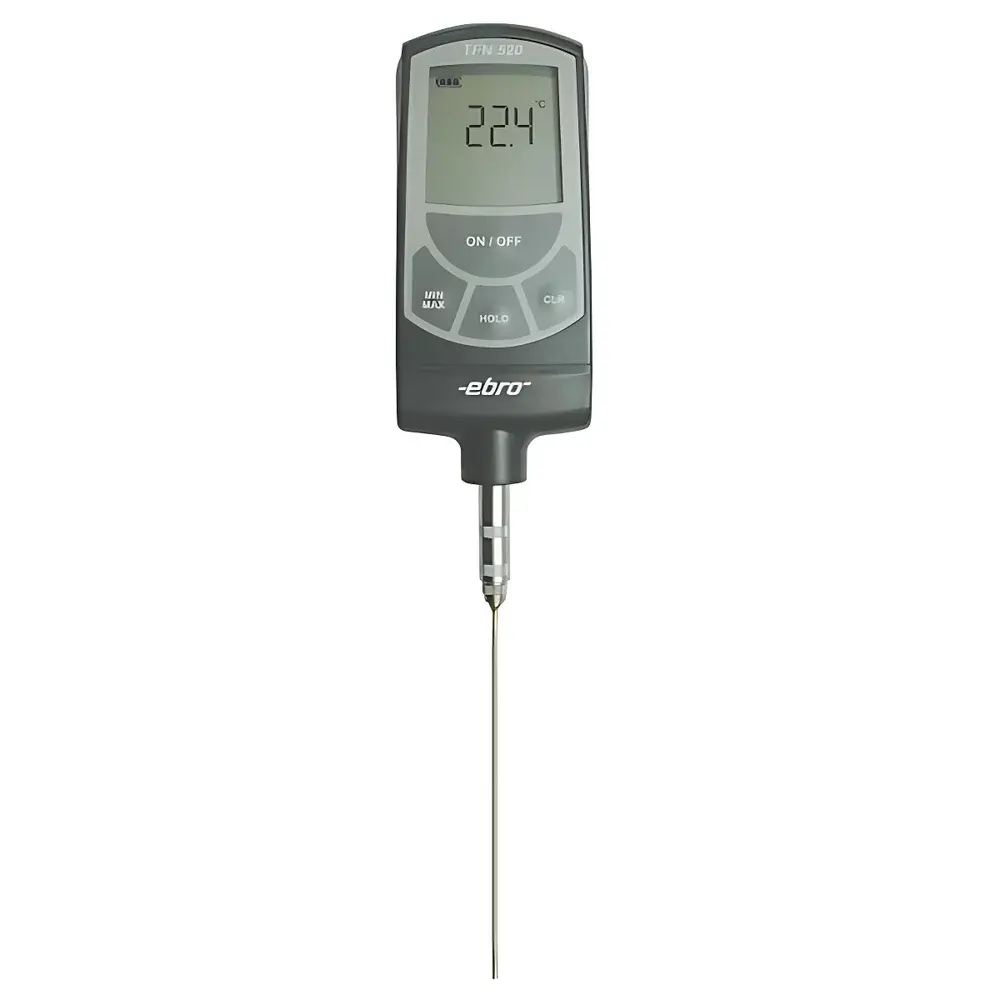
| Channel Configuration | TFN 520 (single-channel), TFN 530 (dual-channel) |
| Connector Options | LEMO (IP52) or SMP (IP40) |
| Compliance | Designed for laboratory and industrial process monitoring per IEC 60584 and ASTM E230 standards |
Overview
The ChemTron TFN 520/530 is a high-precision, portable thermocouple temperature meter engineered for traceable, repeatable thermal measurements across demanding laboratory, calibration, and industrial process environments. Built on a robust analog-to-digital architecture with cold-junction compensation (CJC) optimized for thermoelectric voltage linearity, the instrument supports four standard thermocouple types—K, J, T, and E—enabling flexible deployment across cryogenic, ambient, and high-temperature applications. Its measurement principle relies on precise digitization of millivolt-level thermoelectric signals, referenced against an internally stabilized reference junction, ensuring compliance with fundamental thermocouple calibration conventions defined in IEC 60584 and ASTM E230. With a full-scale operating range spanning −200 °C to +1200 °C (K-type), the TFN series delivers metrologically sound data without external signal conditioning—making it suitable for ISO/IEC 17025-accredited labs, pharmaceutical process validation, and materials testing where thermal stability verification is critical.
Key Features
- High-resolution digital readout with 0.1 °C resolution in primary calibration ranges (e.g., −99.9 °C to +250 °C for K-type)
- Dual-channel capability (TFN 530) enables simultaneous differential or independent temperature monitoring—ideal for thermal gradient analysis or chamber uniformity mapping
- User-replaceable 3.0 V lithium battery with >5 years typical operational lifetime under standard sampling intervals (1–5 s), minimizing maintenance downtime
- Configurable sampling interval from 0.5 s to 15 s—supporting both transient event capture and long-term logging protocols
- Two mechanical interface options: ruggedized LEMO connectors (IP52-rated enclosure) for lab-grade repeatability, or compact SMP connectors (IP40) for OEM integration or space-constrained installations
- Auto-ranging input circuitry eliminates manual range switching; automatic thermocouple type recognition via plug-and-play connector coding (optional firmware configuration)
Sample Compatibility & Compliance
The TFN 520/530 interfaces directly with industry-standard bare-wire, sheathed, and miniature thermocouples—including grounded, ungrounded, and exposed-junction configurations—without requiring external transmitters or signal isolators. Its input impedance (>10 MΩ) and low noise floor (<1 µV RMS) preserve signal integrity even with high-resistance probes or extended cable runs. The device meets electromagnetic compatibility requirements per EN 61326-1 (industrial environment), and its electrical safety design conforms to EN 61010-1 CAT II. For regulated environments, the instrument supports GLP-compliant operation through time-stamped data output and optional CSV export; while not natively Part 11 compliant, its deterministic behavior and audit-ready output format facilitate integration into validated systems governed by FDA 21 CFR Part 11 or EU Annex 11 when paired with appropriate data management software.
Software & Data Management
Data acquisition is performed locally on-device with real-time display and internal storage of up to 10,000 timestamped readings (configurable per channel). Raw data exports via USB-C or Bluetooth 5.0 (optional module) to PC-based utilities compatible with Windows, macOS, and Linux. Export formats include plain-text CSV and Excel-compatible XLSX, preserving measurement metadata (thermocouple type, CJC value, sampling interval, serial number, and UTC timestamp). Optional ChemTron LogView software provides trend visualization, statistical analysis (min/max/avg/std dev), and customizable alarm thresholds—functionality aligned with ISO 17025 clause 7.7 on result reporting and uncertainty estimation. All firmware updates are digitally signed and delivered via secure HTTPS endpoint to ensure integrity and version control.
Applications
- Calibration laboratory reference checks and inter-lab comparison studies
- Thermal validation of autoclaves, ovens, freeze dryers, and environmental chambers (per ISO 13485, USP , and EU GMP Annex 15)
- Materials science workflows: sintering profile verification, polymer curing kinetics, and metal heat-treatment process monitoring
- Research-grade cryogenics support (liquid nitrogen and helium boil-off characterization down to −200 °C)
- Field service diagnostics for HVAC commissioning, power transformer oil temperature trending, and semiconductor fabrication tool thermal mapping
FAQ
What thermocouple types does the TFN 520/530 support?
K, J, T, and E types—each with dedicated accuracy specifications across defined sub-ranges as per IEC 60584.
Is the battery user-replaceable, and what is its expected service life?
Yes—the 3.0 V lithium cell is field-replaceable using standard tools; nominal service life exceeds 5 years at 1-second sampling interval and room-temperature operation.
Does the instrument provide cold-junction compensation (CJC)?
Yes—integrated high-stability CJC sensor with ±0.2 °C uncertainty ensures accurate reference junction correction across ambient temperatures from 0 °C to 50 °C.
Can the TFN be used in hazardous locations?
No—it is not intrinsically safe or ATEX-certified; for hazardous area use, pairing with certified signal isolators and barrier systems is required.
How is traceability maintained during calibration?
The device supports NIST-traceable calibration via documented as-found/as-left reports; factory calibration certificates include measurement uncertainty budgets per ISO/IEC 17025 requirements.