
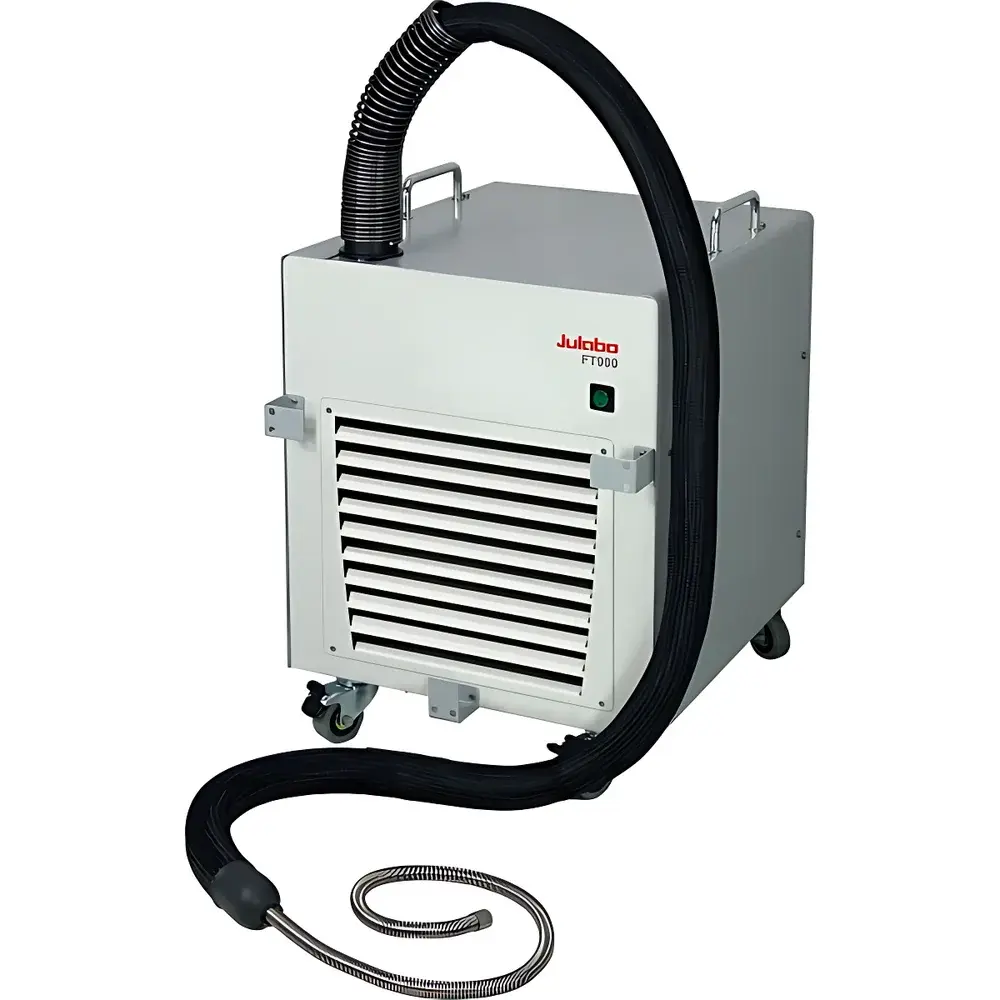
Julabo FT900 Immersion Cooling Circulator
| Brand | Julabo |
|---|---|
| Origin | Germany |
| Model | FT900 |
| Temperature Range | –90 °C to +30 °C |
| Refrigeration Capacity | 0.3 kW at 20 °C, 0.27 kW at 10 °C, 0.24 kW at 0 °C, 0.20 kW at –40 °C, 0.07 kW at –80 °C |
| Ambient Operating Temperature | 5–35 °C |
| Refrigerant System | Two-stage compression with R404A (stage 1) and R23 (stage 2) |
| GWP (R404A) | 3922, GWP (R23): 14800 |
| CO₂-equivalent emissions per unit | 1.216 t (stage 1), 0.962 t (stage 2) |
| Dimensions (W×L×H) | 38 × 55 × 60 cm |
| Weight | 50 kg |
| Immersion Probe | Stainless steel, Ø1.5 cm × 65 cm |
| Hose Length | 160 cm |
| Cooling Method | Air-cooled |
Overview
The Julabo FT900 Immersion Cooling Circulator is a two-stage, air-cooled cryogenic temperature control system engineered for precise, stable, and rapid cooling of external liquid baths, reactors, or jacketed vessels. Unlike conventional bath circulators, the FT900 delivers refrigeration power directly through a compact, high-efficiency immersion probe—eliminating thermal lag and maximizing heat transfer at the point of application. Its dual-compressor architecture employs R404A in the first stage and R23 in the second, enabling sustained operation down to –90 °C without dry ice or liquid nitrogen. This makes it suitable for applications requiring deep-cryogenic stabilization in analytical instrumentation, low-temperature reaction monitoring, material property testing, and controlled crystallization studies. The system operates independently or in tandem with Julabo heating circulators (e.g., F25, HUBER chiller-heater systems) to achieve full bidirectional temperature control across a continuous range spanning –90 °C to +30 °C.
Key Features
- Two-stage cascade refrigeration system optimized for ultra-low temperature stability and reproducibility
- Stainless steel immersion probe (Ø1.5 cm × 65 cm) designed for corrosion resistance and mechanical durability in organic solvents and aqueous media
- Digital temperature display with 0.1 °C resolution and integrated PT100 sensor (standard: 200 mm × Ø6 mm, stainless steel sheath, 1.5 m cable)
- Air-cooled condenser eliminates need for external water supply or chilled water infrastructure
- Compact footprint (38 × 55 × 60 cm) and modular design facilitate integration into fume hoods, glove boxes, or under-bench configurations
- Compliant with IEC 61000-6-3 (EMC emission standards) and IEC 61000-6-2 (immunity requirements) for laboratory environments
- Refrigerant charge data and global warming potential (GWP) values provided per EU F-Gas Regulation (EU No. 517/2014) Annex III reporting requirements
Sample Compatibility & Compliance
The FT900 is compatible with a wide range of process fluids—including ethanol, methanol, ethylene glycol/water mixtures, silicone oils, and fluorinated heat transfer fluids—provided viscosity and thermal stability remain within operational limits at target temperatures. Its stainless steel wetted parts meet ASTM A276 Type 316 specifications. While not intrinsically rated for hazardous area use, the unit conforms to EN 61010-1:2010 for electrical safety in laboratory equipment and includes overtemperature, low-flow, and compressor overload protection. For GLP/GMP-regulated environments, optional audit-trail-capable controllers (e.g., Julabo’s TEMPcontrol software with 21 CFR Part 11 compliance package) support electronic record integrity and user access control.
Software & Data Management
The FT900 supports analog (0–10 V / 4–20 mA) and digital (RS232/RS485) interfaces for integration into centralized lab automation platforms. Julabo’s optional TEMPcontrol PC software enables remote setpoint adjustment, real-time logging of probe and bath temperatures, alarm event history, and export of timestamped CSV files for traceability. When paired with certified time-stamping servers and role-based authentication modules, the system meets documentation requirements under ISO/IEC 17025 Clause 7.7 (result reporting) and FDA 21 CFR Part 11 Subpart B (electronic records and signatures).
Applications
- Cryogenic calibration of thermocouples, RTDs, and infrared sensors in metrology labs
- Low-temperature reaction control in pharmaceutical synthesis (e.g., Grignard, lithiation, asymmetric hydrogenation)
- Thermal conditioning of NMR probe preamplifiers and detector housings
- Stabilization of photomultiplier tubes and CCD sensors in spectroscopy systems
- Material testing under thermal stress: polymer glass transition (Tg) analysis, superconductivity screening, and low-T dielectric characterization
- Controlled freeze-thaw cycling in biopharmaceutical formulation development
FAQ
What is the lowest achievable temperature with the FT900 when operating at ambient 25 °C?
The FT900 achieves a minimum setpoint of –90 °C under standard conditions (25 °C ambient, 50% RH, adequate ventilation). Actual bath temperature depends on thermal load, fluid volume, and insulation; stable operation below –80 °C requires precooling and minimal heat ingress.
Can the FT900 be used with flammable solvents such as diethyl ether or THF?
Yes—provided the circulation loop is fully sealed, vapor-tight, and operated inside an explosion-proof enclosure or fume hood meeting NFPA 45 and local fire code requirements. Julabo does not certify the unit for Class I Division 1 environments.
Is external temperature feedback required for accurate control?
No—the integrated PT100 sensor provides direct measurement at the immersion probe tip. However, for process-critical applications, users may connect an independent external PT100 to the auxiliary input for cascade or master-slave control configurations.
How often does the refrigerant require servicing or replenishment?
Under normal operation and proper maintenance (e.g., filter replacement every 12 months, condenser cleaning quarterly), the sealed refrigerant circuit requires no routine recharge. Leak detection and recovery must follow EPA Section 608 or EU F-Gas Regulation protocols if integrity is compromised.
Does the FT900 support continuous unattended operation?
Yes—it features automatic restart after power interruption, configurable alarm thresholds, and hardware-based thermal cutoffs. For 24/7 deployment, integration with building management systems (BMS) via Modbus RTU is recommended for remote status monitoring.



