
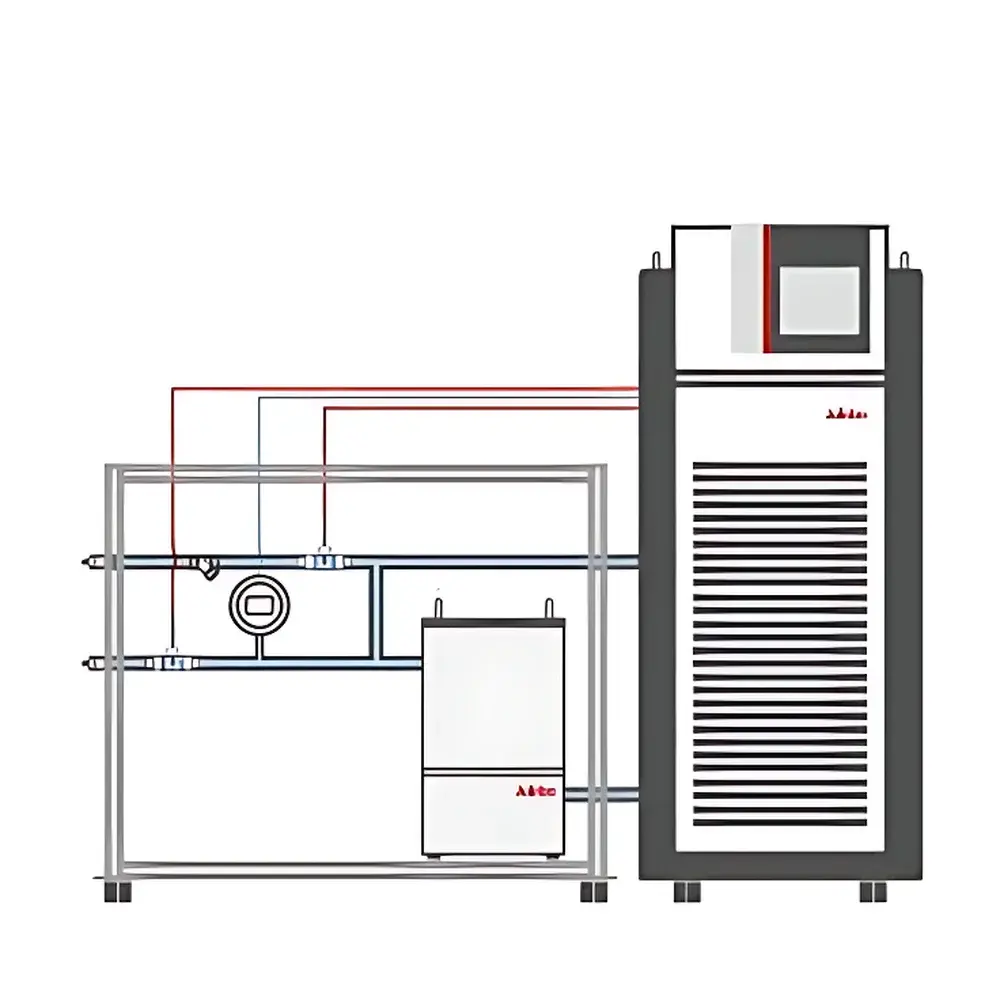
JULABO NEM Series Electric Motor Performance Test Bench
| Brand | JULABO |
|---|---|
| Origin | Germany |
| Model | NEM / NEM-50 / NEM-92 |
| Temperature Range | −20 to +90 °C (NEM-50) / −40 to +150 °C (NEM-92) |
| Flow Rate | 9–26 L/min |
| Temperature Stability | ±0.05 to ±0.1 °C (NEM-50) / ±0.05 to ±0.2 °C (NEM-92) |
| Display | 5.7″ TFT touchscreen, 0.01 °C resolution |
| Heating Power | 6 kW (NEM-50) / 12 kW (NEM-92) |
| Cooling Power @20 °C | 7.5 kW (NEM-50) / 25 kW (NEM-92) |
| Pump Flow | 35–76 L/min (NEM-50) / 26–80 L/min (NEM-92) |
| Pump Pressure | 0.48–3.2 bar (NEM-50) / 0.5–3.0 bar (NEM-92) |
| Compressor | Single-stage water-cooled (NEM-50) / Two-stage water-cooled (NEM-92) |
| Heat Exchanger | Not equipped (NEM-50) / Equipped (NEM-92) |
| Secondary Circulation Pump | Not equipped (NEM-50) / Equipped (NEM-92) |
| Heat Transfer Fluid | Antifreeze (Thermal HL60) |
| Dimensions (W×D×H) | 53×66.5×126 cm (NEM-50) / 95×127×190 cm (NEM-92) |
Overview
The JULABO NEM Series Electric Motor Performance Test Bench is a precision-engineered thermal management platform designed specifically for the dynamic characterization and validation of electric motors under controlled thermal-hydraulic conditions. Unlike generic temperature circulators, the NEM system integrates high-fidelity flow regulation, pressure modulation, and sub-degree temperature stability into a unified test environment—enabling rigorous evaluation of motor efficiency, thermal dissipation, winding insulation behavior, and coolant interface performance across operational duty cycles. Its architecture supports both steady-state mapping and transient thermal profiling, making it suitable for R&D labs developing traction motors for EVs, actuation systems for aerospace electromechanical actuators, and high-power industrial servo drives. The system operates on the principle of closed-loop thermofluidic control: a precisely metered antifreeze-based heat transfer fluid (Thermal HL60) is conditioned by a dual-mode refrigeration/heating circuit, then delivered at defined mass flow rate and pressure to the motor’s liquid cooling jacket or stator channeling. Real-time feedback from integrated flowmeters, pressure transducers, and PT100-sensed return-line temperatures enables synchronized thermal load application aligned with electrical input parameters.
Key Features
- 5.7-inch industrial-grade TFT color touchscreen with intuitive HMI for simultaneous monitoring and adjustment of temperature, flow rate, and pump pressure
- EHC (Enhanced Hierarchical Cooling) segmented impulse heat exchange technology—improves thermal ramp rates by up to 40% and extends compressor service life under cyclic load conditions
- ACC (Active Compression Control) dynamic refrigeration algorithm—maintains effective cooling capacity even at elevated setpoints (e.g., +130 °C), preventing thermal drift during high-power motor testing
- ICC (Intelligent Cascade Control) temperature regulation—achieves long-term stability of ±0.05 °C (NEM-50) and ±0.05 °C to ±0.2 °C (NEM-92) across full operating range
- Dual-range intelligent circulation pump with selectable constant-pressure or constant-flow modes—supports low-viscosity coolant delivery at 0.48–3.2 bar (NEM-50) or 0.5–3.0 bar (NEM-92)
- Hydraulically sealed fluid path compatible with ethylene-glycol-based antifreeze solutions—eliminates risk of corrosion or phase separation in extended-duration tests
- Multi-protocol communication interfaces (RS485, Ethernet, optional CAN bus)—enables seamless integration with motor drive test stands, DAQ systems, and PLC-based automation controllers
- Front-access operator zone with rear-mounted fluid and signal connections—optimizes lab space utilization and simplifies maintenance workflows
- Integrated inline particulate filter (≤5 µm retention)—protects motor cooling channels and internal heat exchangers from debris ingress
- Optional remote control module with timestamped parameter logging—supports audit-ready data capture compliant with GLP and internal QA protocols
Sample Compatibility & Compliance
The NEM series accommodates a broad spectrum of electric motor geometries and cooling architectures—including hairpin-wound traction motors, axial-flux prototypes, and modular stator assemblies with embedded microchannel coolers. Its flexible flow/pressure envelope allows emulation of OEM-referenced coolant specifications per ISO 6722-2 (automotive fluid compatibility) and SAE J1708 (heavy-duty vehicle thermal management). All models comply with CE marking requirements under the EU Machinery Directive 2006/42/EC and Electromagnetic Compatibility Directive 2014/30/EU. The system’s firmware supports configurable alarm thresholds and event-triggered data snapshots—facilitating alignment with IEC 61800-5-1 (adjustable speed electrical power drive systems) safety validation workflows. When deployed in regulated environments, optional 21 CFR Part 11-compliant software modules provide electronic signature support, audit trail generation, and role-based access control for test parameter configuration.
Software & Data Management
Standard operation utilizes JULABO’s proprietary NEM-Link control software, which provides real-time visualization of thermal-hydraulic variables alongside user-defined trend overlays (e.g., motor surface temperature vs. torque output). Export formats include CSV, XML, and HDF5—ensuring interoperability with MATLAB, Python-based analysis pipelines, and LabVIEW-based test automation frameworks. For enterprise deployment, optional integration with JULABO’s CloudConnect gateway enables secure remote diagnostics, predictive maintenance alerts based on compressor runtime analytics, and centralized firmware update distribution. All logged datasets retain native time synchronization (NTP-aligned timestamps) and are tagged with operator ID, test protocol version, and environmental ambient metadata—supporting traceability requirements in ISO/IEC 17025-accredited laboratories.
Applications
- Characterization of thermal resistance (Rth,jc) and transient thermal impedance (Zth) in permanent magnet synchronous motors (PMSMs)
- Validation of coolant flow distribution uniformity across multi-pass stator cooling manifolds
- Accelerated aging studies of insulation systems under combined thermal-electrical stress (IEC 60034-18-41)
- Development testing of bidirectional wireless charging coil thermal management subsystems
- Calibration of embedded motor temperature sensors against reference-grade PT100 measurements
- Dynamic thermal response analysis during regenerative braking duty cycles (SAE J2908)
- Verification of thermal shutdown logic in motor control units (MCUs) under fault-condition scenarios
FAQ
What types of electric motors can be tested on the NEM platform?
The NEM bench supports any liquid-cooled motor with standardized inlet/outlet porting (G1/4″ or M12x1.5), including IPM, SRM, and axial-flux configurations—provided coolant flow rates fall within the 9–26 L/min operational envelope.
Is Thermal HL60 the only approved heat transfer fluid?
While Thermal HL60 is factory-validated and recommended for optimal viscosity-temperature performance between −40 °C and +150 °C, alternative glycol-water blends meeting ASTM D3306 specifications may be used subject to prior compatibility verification with JULABO Technical Support.
Can the NEM system operate unattended for extended durations?
Yes—equipped with redundant safety interlocks (high-temp cutoff, low-flow shutoff, pressure relief), automatic leak detection via flow differential monitoring, and email/SNMP alerting, the NEM platform meets UL 61010-1 requirements for Class II continuous operation.
Does the NEM-92 model support cryogenic motor testing?
No—the NEM-92 achieves a minimum operating temperature of −40 °C, which is sufficient for most wide-bandgap semiconductor-integrated motor applications but not for superconducting motor R&D requiring sub-−100 °C environments.
How is calibration traceability maintained?
Each unit ships with a factory-issued calibration certificate traceable to PTB (Physikalisch-Technische Bundesanstalt), covering temperature sensors, pressure transducers, and Coriolis-type flow meters—valid for 12 months under normal usage conditions.




