
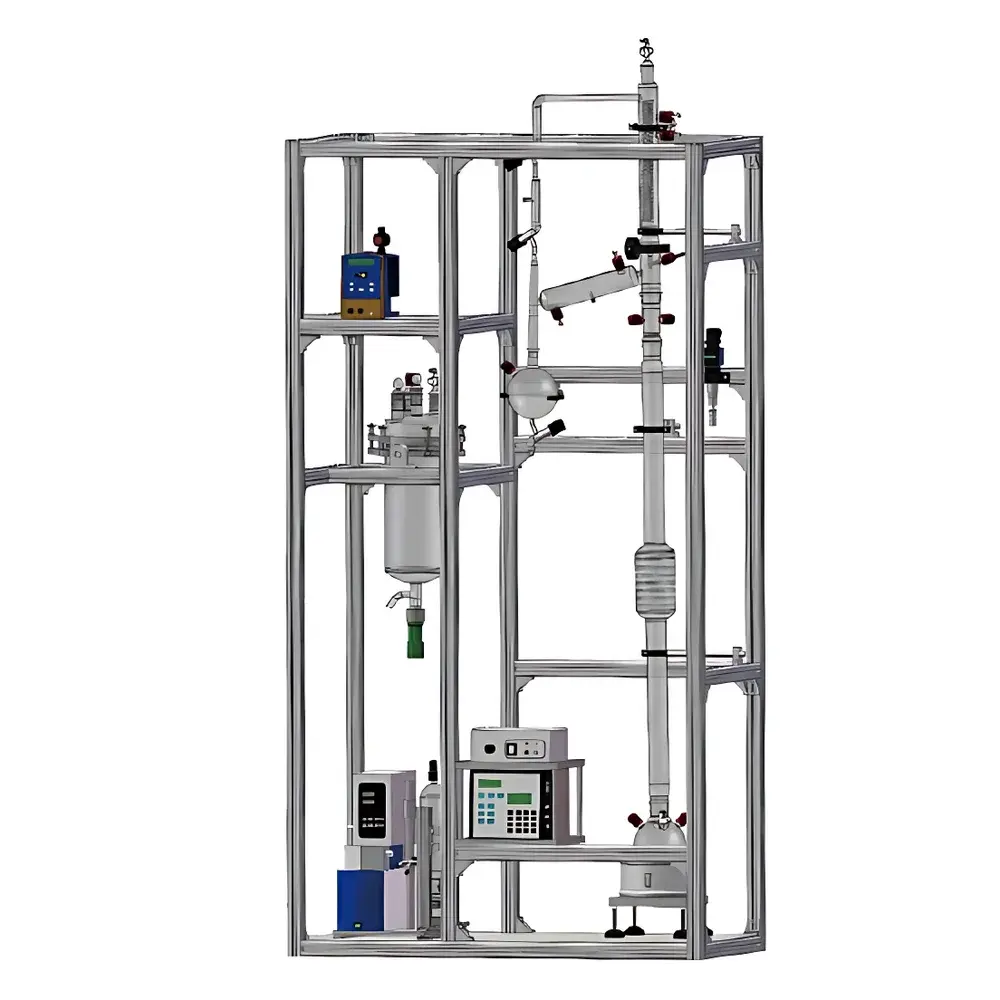
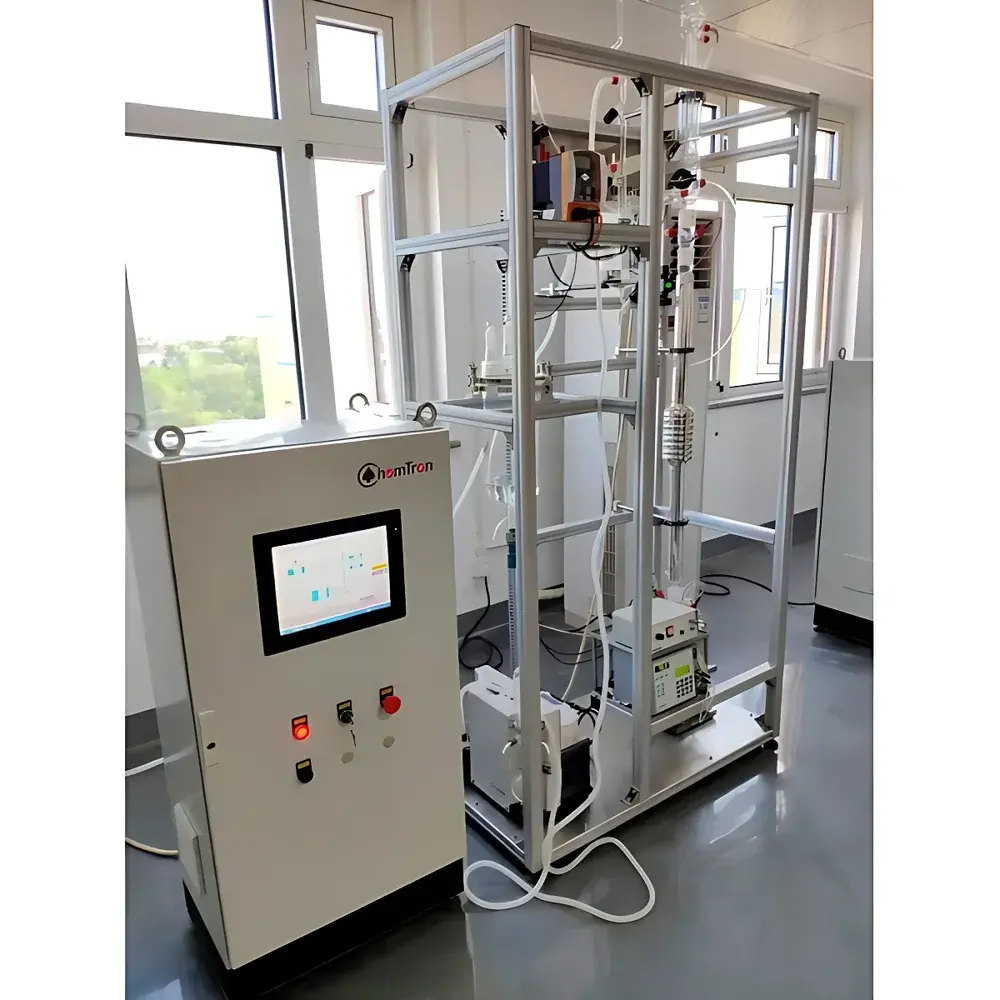
ChemTron Auto-Continuous Distillation & Fractional Distillation System
| Brand | ChemTron |
|---|---|
| Origin | Germany |
| Model | Auto-Continuous Distillation & Fractional Distillation System |
| Construction Material | Quartz Glass |
| Vacuum Performance | ≤10⁻⁶ mbar |
| Column Design | Vacuum-Silvered Double-Jacketed Column with Linear Observation Window and Thermal-Stress-Compensating Corrugated Expansion Section |
| Reflux Control | Programmable Electromagnetic Valve with PID-Controlled Reflux Ratio Setting |
| Automation Core | PLC-Based Control System Integrated with Quartz Fiber-Optic Level Sensor, Precision Temperature Sensors (Pt100), Absolute Vacuum Transducer, and Peristaltic Feed Pump |
| System Compliance | Designed for GLP/GMP-aligned lab environments |
Overview
The ChemTron Auto-Continuous Distillation & Fractional Distillation System is a fully integrated, vacuum-capable laboratory-scale separation platform engineered for high-fidelity fractional distillation under controlled thermal and pressure conditions. It operates on the fundamental principle of differential volatility—leveraging relative vapor pressure differences among components in a liquid mixture to achieve sequential phase equilibrium separation across a structured column. Unlike batch distillation, this system enables true continuous feed and fraction collection, supporting steady-state mass transfer analysis critical for process development, thermodynamic modeling, and scale-up studies. Its design targets applications where component relative volatility lies in the challenging range of 1.05–1.10—requiring high-efficiency theoretical plates, precise reflux management, and exceptional thermal stability to maintain column efficiency and reproducible separation profiles.
Key Features
- Vacuum-silvered double-jacketed distillation column achieving ultimate vacuum levels down to ≤10⁻⁶ mbar—eliminating external heating tapes or insulating wraps that induce axial temperature gradients and compromise vapor–liquid equilibrium fidelity.
- Linear borosilicate quartz observation window integrated along the column length, enabling real-time visual monitoring of vapor flow, liquid film formation, entrainment behavior, and foam dynamics without interrupting operation.
- Thermally compensated corrugated expansion segment at the column mid-section—absorbing differential thermal expansion between heated base and cooled upper zones, thereby preventing catastrophic fracture under rapid ramping or cooling cycles.
- Digital electromagnetic reflux valve with closed-loop PID control, permitting programmable reflux ratio setpoints from 0:100 (total withdrawal) to 100:0 (total reflux), with resolution ≤0.1% and repeatability ±0.3% over extended operation.
- Quartz fiber-optic liquid level sensor installed in reboiler and receiver vessels—immune to chemical corrosion, unaffected by foaming or emulsion layers, and delivering sub-millimeter level detection accuracy under full vacuum.
- Modular PLC-based control architecture with isolated I/O, calibrated Pt100 temperature sensors (Class A, ±0.15 °C), absolute capacitance-based vacuum transducers (0.001–1000 mbar range), and chemically resistant peristaltic feed pump (0.01–50 mL/min, pulseless flow).
Sample Compatibility & Compliance
The system accommodates thermally sensitive, high-boiling, and low-volatility organic and inorganic compounds—including pharmaceutical intermediates, fine chemicals, essential oils, polymer precursors, and petrochemical fractions—within operating temperature ranges up to 300 °C (reboiler) and ambient-to–40 °C (condenser). All wetted parts are constructed from high-purity quartz glass (ASTM D2298-compliant) and PTFE/FEP-lined stainless steel, ensuring minimal extractables and compatibility with aggressive solvents (e.g., chlorinated hydrocarbons, concentrated acids/bases). The system meets structural and operational requirements aligned with ISO 17025 calibration traceability frameworks and supports integration into FDA-regulated workflows when configured with 21 CFR Part 11–compliant software extensions, including electronic signatures, change control logs, and immutable audit trails for all critical parameters (temperature, pressure, reflux ratio, feed rate, fraction volume).
Software & Data Management
The embedded HMI interface provides intuitive graphical configuration of distillation protocols—including multi-step temperature ramps, dynamic reflux scheduling, automated fraction switching based on real-time temperature or level thresholds, and vacuum ramping profiles. Raw sensor data (time-stamped at 100 Hz) is logged internally and exportable via USB or Ethernet to CSV or HDF5 formats. Optional LabVIEW™-compatible drivers and OPC UA server enable bidirectional integration with LIMS, MES, or digital twin platforms. All control logic resides within the certified PLC firmware; no third-party runtime dependencies ensure deterministic response times and long-term validation stability—essential for GxP documentation and regulatory submission packages.
Applications
- Process R&D for API purification, solvent recovery, and chiral separation optimization in pharmaceutical manufacturing.
- Thermophysical property determination—including activity coefficients, VLE (vapor–liquid equilibrium) data acquisition, and stage-wise mass balance validation for simulation tools such as Aspen Plus® or CHEMCAD®.
- Teaching laboratories for unit operations courses—demonstrating McCabe–Thiele construction, minimum reflux calculation, total reflux operation, and column efficiency (HETP/HTU) measurement.
- Food & flavor chemistry—fractionation of volatile aroma compounds under mild vacuum to preserve heat-labile terpenes and lactones.
- Academic research on non-ideal mixtures, azeotrope breaking strategies, and reactive distillation kinetics.
FAQ
What vacuum level can the system achieve, and how is it maintained?
The system achieves and sustains vacuum levels ≤10⁻⁶ mbar using a turbomolecular pumping station backed by a dry scroll forepump, with active pressure regulation via feedback-controlled throttle valve and real-time compensation for outgassing.
Is the column jacketed for both heating and cooling?
No—the silvered double jacket is exclusively for thermal insulation under high vacuum; heating is applied solely to the reboiler and column base via precision-wound heating sleeves, while condensation occurs in an actively chilled head with dual-stage Peltier elements.
Can the system operate unattended overnight?
Yes—fully autonomous operation is supported via preloaded protocols, hardware interlocks (overtemperature, overpressure, low coolant flow), and alarm-triggered safe shutdown sequences compliant with IEC 61508 SIL1 requirements.
Are custom column packings or trays available?
Standard configurations include structured stainless steel gauze packing (surface area: 250 m²/m³); optional alternatives include glass helices, Raschig rings, or custom-designed plate trays—each characterized for HETP and pressure drop prior to delivery.
Does the system support ASTM or ISO standard test methods?
While not certified to a single monolithic standard, its architecture satisfies functional requirements of ASTM D86, D1078, ISO 3405, and USP , and raw data output formats align with ASTM E1394 for instrument data interchange.



