
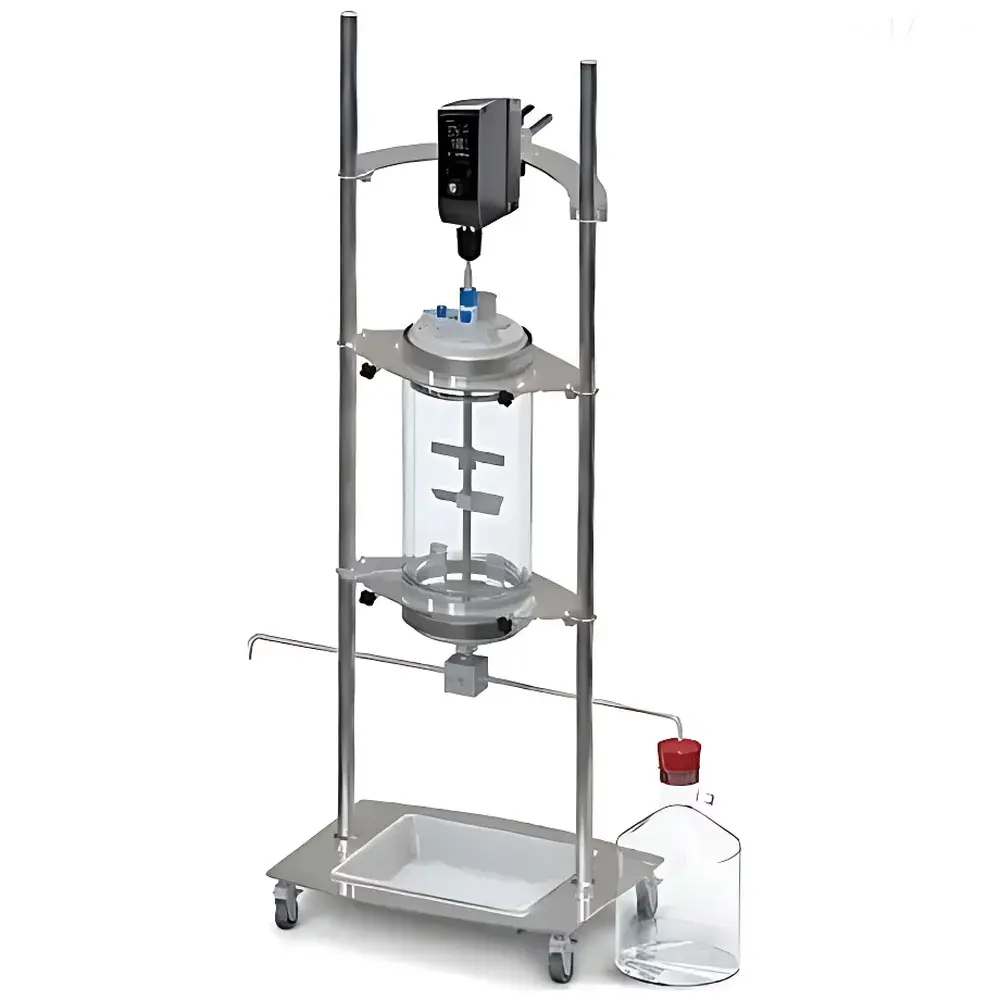
ChemTron VFR / PFR Glass Filtration Reactor
| Brand | ChemTron |
|---|---|
| Origin | Germany |
| Model | VFR / PFR |
| Construction Material | Borosilicate Glass (Duran®) |
| Maximum Operating Pressure | 35 psig (2.4 bar) |
| Temperature Control | Jacketed (optional) |
| Filtration Modes | Vacuum Filtration (VFR) & Pressure Filtration (PFR) |
| Available Volumes | 150 mL – 6000 mL |
| Sealing System | ACE SAFE™ threaded connections with dual O-ring seals |
| Filter Support Options | PTFE adapters, sintered glass discs, PE/PTFE rings, custom configurations |
| Compliance | Designed for GLP/GMP-aligned laboratory workflows |
Overview
The ChemTron VFR / PFR Glass Filtration Reactor is an engineered modular synthesis platform that integrates reaction, mixing, temperature control, and solid–liquid separation into a single borosilicate glass vessel. Unlike conventional batch reactors requiring post-reaction transfer to external filtration units, this system embeds the filtration interface directly at the reactor base—enabling in-situ vacuum or pressure-driven filtration without breaking containment. The core architecture leverages Duran® 3.3 borosilicate glass for chemical inertness, thermal shock resistance (up to ΔT = 150 °C), and optical clarity for real-time process monitoring. Its ACE SAFE™ threaded interface—featuring dual concentric O-rings at both flange and filter adapter junctions—ensures leak-tight operation across full vacuum (≤1 mbar) and positive pressure (up to 35 psig / 2.4 bar), eliminating cross-contamination risks and minimizing solvent exposure during solid isolation.
Key Features
- Integrated Filtration Architecture: Bottom-mounted filter support with precision-machined recessed seating ensures full active area utilization (>95% disc coverage) while preventing lateral displacement or channeling under differential pressure.
- Dual-Mode Operation: Configurable as either vacuum filtration reactor (VFR) or pressure filtration reactor (PFR) via interchangeable ACE SAFE™ bottom adapters—eliminating need for separate equipment sets.
- Jacketed Thermal Management: Optional double-wall jacket design circulates heat transfer fluid uniformly across both reaction and filtration zones, maintaining isothermal conditions during crystallization or hot filtration to prevent premature solid deposition or clogging.
- Modular Mechanical Seal Assembly: PTFE/PEEK composite bearings and precision-ground shafts deliver low-torque, high-cycle stirring performance with zero leakage—even under sustained vacuum or pressure—supporting reproducible mass transfer and suspension homogeneity.
- ACE SAFE™ Interchangeability: All threaded interfaces (flange-to-body, adapter-to-filter, valve-to-adapter) conform to standardized ACE SAFE™ specifications—ensuring rapid, tool-free assembly/disassembly without height recalibration or torque-sensitive alignment.
- Customizable Filter Support & Media: Supports sintered glass (pore sizes: 10–100 µm), polyethylene, cellulose, and specialty membranes; PTFE adapters available with bottom or side discharge ports, each fitted with chemically resistant PTFE stopcocks (¼” NPT).
Sample Compatibility & Compliance
The reactor accommodates heterogeneous catalytic reactions, crystallization processes, Grignard syntheses, hydrogenations, and multi-step sequences involving intermediate isolations. Its all-glass wetted path—free of metal gaskets, elastomeric seals in contact with process media, or leachable components—meets stringent requirements for pharmaceutical intermediates, fine chemicals, and academic research where trace metal contamination must be avoided. The system supports compliance with ISO 7207-1 (filtration integrity testing), ASTM E2656 (laboratory reactor safety standards), and FDA 21 CFR Part 11 when integrated with validated ChemTron CRS software (audit trail, electronic signatures, parameter locking). All glass components are certified to DIN ISO 3585 and ASTM E438 Type I, Class A specifications.
Software & Data Management
When paired with the optional ChemTron CRS6384/6386 control platform, the reactor enables centralized orchestration of stirring speed (0–300 rpm), jacket temperature (−20 °C to +200 °C), internal pressure/vacuum (±0.01 bar resolution), and torque monitoring. Real-time data logging records time-stamped profiles for temperature vs. time, pressure vs. time, RPM vs. torque, and filtration rate (mL/min), exportable in CSV or PDF formats compliant with GLP documentation standards. The software includes configurable alarm thresholds, automated hold steps, and event-triggered actions (e.g., pause stirring upon reaching target vacuum level), supporting repeatable SOP execution and regulatory audit readiness.
Applications
- Continuous crystallization with in-line solid isolation and mother liquor recycling
- Catalyst recovery in asymmetric hydrogenation or cross-coupling reactions
- Hot gravity filtration of thermally labile compounds without cooling-induced precipitation
- Multi-step synthesis with intermediate work-up (e.g., quench → neutralization → filtration → re-dissolution)
- Process analytical technology (PAT) integration via inline probes (pH, FTIR, Raman) mounted through standard 14/20 or 24/40 ports
- Scale-down modeling for API manufacturing—matching geometry, surface-to-volume ratio, and filtration dynamics of pilot-scale vessels
FAQ
What is the maximum allowable working pressure for the VFR/PFR series?
The reactor body is rated for continuous operation up to 35 psig (2.4 bar) at 20 °C, per EN 13445-3 and ASME BPVC Section VIII Div. 1 equivalency validation.
Can sintered glass filters be autoclaved?
Yes—Duran® sintered glass discs are autoclavable at 121 °C for 20 minutes; however, repeated steam sterilization may reduce long-term pore uniformity and is not recommended for sub-10 µm grades.
Is the jacket connection compatible with standard circulators?
Yes—the 28/15 O-ring groove inlet/outlet ports accept industry-standard quick-connect fittings; flow direction is tangential to maximize thermal exchange efficiency and minimize dead volume.
How is filter disc retention ensured during high-torque stirring?
A precision-machined annular ridge on the internal filter support plate engages the outer perimeter of the disc, while the ACE SAFE™ adapter applies axial preload—preventing lift-off even at 300 rpm with viscous slurries.
Are replacement parts traceable to manufacturing lot numbers?
Yes—each component (O-rings, adapters, stirrers) carries a laser-etched serial number linked to raw material certifications, dimensional inspection reports, and pressure test records per ISO 9001:2015.



