
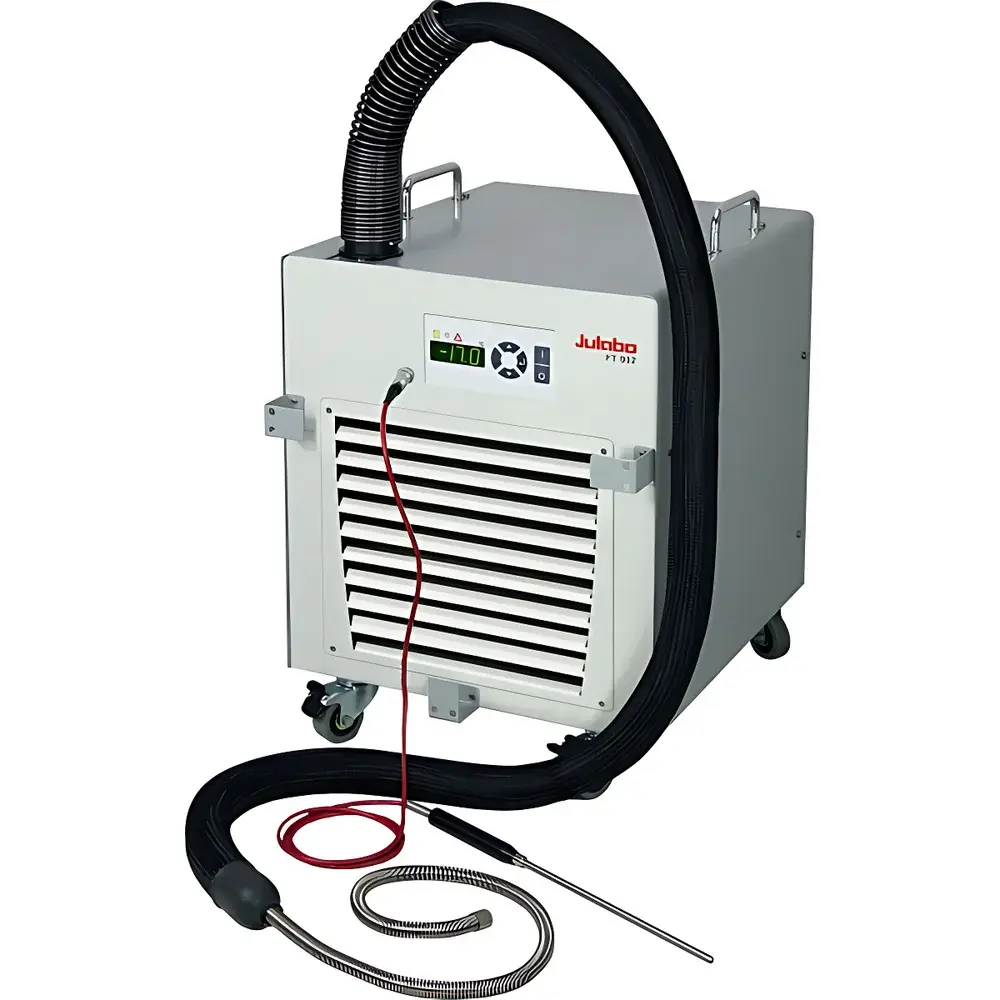
Julabo FT902 Immersion Cooling Circulator
| Brand | Julabo |
|---|---|
| Origin | Germany |
| Model | FT902 |
| Temperature Range | −90 °C to +30 °C |
| Temperature Stability | ±1 °C |
| Temperature Resolution | 0.1 °C |
| Cooling Power (at −80 °C) | 0.071 kW |
| Cooling Power (at 20 °C) | 0.3 kW |
| Refrigerant System | Two-stage cascade (R404A / R23) |
| Refrigerant Charge | 310 g R404A + 65 g R23 |
| GWP (R404A) | 3922 |
| GWP (R23) | 14800 |
| Ambient Operating Temperature | 5–35 °C |
| Dimensions (W×L×H) | 38 × 55 × 60 cm |
| Weight | 50 kg |
| Immersion Probe | Stainless steel, Ø6 mm × 200 mm, with 1.5 m PT100 cable |
| Cooling Head Dimensions | 65 × 1.5 cm (L × Ø) |
| Hose Length | 160 cm |
| Cooling Method | Air-cooled compression |
Overview
The Julabo FT902 Immersion Cooling Circulator is a high-performance, two-stage cascade refrigeration system engineered for precise, stable, and rapid low-temperature control in laboratory and pilot-scale applications. Unlike conventional bath circulators, the FT902 employs an immersion-type cooling head that delivers full refrigeration capacity directly into the target fluid—eliminating thermal lag and maximizing heat transfer efficiency. Its dual-refrigerant cascade architecture (R404A for the high-stage and R23 for the low-stage) enables sustained operation down to −90 °C, making it suitable for cryogenic process simulation, low-temperature reaction quenching, superconductivity testing, and solvent crystallization studies where dry ice or liquid nitrogen alternatives are required but impractical due to handling, safety, or reproducibility constraints. The unit operates independently or in tandem with Julabo heating circulators (e.g., HL series) to establish bidirectional temperature control across extended ranges—including sub-ambient setpoints without external chillers.
Key Features
- Two-stage cascade refrigeration system enabling stable operation from −90 °C to +30 °C with ±1 °C temperature stability
- Digital PID temperature controller with 0.1 °C resolution and LED display; factory-calibrated for traceable accuracy
- Stainless-steel immersion probe (Ø6 mm × 200 mm) with integrated PT100 sensor (1.5 m shielded cable) included as standard
- Air-cooled condenser design—no external water supply or chiller required; suitable for standard laboratory environments (5–35 °C ambient)
- Compact footprint (38 × 55 × 60 cm) and modular immersion head (65 × 1.5 cm) optimized for integration into reactors, jacketed vessels, and custom manifolds
- Refrigerant charge fully documented per F-Gas Regulation (EU No. 517/2014); R404A (310 g) and R23 (65 g) volumes and CO₂-equivalent impact (2.178 t CO₂-eq total) provided for environmental compliance reporting
Sample Compatibility & Compliance
The FT902 is compatible with a broad range of heat-transfer fluids including silicone oils, ethylene glycol/water mixtures, and low-viscosity hydrocarbon solvents—provided they remain pumpable and non-corrosive at operating temperatures. Its stainless-steel wetted parts (cooling head, internal tubing, and pump housing) ensure chemical resistance and long-term integrity under repeated thermal cycling. The unit conforms to IEC 61010-1:2010 for electrical safety in laboratory equipment and meets CE marking requirements for electromagnetic compatibility (EMC Directive 2014/30/EU). While not intrinsically rated for hazardous areas, its sealed refrigeration circuit and absence of open cryogen handling align with OSHA 1910.120 and ISO 13857 safety principles for operator protection. Documentation supports GLP-compliant validation protocols, including IQ/OQ templates and calibration traceability to national standards (DKD/DAkkS-accredited reference sensors available upon request).
Software & Data Management
The FT902 operates autonomously via its front-panel interface but supports optional analog (0–10 V / 4–20 mA) and digital (RS232) communication ports for integration into centralized lab control systems (e.g., LabVIEW, DeltaV, or SCADA). Julabo’s optional ComPacT software enables remote monitoring, real-time data logging (timestamped temperature, setpoint, alarm status), and export to CSV or Excel formats. Audit trail functionality—compliant with FDA 21 CFR Part 11 requirements when deployed with user authentication and electronic signature modules—supports regulated QC/QA workflows in pharmaceutical, biotech, and materials science laboratories.
Applications
- Cryogenic reaction control in organic synthesis (e.g., lithiation, Grignard quenching, low-T Diels–Alder)
- Thermal conditioning of spectroscopic cells (FTIR, UV-Vis) and detector housings requiring sub-zero stabilization
- Calibration of low-temperature sensors and thermocouples per ASTM E220 and ISO/IEC 17025
- Material property testing: coefficient of thermal expansion (CTE), glass transition (Tg) determination, and mechanical hysteresis analysis
- Process development for freeze-drying cycle optimization and cryopreservation media evaluation
- Replacement of dry ice baths in analytical sample preparation (e.g., LC-MS autosampler cooling, GC injector chilling)
FAQ
What is the lowest temperature achievable with the FT902 under continuous operation?
The FT902 maintains −90 °C at the immersion probe tip under nominal load conditions (e.g., 1 L of silicone oil, no external heat input). Sustained performance at this limit requires ambient temperature ≤25 °C and adequate ventilation.
Can the FT902 be used with flammable solvents?
Only non-flammable, thermally stable heat-transfer media meeting Julabo’s viscosity and vapor pressure specifications (e.g., Dow Corning PMX-200 series oils) are approved. Direct use with acetone, ether, or THF is prohibited due to flash point and compatibility risks.
Is external temperature feedback required for accurate control?
No—the integrated PT100 sensor is standard and provides direct measurement at the immersion point. External sensor inputs are optional for secondary loop monitoring or cascade control configurations.
How often does the refrigeration system require maintenance?
Under normal laboratory use, compressor oil and filter inspection is recommended every 24 months; refrigerant leak checks should be performed annually per F-Gas Regulation Article 4. Full service intervals depend on cumulative runtime and ambient dust exposure.
Does the FT902 support validation documentation for GMP environments?
Yes—Julabo provides IQ/OQ protocol templates, factory calibration certificates (traceable to PTB), and optional 21 CFR Part 11-compliant software packages with electronic signatures and audit trail generation.



