
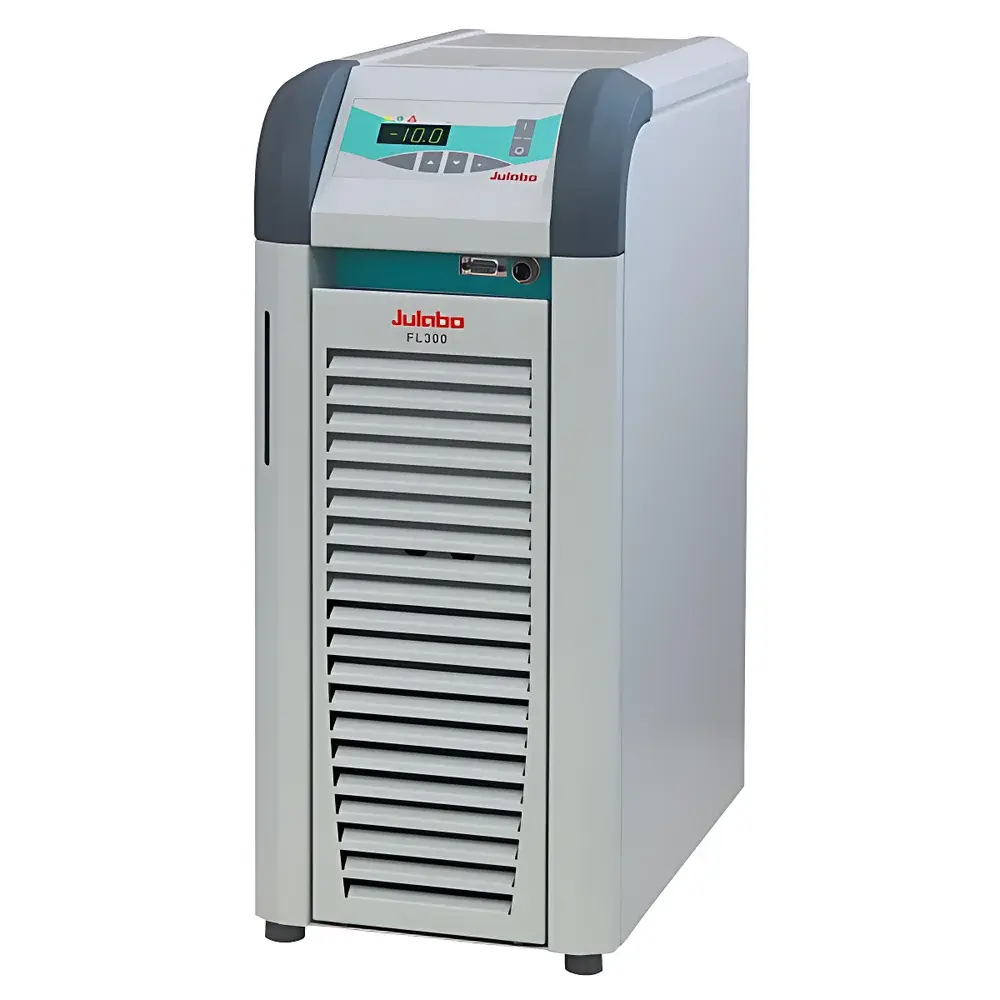
Julabo FL300 Circulating Chiller
| Brand | Julabo |
|---|---|
| Origin | Germany |
| Model | FL300 |
| Cooling Type | Air-Cooled |
| Temperature Range | -20 to +40 °C |
| Cooling Capacity | 300 W at 20 °C |
| Temperature Stability | ±0.5 °C |
| Pump Flow Rate | 15 L/min |
| Pump Pressure | 0.35 bar |
| Reservoir Volume | 4.5 L |
| Operating Mode | Continuous |
| Refrigerant | R134a (GWP = 1430) |
| Compressor | Single-Stage |
| Communication Interface | RS232 (optional), Profibus (optional) |
| Ambient Operating Temperature | 5–40 °C |
| Dimensions (W×L×H) | 25 × 50 × 60 cm |
| Weight | 39 kg |
| Sound Pressure Level (1 m) | 55 dBA |
| Fluid Compatibility | Water, Ethylene Glycol/Water Mixtures, JULABO Thermal Bath Fluids |
| Max. Return Fluid Temperature | ≤80 °C |
| Hose Connections | Dual conical fittings (ID 8 mm & 12 mm), M16×1 male thread pump ports |
Overview
The Julabo FL300 Circulating Chiller is a compact, air-cooled, single-stage refrigeration system engineered for precise temperature control and reliable heat removal in laboratory-scale applications. Based on vapor-compression thermodynamics using R134a refrigerant, the FL300 maintains stable bath temperatures from –20 °C to +40 °C with a maximum cooling capacity of 300 W at 20 °C ambient. Its integrated circulation pump delivers up to 15 L/min at 0.35 bar pressure, enabling efficient thermal coupling with external equipment such as spectrophotometers, laser sources, rotary evaporators, or analytical detectors. Designed to replace wasteful tap-water cooling, the FL300 reduces water consumption while delivering consistent thermal performance under continuous operation. Its sealed refrigeration circuit, low-noise compressor (55 dBA at 1 m), and robust stainless-steel reservoir comply with ISO 14001 environmental design principles and support sustainable lab infrastructure.
Key Features
- Air-cooled, single-stage R134a refrigeration system with no external water supply required, eliminating risk of leaks, scaling, or municipal water dependency.
- Precise temperature control with stability of ±0.5 °C across the full operating range (–20 to +40 °C) and 0.1 °C digital resolution via LED display.
- High-flow, low-pulsation circulation pump (15 L/min, 0.35 bar) featuring dual hose ports with interchangeable conical fittings (ID 8 mm and 12 mm) and M16×1 male-thread connections.
- 4.5 L stainless-steel reservoir with integrated level indicator and corrosion-resistant internal coating compatible with water, ethylene glycol/water mixtures (up to 50 vol%), and JULABO Thermal bath fluids.
- Extended return fluid tolerance: accepts inlet fluid temperatures up to 80 °C—enabling safe integration with exothermic processes or high-temperature reactors.
- Optional digital communication interfaces (RS232 and Profibus) support remote monitoring, automated logging, and integration into centralized lab management systems compliant with GLP/GMP data integrity requirements.
- Compact footprint (25 × 50 × 60 cm) and 39 kg mass facilitate benchtop or under-bench installation without structural reinforcement.
Sample Compatibility & Compliance
The FL300 is validated for use with aqueous and glycol-based heat transfer media commonly employed in analytical instrumentation cooling loops. It meets IEC 61010-1:2010 safety standards for laboratory electrical equipment and complies with EU RoHS Directive 2011/65/EU and REACH Regulation (EC) No. 1907/2006. Its R134a refrigerant charge (133 g) yields a CO₂-equivalent emissions impact of 0.19 t—calculated per EN 378-1:2016—making it suitable for institutions tracking Scope 1 refrigerant-related emissions. The unit operates within ambient conditions of 5–40 °C and requires no special ventilation beyond standard lab airflow. All wetted parts are chemically inert to common solvents and non-oxidizing coolants, ensuring long-term compatibility with HPLC column ovens, NMR probe coolers, and vacuum pump jackets.
Software & Data Management
When equipped with the optional RS232 interface, the FL300 supports ASCII-based command protocols for bidirectional communication with host PCs or PLCs. Temperature setpoints, real-time bath readings, pump status, and alarm conditions (e.g., low-level, overtemperature, compressor fault) can be logged at user-defined intervals. Data export formats include CSV and tab-delimited text, facilitating traceability in regulated environments. While the FL300 does not natively support FDA 21 CFR Part 11 electronic signature functionality, its audit-ready event log—when paired with validated third-party SCADA or LIMS software—meets ALCOA+ data integrity criteria for QC/QA laboratories operating under ISO/IEC 17025 or USP guidelines.
Applications
- Cooling of UV-Vis and FTIR spectrometers requiring stable detector temperature to minimize dark-current drift.
- Thermal regulation of laser diodes and solid-state amplifiers where wavelength stability depends on junction temperature control.
- Condenser cooling for rotary evaporators processing heat-sensitive compounds below 40 °C.
- Temperature stabilization of electrophoresis power supplies and gel imaging systems during extended runs.
- Supporting cryogenic sample preparation workflows when paired with external heat exchangers or Peltier modules.
- Integration into modular synthesis platforms where multiple instruments share a centralized coolant loop.
FAQ
What is the maximum allowable inlet fluid temperature?
The FL300 accepts return fluid at temperatures up to 80 °C—significantly higher than typical chiller specifications—allowing safe operation with warm process streams.
Can the FL300 operate continuously for 24/7 applications?
Yes. It is rated for uninterrupted duty cycle under ambient conditions between 5–40 °C and requires only periodic visual inspection of reservoir level and condenser coil cleanliness.
Is glycol mixture concentration limited?
Ethylene glycol/water solutions up to 50% v/v are supported; higher concentrations may reduce heat transfer efficiency and increase viscosity beyond pump design limits.
Does the unit include dry-run protection?
Yes. Integrated flow and level sensors trigger automatic pump shutdown if circulation is obstructed or reservoir volume falls below operational minimum.
How is temperature calibration verified?
The factory calibration is traceable to PTB (Physikalisch-Technische Bundesanstalt) standards. Users may perform field verification using a NIST-traceable reference thermometer immersed in the reservoir.
Related Products



