
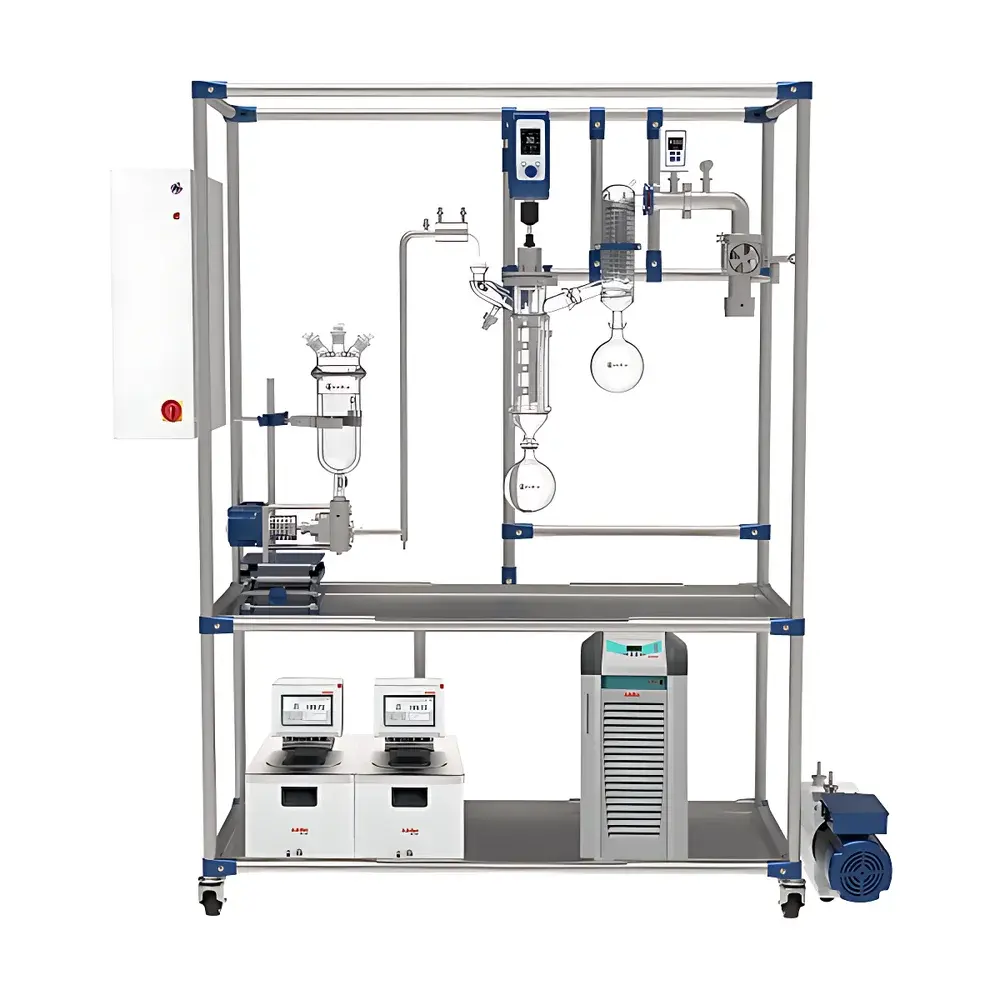
ChemTron MD52 Molecular Distillation System with Thin-Film Evaporation Capability
| Brand | ChemTron |
|---|---|
| Origin | Germany |
| Model | MD52/TF40 |
| Effective Evaporation Area | 0.052 m² |
| Evaporator Internal Diameter | 100 mm |
| Condensing Area | 0.08 m² |
| Feed Capacity | 1 L/h (typical) |
| Max. Feed Viscosity | 5000 cP |
| Operating Pressure Range | Down to 0.001 mbar (0.1 Pa) |
| Heating Temperature Range | Up to 350 °C |
| Wiper Speed | 60–500 rpm |
| Material of Construction | DIN 1.4571 (316Ti stainless steel) & Schott Duran® 3.3 borosilicate glass |
Overview
The ChemTron MD52 Molecular Distillation System is a high-vacuum, short-path distillation platform engineered for the gentle, high-efficiency separation and purification of thermally labile, high-boiling, or highly viscous compounds. Unlike conventional batch or fractional distillation, the MD52 operates on the principle of molecular distillation—where separation occurs under ultra-high vacuum (as low as 0.001 mbar), minimizing mean free path distances between evaporator and condenser surfaces (<10 mm). This enables vapor molecules to travel unimpeded from the heated film surface to the cooled condensing surface without intermolecular collisions, thereby preserving structural integrity of sensitive actives such as polyunsaturated fatty acids (EPA/DHA), cannabinoids (CBD), tocopherols, sterols, and pharmaceutical intermediates. The system integrates a rotating wiper-driven thin-film evaporator with an in-line, internal condenser—ensuring residence times under 30 seconds and negligible thermal degradation. Its modular architecture supports both molecular distillation and conventional thin-film evaporation modes, making it adaptable across R&D, pilot-scale process development, and GLP-compliant purification workflows.
Key Features
- Ultra-high vacuum capability down to 0.001 mbar (0.1 Pa), achieved via optional oil diffusion pump + cold trap configuration
- Rotating wiper system with adjustable speed (60–500 rpm) and optimized geometry for uniform, turbulent film formation—even at viscosities up to 5000 cP
- Evaporation surface area of 0.052 m² with 100 mm internal diameter; precision-machined 1.4571 (316Ti) stainless steel and Schott Duran® 3.3 glass construction for chemical inertness and thermal stability
- Integrated internal condenser (0.08 m² active area) positioned <15 mm from evaporator surface—minimizing pressure drop and enabling true short-path operation
- Modular heating options: thermostatic oil baths (up to 300 °C, ±0.01 °C stability) or water bath (up to 100 °C, ±0.05 °C stability)
- Dual-mode operation: selectable between molecular distillation (sub-0.01 mbar) and thin-film evaporation (1–10 mbar) configurations
- Vacuum-integrated feed and collection modules—including continuous gear-pump dosing, S-loop refill capability, and fractionated three-way collector with vacuum-retaining valve actuation
Sample Compatibility & Compliance
The MD52 is validated for processing heat-sensitive, oxidizable, and polymerizable materials including natural extracts (e.g., fish oil, lanolin, botanical concentrates), synthetic polymers (e.g., PTMEG, polyacrylates), pharmaceutical intermediates (e.g., caprolactam, BDO, isocyanate prepolymers), and agrochemical actives. All wetted parts comply with USP Class VI and FDA 21 CFR Part 177 requirements for food- and pharma-contact applications. The system supports full traceability under GLP and GMP frameworks: vacuum setpoints, temperature profiles, wiper speed, and feed rates are logged with timestamped audit trails. Optional integration with ChemTron’s LabControl™ software enables 21 CFR Part 11–compliant electronic signatures, role-based access control, and data integrity validation per ALCOA+ principles.
Software & Data Management
The MD52 is compatible with ChemTron LabControl™ v4.2—a dedicated process orchestration suite for vacuum thermal separation systems. It provides real-time monitoring of vacuum level (via Pirani/capacitance manometer), evaporator wall temperature (Pt100 RTD), condenser temperature (dual-sensor redundancy), wiper rotational frequency, and feed rate (pulse-counted gear pump output). All parameters are recorded at user-defined intervals (1–60 s) into encrypted SQLite databases with SHA-256 checksums. Export formats include CSV, PDF report templates (ASTM D6304, ISO 11348), and direct integration with LIMS via OPC UA or REST API. Optional remote diagnostics and predictive maintenance alerts (e.g., wiper motor current drift, vacuum leak detection) are supported through secure TLS 1.3 cloud gateway.
Applications
- Lipid & nutraceutical refining: EPA/DHA concentration from fish oil; removal of pesticides and PCBs from edible oils; tocopherol and β-carotene enrichment; phospholipid dehydration
- Pharmaceutical & biotech: Purification of CBD and minor cannabinoids; isolation of thermolabile APIs; solvent removal from peptide synthesis residues; monomer recovery from polymerization effluents
- Flavor & fragrance: Terpene fractionation from citrus oils; deodorization of tobacco extracts; isolation of heat-labile aroma compounds (e.g., linalool, citral)
- Polymer & specialty chemicals: Fractionation of Fischer–Tropsch waxes; purification of silicone oligomers; removal of residual monomers (e.g., HDI, MDI) from polyurethane prepolymers
- Recycling & circular chemistry: Reclamation of spent transformer oil, glycerol from biodiesel production, and pharmaceutical mother liquors
FAQ
What distinguishes molecular distillation from standard thin-film evaporation?
Molecular distillation operates at pressures below 0.01 mbar, where mean free path exceeds the evaporator–condenser gap—enabling collisionless vapor transport and near-zero thermal stress. Thin-film evaporation typically runs at 1–10 mbar and relies on enhanced convection rather than free-molecule flow.
Can the MD52 handle crystallizing or fouling feedstocks?
Yes—the wiper design continuously renews the liquid film and prevents boundary layer buildup. Combined with precise temperature zoning and high-turbulence film dynamics, it mitigates scaling even with sterol-rich or wax-containing feeds.
Is the system compliant with FDA 21 CFR Part 11 for electronic records?
When configured with LabControl™ software, audit trail logging, electronic signatures, and role-based permissions, the MD52 meets all technical and procedural requirements of 21 CFR Part 11 for regulated environments.
What vacuum level is required for effective CBD purification?
Typical CBD molecular distillation requires ≤0.002 mbar to achieve sufficient volatility differential between cannabinoids and chlorophyll/wax residues while maintaining <60 °C bulk temperature.
How is calibration traceability maintained for temperature and vacuum sensors?
All Pt100 RTDs and capacitance manometers are supplied with NIST-traceable calibration certificates (ISO/IEC 17025 accredited). Field verification protocols and auto-zero routines are embedded in LabControl™ firmware.
Related Products



