
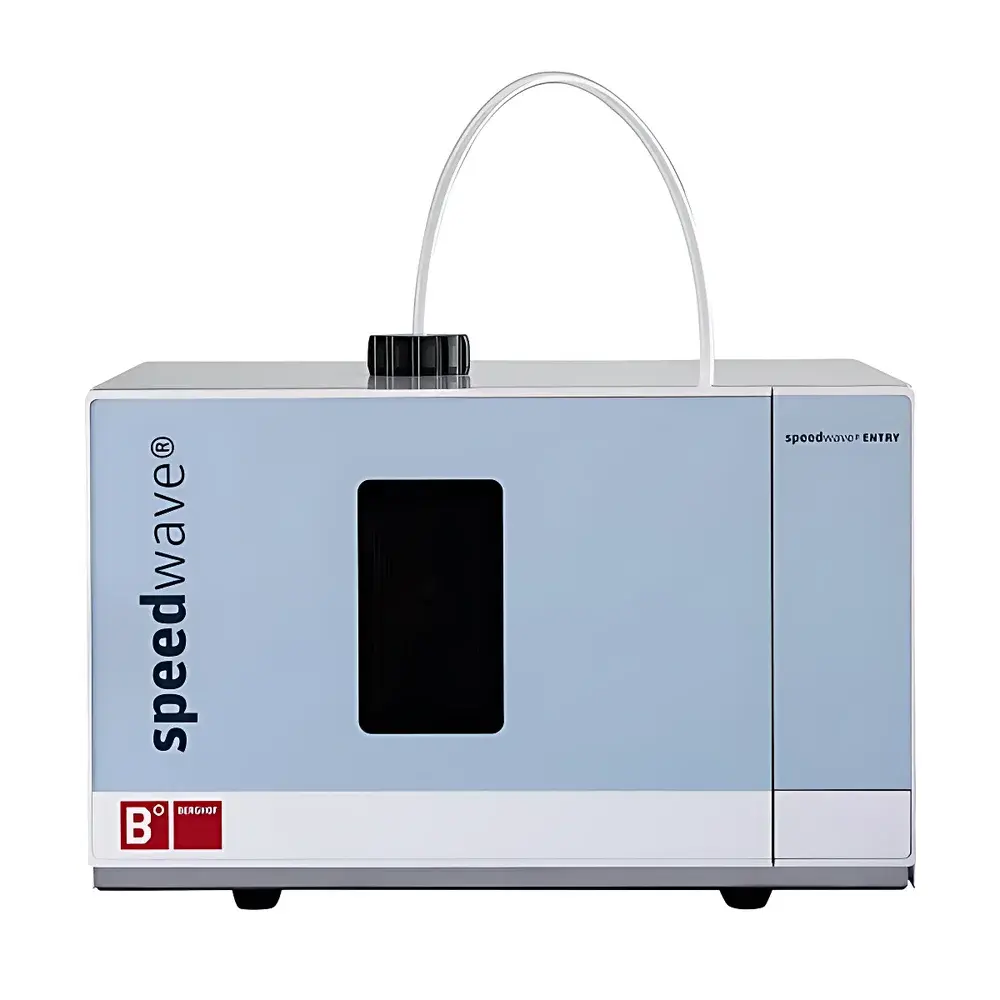
Berghof Speedwave ENTRY Microwave Digestion System
| Brand | ChemTron |
|---|---|
| Origin | Germany |
| Model | Berghof Speedwave ENTRY |
| Cavity Class | Industrial-grade |
| Sample Capacity | 24 vessels |
| Microwave Source | Dual magnetron |
| Max Temperature | 230 °C |
| Max Pressure | 75 bar |
| Microwave Power | 1000 W |
| Temperature Range | 75–260 °C |
| Cavity Volume | 32 L (355 × 365 × 251 mm W×D×H) |
| Vessel Types | DAP-60K (60 mL, 40 bar, 230 °C, 10-position rotor) & DAQ-10 (10 mL, 75 bar, 230 °C, 24-position rotor) |
| Temperature Monitoring | Non-contact infrared (DIRC optical sensing), real-time per-vessel measurement |
| Dimensions (Main Unit) | 510 × 470 × 330 mm (W×D×H) |
| Weight (Main Unit) | ~22 kg |
| Interface | USB, RS232 |
| Ventilation | Continuous active cavity ventilation with external fume exhaust option |
Overview
The Berghof Speedwave ENTRY Microwave Digestion System is an industrial-grade, front-loading microwave platform engineered for reproducible, high-throughput sample preparation in regulated analytical laboratories. Designed and manufactured in Germany by Berghof—now distributed globally by ChemTron—the system implements controlled microwave energy delivery via dual magnetron technology to achieve rapid, uniform thermal decomposition of solid and semi-solid matrices. Its core operational principle relies on dielectric heating of polar molecules (e.g., HNO₃, HCl, HF) under pressurized conditions, enabling complete mineralization of organic matter and dissolution of inorganic lattices while preserving analyte integrity. Unlike conventional single-point temperature monitoring systems, the Speedwave ENTRY integrates Berghof’s proprietary DIRC (Direct Infrared Control) optical sensing technology, which measures vessel internal temperature non-invasively and independently for every sample position—eliminating thermal lag and reference-vessel bias. This architecture supports method robustness across diverse sample types and ensures compliance with ISO/IEC 17025, ASTM D5511, and EPA Method 3052 requirements for trace metal analysis.
Key Features
- Dual-magnetron microwave generation: Delivers stable 1000 W output with precise power modulation, minimizing hot-spot formation and ensuring homogeneous energy distribution across the 32 L rectangular cavity.
- DIRC optical temperature monitoring: Real-time, contactless infrared measurement of internal temperature in all vessels simultaneously—no thermocouples, no calibration drift, no cross-contamination risk.
- Tool-free vessel handling: Front-access design enables rapid loading/unloading of rotors; DAP-60K (10-position) and DAQ-10 (24-position) rotors accommodate 60 mL and 10 mL TFM-PTFE vessels respectively.
- Industrial-grade cavity construction: Electro-polished stainless-steel chamber with continuous forced-air ventilation; optional external fume extraction compatible with HF/HCl applications.
- High-durability consumables: TFM-PTFE DAP-60K vessels rated for up to 10,000 digestion cycles; DAQ-10 quartz liners provide enhanced acid resistance and low blank performance for ultra-trace analysis.
- Preconfigured method library: Onboard protocols optimized for soils, biological tissues, polymers, and environmental sludges—fully editable and exportable via USB or RS232.
Sample Compatibility & Compliance
The Speedwave ENTRY accommodates a broad spectrum of sample matrices—including foodstuffs, clinical specimens, geological materials, catalysts, and electronic waste—when paired with appropriate acid mixtures (e.g., HNO₃/HF for silicates; HNO₃/H₂O₂ for organics). Vessel chemistries are validated per ASTM D3755 and ISO 11885 for trace metal recovery (>95% for Cd, Pb, As, Cr, Ni). The system meets GLP/GMP documentation prerequisites through audit-trail-enabled software (optional upgrade), supports 21 CFR Part 11-compliant electronic signatures when integrated with compliant LIMS, and maintains pressure/temperature logging at ≥1 Hz resolution for full method traceability. All vessel assemblies comply with PED 2014/68/EU and EN 61000-6-3 electromagnetic compatibility standards.
Software & Data Management
Control is executed via a dedicated touchscreen interface (190 × 115 × 170 mm controller unit) with intuitive workflow navigation. Method parameters—including ramp profiles, hold times, power gradients, and safety interlocks—are stored locally and transferable via USB mass storage. Raw temperature/pressure/time datasets export in CSV format for post-acquisition statistical analysis (e.g., RSD calculation per batch, outlier detection). Optional PC-based software provides advanced features: multi-user role management, automated report generation (PDF/Excel), instrument calibration history tracking, and integration with laboratory information management systems (LIMS) via standard RS232 serial protocol. Audit trails record operator ID, timestamp, parameter changes, and error events—retained for ≥36 months per internal memory buffer.
Applications
- Environmental testing: Heavy metal quantification in soils, sediments, and wastewater sludge per EPA 3050B/3052.
- Clinical & pharmaceutical QC: Digestion of tissue, blood, and excipients prior to ICP-MS or AAS analysis.
- Geochemical analysis: Complete dissolution of silicate rocks using HF-containing reagents under closed-vessel conditions.
- Materials science: Preparation of catalyst residues, battery electrodes, and nanocomposites for elemental profiling.
- Food safety monitoring: Multi-element screening in infant formula, spices, and seafood for regulatory compliance (EU No. 1881/2006).
FAQ
Does the Speedwave ENTRY support method validation per ISO 17025?
Yes—the system provides full parameter logging, vessel-specific temperature traceability, and configurable reporting templates aligned with ISO/IEC 17025 clause 7.7 on result validity assurance.
Can DAQ-10 quartz liners be used with hydrofluoric acid?
No—quartz is etched by HF; only TFM-PTFE DAP-60K vessels are recommended for HF-based digestions.
Is external fume extraction mandatory?
It is strongly recommended—and required by OSHA 1910.1200—when processing HF, concentrated HCl, or perchloric acid to ensure operator safety and prevent cavity corrosion.
What is the expected service life of the DIRC optical sensor?
The infrared emitter/detector assembly is rated for ≥50,000 operating hours under normal lab conditions and requires no routine recalibration.
How does the system handle overpressure events?
Each vessel incorporates a redundant burst-disk safety mechanism; the cavity is further protected by a pressure-relief valve set at 80 bar and monitored continuously via piezoresistive transducers.



