
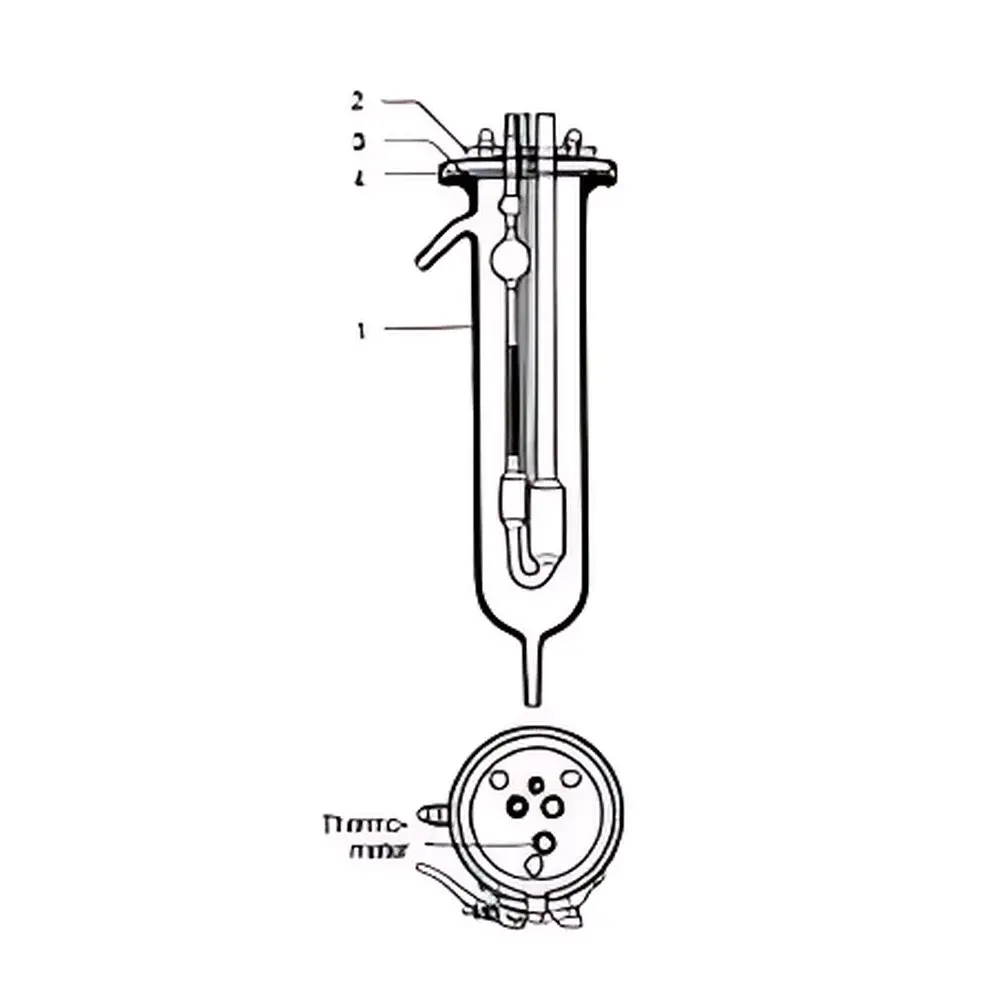
ChemTron 57701 Ubbelohde Viscometer Jacketed Bath Assembly
| Brand | ChemTron |
|---|---|
| Origin | Germany |
| Model | 57701 |
| Temperature Range | 0–180 °C |
| Compatibility | Ubbelohde, Ostwald, and Cannon-Fenske capillary viscometers |
| Mounting Options | Standard 4-hole viscometer holder (Ø4/6/8/10 mm) |
| Sensor Interface | Pt-100 RTD port with 2-wire or 4-wire configuration |
| Fluid Circulation | Compatible with CD-200F thermostatic circulator (external) |
| Sealing | ND60 O-ring (22534) and NW60 quick-clamp (07234) included |
| Pump Integration | Supports VZ 5655 VISCO Pump for automated efflux timing |
Overview
The ChemTron 57701 Ubbelohde Viscometer Jacketed Bath Assembly is a precision-engineered thermal management system designed specifically for capillary viscometry in accordance with ISO 3104, ASTM D445, and ASTM D2161 standards. Unlike generic immersion baths, this assembly implements a double-wall glass jacket architecture that ensures uniform axial temperature distribution along the entire length of the capillary tube—critical for minimizing thermal gradients that induce measurement drift in kinematic viscosity determinations. The system operates within a validated range of 0 °C to 180 °C when paired with a compatible external thermostatic circulator (e.g., CD-200F), enabling high-temperature applications such as polymer melt characterization or high-boiling-point solvent analysis. Its modular design integrates seamlessly with standard Ubbelohde, Ostwald, and Cannon-Fenske viscometers, supporting both manual and automated efflux timing workflows via optional VZ 5655 VISCO Pump integration.
Key Features
- Double-wall borosilicate glass jacket (model 57701) providing optimal thermal inertia and optical clarity for real-time meniscus observation
- Standardized 4-port viscometer holder (part 23800) accommodating capillary tubes with outer diameters of 4 mm, 6 mm, 8 mm, and 10 mm—ensuring compatibility across major viscometer geometries
- Dedicated Pt-100 sensor port (IEC 60751 Class A tolerance) located at the critical measurement zone, enabling direct-in-bath temperature feedback with ±0.02 °C stability under steady-state conditions
- Integrated sealing solution: ND60 fluorosilicone O-ring (22534) and NW60 stainless-steel quick-clamp (07234) guarantee leak-tight coupling between jacket and viscometer without mechanical stress on fragile capillaries
- Thermal interface optimized for low-flow, high-stability circulation—compatible with CD-200F circulators delivering ≤0.01 °C temperature fluctuation over 24 hours per ISO 17025 calibration protocols
Sample Compatibility & Compliance
The 57701 assembly supports all standard capillary viscometers used in quality control and R&D laboratories, including Ubbelohde-type dilution viscometers for intrinsic viscosity (e.g., [η] determination per ISO 1628-1), and calibrated Ostwald viscometers for routine kinematic viscosity testing. It meets the thermal uniformity requirements specified in ASTM D445 Annex A1 for bath temperature homogeneity (<±0.03 °C over the capillary length). When configured with traceable Pt-100 sensors and operated under documented SOPs, the system supports GLP-compliant data generation and satisfies audit requirements for FDA 21 CFR Part 11–enabled environments where electronic records and signatures are implemented. No internal electronics or firmware are present—thermal control and data acquisition remain fully external, simplifying validation and reducing regulatory burden.
Software & Data Management
As a passive thermal interface component, the 57701 jacket does not include embedded software or connectivity. However, it is fully interoperable with third-party viscometry automation platforms—including those compliant with ASTM E2500-19 (Good Automated Manufacturing Practice) and ISO/IEC 17025:2017 clause 7.7 (data integrity). When used with a CD-200F circulator equipped with digital communication (RS485 or Ethernet), temperature setpoints, actual bath temperatures, and runtime logs can be logged into LIMS or ELN systems via OPC UA or Modbus TCP. The Pt-100 sensor output may be routed to certified DAQ modules (e.g., National Instruments PXIe-4353) for synchronized timestamping and audit-trail generation aligned with ALCOA+ principles (Attributable, Legible, Contemporaneous, Original, Accurate, Complete, Consistent, Enduring, Available).
Applications
- Kinematic viscosity determination of petroleum products (lubricants, base oils, fuels) per ASTM D445 and ISO 3104
- Intrinsic viscosity and molecular weight assessment of polymers (e.g., PET, PA6, PEEK) in concentrated solutions using Ubbelohde capillaries
- High-temperature viscosity profiling of thermosetting resins and epoxy formulations during cure kinetics studies
- Quality assurance of pharmaceutical excipients (e.g., hydroxypropyl methylcellulose, polyvinylpyrrolidone) per USP
- Calibration verification of primary and secondary viscometer standards in metrology labs accredited to ISO/IEC 17025
FAQ
Is the 57701 jacket compatible with non-Ubbelohde viscometers?
Yes—it accommodates Ostwald, Cannon-Fenske, and suspended-level viscometers via interchangeable mounting inserts; custom holders are available upon request.
What circulator specifications are required for stable 180 °C operation?
A thermostatic circulator with silicone oil compatibility, ≥200 °C max setpoint, and pressure-rated closed-loop design (e.g., CD-200F with HT fluid option) is mandatory.
Can the Pt-100 port accept third-party sensors?
Yes—the port conforms to standard 6-mm diameter × 25-mm depth M6 thread; any IEC 60751-compliant Pt-100 probe with 2- or 4-wire termination may be installed.
Does ChemTron provide IQ/OQ documentation for this assembly?
No—this is a mechanical/peripheral component; qualification must be performed by the end user per their site-specific validation protocol and risk assessment.
Is the glass jacket resistant to halogenated solvents?
Borosilicate 3.3 glass exhibits excellent resistance to most organic solvents, but prolonged exposure to hot chlorinated hydrocarbons (e.g., chloroform, carbon tetrachloride) is not recommended without prior compatibility testing.



