
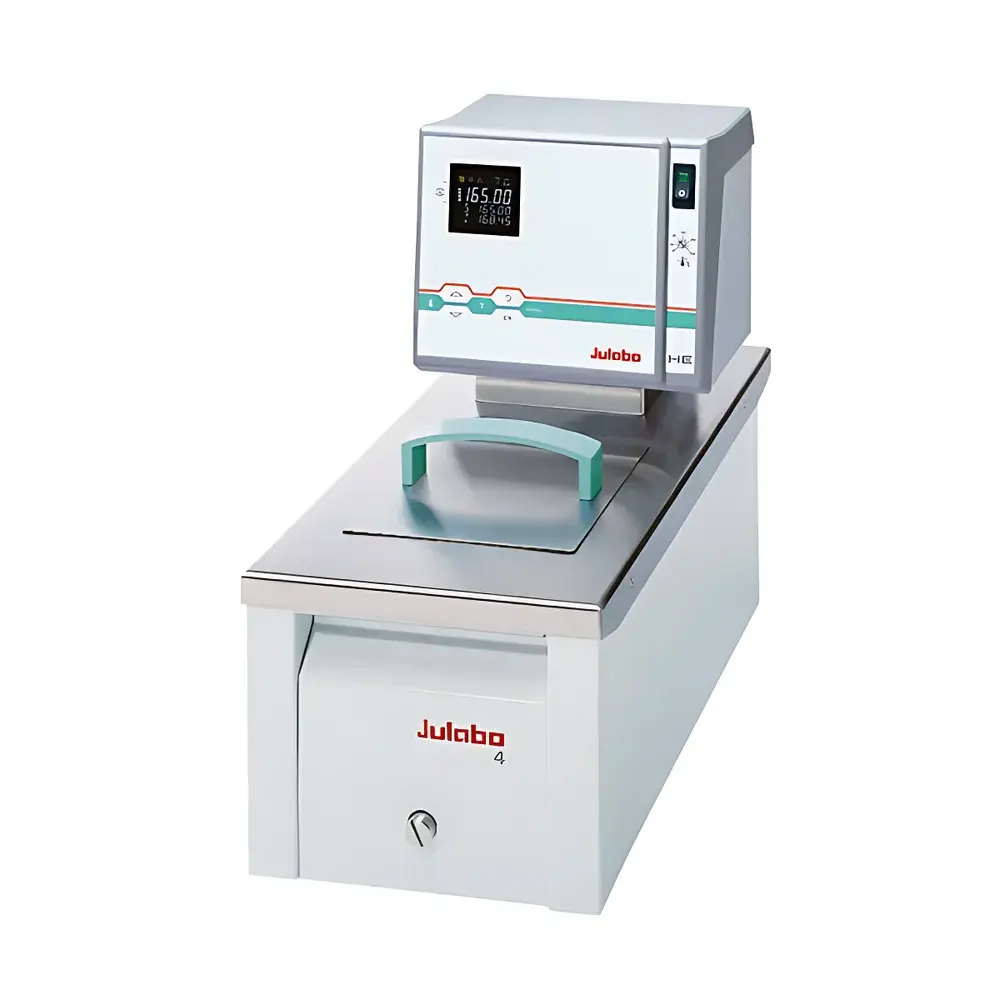
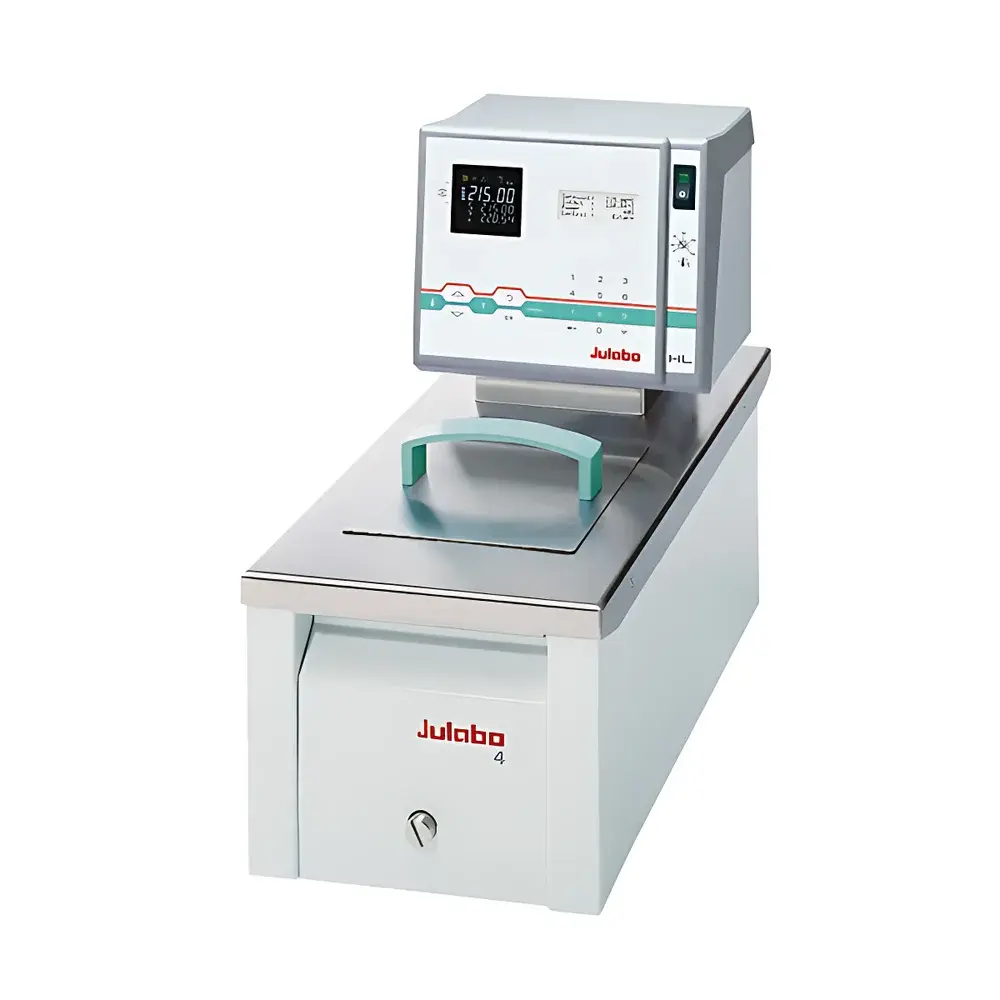
JULABO HE-4 Programmable High-Temperature Circulating Bath
| Brand | JULABO |
|---|---|
| Origin | Germany |
| Model | HE-4 |
| Temperature Range | +5 to +250 °C |
| Temperature Stability | ±0.01 °C |
| Bath Volume | 4.5 L |
| Circulation | Internal & External |
| Display Resolution | 0.01 °C |
| Pump Flow Rate | 22–26 L/min |
| Max. Pump Pressure | 0.4–0.7 bar |
| Communication Interfaces | RS232 (standard), RS485 (optional), Profibus (optional) |
| Programming Capacity | 1 profile × 10 steps (built-in), expandable to 6 profiles × 60 steps via integrated program editor |
| Compliance | DIN 12876-1 Class III (FL) |
Overview
The JULABO HE-4 Programmable High-Temperature Circulating Bath is an engineered thermal management system designed for precise, stable, and reproducible temperature control in demanding laboratory and industrial applications. Operating on the principle of forced convection via a high-efficiency circulation pump, the HE-4 maintains uniform thermal distribution across internal bath media (water, silicone oil, or other compatible heat-transfer fluids) and enables accurate external temperature regulation of connected equipment—such as reactors, spectrometers, or material testing fixtures—via its integrated Pt100 sensor port and programmable output logic. With a wide operational range from +5 °C to +250 °C and a certified stability of ±0.01 °C under steady-state conditions, the HE-4 meets the stringent thermal consistency requirements of ISO/IEC 17025-accredited laboratories and complies with DIN 12876-1 Class III (FL) safety standards for flammable liquid handling. Its dual-mode circulation architecture supports both closed-loop internal homogenization and open-loop external temperature coupling—making it suitable for applications requiring traceable, auditable, and GxP-aligned thermal protocols.
Key Features
- Intelligent ICC (Intelligent Control Circuit) algorithm: Automatically adapts PID parameters in real time to optimize response during ramping, holding, and load changes—reducing overshoot and improving settling time.
- VFD multi-line display: Simultaneously shows bath temperature, external system temperature (via optional Pt100), setpoint, and pump pressure—all at 0.01 °C resolution.
- TCF (Temperature Control Function): Enables dynamic differential control between internal and external sensors, including user-defined extremum thresholds and adaptive rate limiting.
- ATC3 three-point calibration: Supports traceable temperature verification at three independent points within the operating range, facilitating compliance with ISO 17025 calibration documentation requirements.
- Auto-compensating pump drive: Electronically adjusts motor output torque based on fluid viscosity changes—ensuring consistent flow (22–26 L/min) and pressure (0.4–0.7 bar) across temperature transitions without manual intervention.
- Integrated cooling coil: Allows passive ambient-assisted cooling near room temperature without auxiliary chillers—enhancing energy efficiency and extending thermal cycle flexibility.
- Low-level pre-alarm system: Detects decreasing bath fluid volume before critical threshold is reached; continues operation while alerting users—minimizing process interruption (JULABO patented).
Sample Compatibility & Compliance
The HE-4 accommodates a broad spectrum of heat-transfer media—including deionized water, glycol-water mixtures, and high-boiling-point silicone oils—within its 4.5 L stainless-steel bath chamber (DIN 12876-1 Class III FL rated). Its M16×1 pump ports accept standard 8 mm and 12 mm tubing via included compression fittings, enabling seamless integration with jacketed reactors, calorimeters, or custom thermal manifolds. All electronic controls conform to IEC 61000-6-3 (EMC) and IEC 61000-6-2 (immunity) standards. The device supports audit-ready operation when paired with JULABO’s optional software suite, providing full 21 CFR Part 11-compliant electronic signatures, change logs, and data integrity features required for FDA-regulated environments.
Software & Data Management
The HE-4 communicates via RS232 (standard), RS485 (optional), and Profibus DP (optional) interfaces, enabling direct integration into LabVantage, DeltaV, or custom SCADA architectures. Its onboard program editor allows creation of up to six independent temperature profiles—each containing up to 60 definable steps with ramp rates, dwell times, and conditional triggers (e.g., “hold until external sensor reaches 95.00 °C”). When used with JULABO’s WinWeld or LabSoft software (sold separately), users gain access to real-time graphing, automated report generation (PDF/CSV), alarm event archiving, and GLP/GMP-compliant electronic record retention—including operator ID tagging and timestamped parameter modifications.
Applications
- Calibration of thermometers, RTDs, and thermocouples per ASTM E230/E74 standards.
- Thermal conditioning of polymer samples prior to DSC, TGA, or rheological testing.
- Stabilization of optical components in interferometry and laser alignment setups.
- Controlled heating of reaction vessels in synthetic chemistry workflows requiring strict exotherm management.
- Supporting accelerated aging studies per ISO 11348 and ASTM D5762 protocols.
- Integration with HPLC column ovens and GC injector blocks where precise, low-drift thermal setpoints are critical.
FAQ
Is the HE-4 suitable for use with flammable heat-transfer fluids?
Yes—the stainless-steel bath chamber and electrical architecture comply with DIN 12876-1 Class III (FL), permitting safe operation with silicone oils and other Class F liquids when installed in accordance with local hazardous area regulations.
Can the HE-4 cool below ambient temperature?
No—it is a heating-only circulator. However, its built-in cooling coil permits passive heat dissipation near ambient; for active sub-ambient control, pairing with an external chiller (e.g., JULABO F25) is recommended.
Does the HE-4 support 21 CFR Part 11 compliance out of the box?
Hardware-level audit trail logging requires connection to JULABO’s validated LabSoft software suite; standalone unit operation provides basic event logging but not full electronic signature or role-based access control.
What is the maximum allowable viscosity for stable pump performance?
The auto-compensating pump maintains rated flow and pressure up to 500 cSt at 25 °C; beyond this, flow rate reduction should be verified experimentally using calibrated viscometry.
How often should ATC3 calibration be performed?
JULABO recommends quarterly verification against NIST-traceable references in regulated environments; annual full recalibration is advised for ISO/IEC 17025 accreditation maintenance.



