
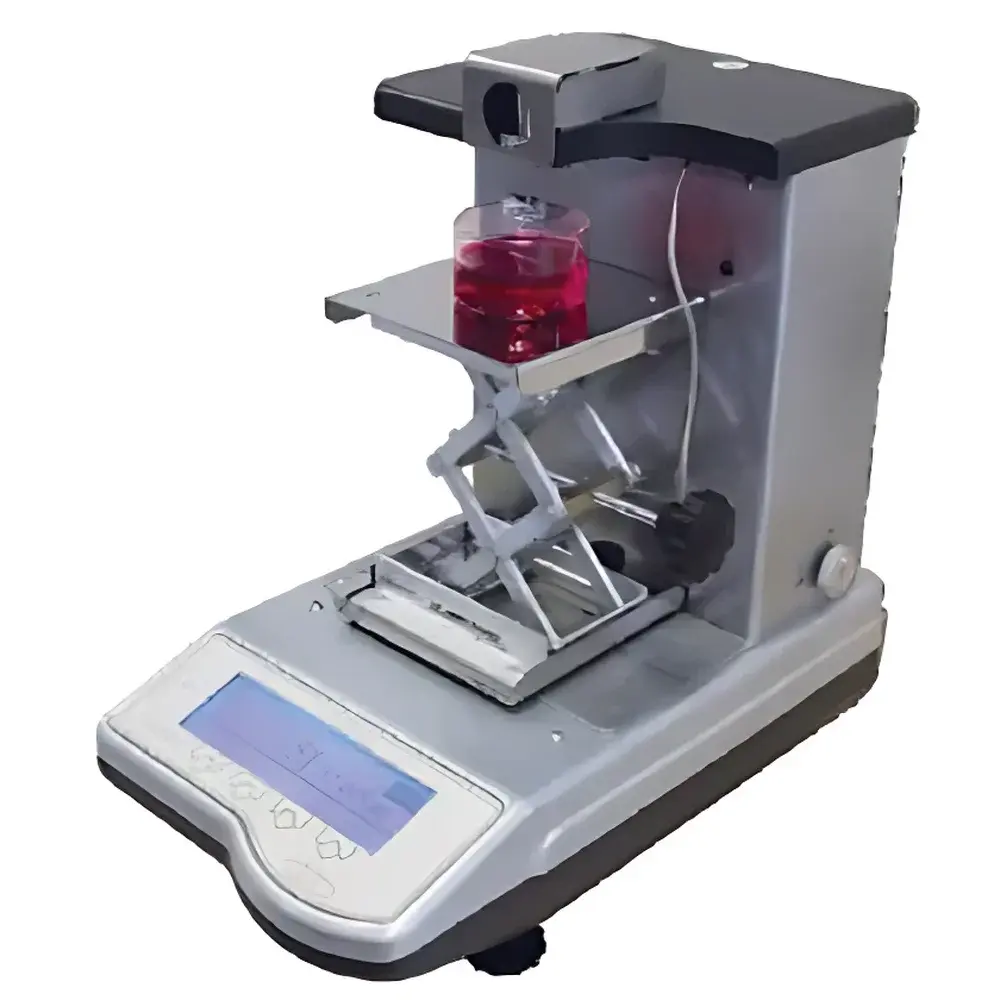
ChemTron DCA Digital Surface Tensiometer
| Brand | ChemTron |
|---|---|
| Origin | Germany |
| Model | DCA |
| Measurement Principle | Wilhelmy Plate Method |
| Surface Tension Range | 1–1000 mN/m |
| Accuracy | ±0.02 mN/m |
| Resolution | 0.01 mN/m |
| Maximum Sample Weight | ≤110 g |
| Density Measurement Range (with optional accessories) | 0.5–2.25 g/cm³ |
| Density Readability | 0.00005 g/cm³ |
| Density Reproducibility | ±0.00005 g/cm³ |
| Temperature Control Range (with jacketed cell & PT100 sensor) | 0–50 °C |
| Temperature Accuracy | ±0.05 °C |
| Temperature Readability | 0.1 °C |
| Power Supply | 230 V (−15% / +10%), 50 Hz, 10 VA |
| Dimensions (W × D × H) | 210 × 370 × 380 mm |
| Weight | 8 kg |
Overview
The ChemTron DCA Digital Surface Tensiometer is a precision laboratory instrument engineered for reliable and repeatable surface tension measurement using the standardized Wilhelmy plate method. Based on the principle of measuring the maximum wetting force exerted on a vertically immersed plate—typically a platinum or specially treated glass plate—the DCA quantifies interfacial forces at the liquid–air boundary with high sensitivity and stability. Surface tension is a fundamental thermodynamic property governing wettability, emulsification, foaming behavior, capillary penetration, and interfacial adsorption kinetics. As such, accurate determination of surface tension is critical in quality control, formulation development, and regulatory compliance across pharmaceutical, cosmetic, coating, detergent, and environmental testing laboratories. The DCA’s robust mechanical architecture, temperature-stabilized measurement environment, and calibrated force transduction system ensure traceable results aligned with ISO 1409, ASTM D971, and DIN 53914 standards.
Key Features
- Wilhelmy plate method compliant with international standards (ISO 1409, ASTM D971) for surface tension determination
- Digital real-time display with 0.01 mN/m resolution and ±0.02 mN/m accuracy across 1–1000 mN/m range
- Integrated PT100 (1/3 DIN) temperature sensor enabling precise thermal monitoring from 0 to 50 °C (±0.05 °C accuracy)
- Optional density module supporting dual-parameter characterization: surface tension and density (0.5–2.25 g/cm³, readability 0.00005 g/cm³)
- Manual vertical positioning stage with fine-adjustment capability for consistent immersion depth control
- Modular accessory support including Du Noüy platinum ring, Wilhelmy glass plate (24 × 24 × 0.15 mm), thermostatted jacketed cuvette, and dedicated sample holders
- Low-power design (10 VA) compatible with standard European mains (230 V, 50 Hz) and suitable for benchtop integration in GLP-compliant environments
Sample Compatibility & Compliance
The DCA accommodates aqueous solutions, organic solvents, surfactant formulations, polymer dispersions, and biological fluids without modification. Its open-access measurement chamber permits direct insertion of custom vessels and facilitates cleaning between samples—a key requirement for multi-user labs handling regulated materials. When configured with the optional density module and jacketed cell, the system supports simultaneous surface tension and density measurements under controlled thermal conditions, meeting requirements for USP analytical instrument qualification and FDA 21 CFR Part 11 data integrity expectations when paired with validated lab information management systems (LIMS). All calibration routines—including internal zero-point and span verification—are documented and reproducible per ISO/IEC 17025 guidelines.
Software & Data Management
While the DCA operates as a standalone instrument with front-panel digital readout, it supports analog output (0–10 V) for integration into centralized data acquisition platforms. Raw force and temperature signals can be logged externally via compatible DAQ hardware, enabling time-series analysis, statistical process control (SPC), and audit-trail generation. For full traceability, users may pair the DCA with ChemTron’s optional PC-based software suite (sold separately), which provides automated reporting, calibration certificate generation, trend visualization, and export to CSV or PDF formats compliant with GLP/GMP documentation workflows.
Applications
- Formulation optimization of detergents and cleaning agents by correlating surface tension reduction with soil removal efficiency
- Evaluation of textile wetting kinetics and penetration rates into porous substrates
- Stability assessment of emulsions and foams in food, pharmaceutical, and personal care products
- Quality assurance of coatings and inks through dynamic surface tension profiling during substrate contact
- Interfacial characterization of drug delivery systems, including liposomes and micellar carriers
- Environmental monitoring of surfactant contamination in wastewater and surface water samples
- Material science studies involving polymer–solvent interactions and surface energy mapping of functionalized films
FAQ
What measurement method does the DCA use?
The DCA employs the Wilhelmy plate method, where surface tension is calculated from the vertical force required to detach a calibrated plate from the liquid surface.
Is temperature control integrated or optional?
A PT100 temperature sensor is standard; however, active temperature stabilization requires the optional jacketed measurement cell and external circulator.
Can the DCA measure interfacial tension between two liquids?
Yes—when used with appropriate fixtures and calibration protocols, the DCA supports liquid–liquid interfacial tension measurements per ASTM D1331.
Does the instrument support automated calibration?
It features internal automatic zero-point calibration; span calibration requires certified reference liquids (e.g., ultra-pure water, diiodomethane) and manual user input.
What accessories are required for density measurement?
Density functionality requires the optional Du Noüy ring, stainless-steel sinker, and thermostatted jacketed cell—supplied as a bundled kit.
Is the DCA suitable for GMP-regulated environments?
Yes—its mechanical stability, documented calibration procedures, and compatibility with electronic record systems enable validation per Annex 11 and ALCOA+ principles.







