
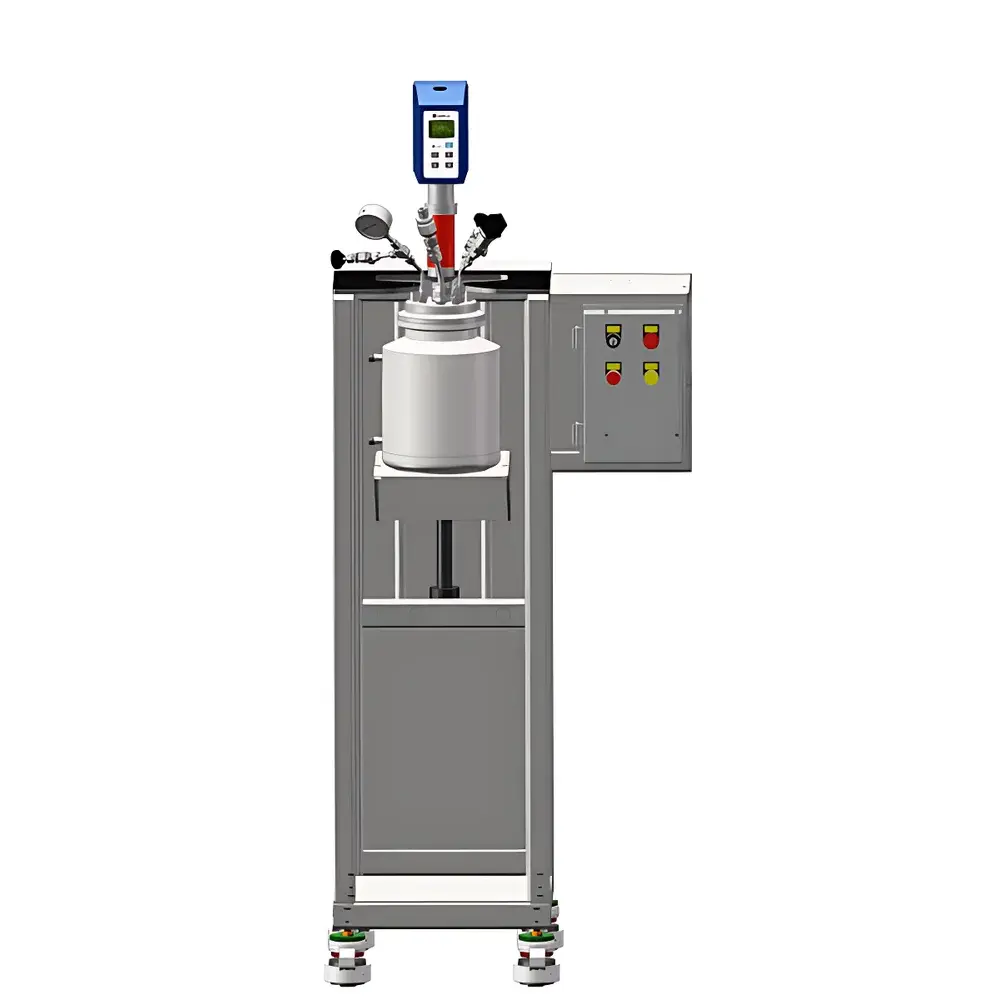
ChemTron NR-5L / NR-10L Medium-Pressure Laboratory Reactor
| Brand | ChemTron |
|---|---|
| Origin | Germany |
| Model | NR-5L / NR-10L |
| Material | Stainless Steel (316L) or Hastelloy C-276 |
| Design Pressure | 25 bar |
| Max. Operating Temperature | 300°C (stainless/Hastelloy), 230°C (with PTFE lining) |
| Vessel Capacity | 5 L / 10 L |
| Internal Diameter | 207 mm / 229 mm |
| Internal Height | 234 mm / 320 mm |
| Weight | 16.4 kg / 20 kg |
| Sealing Options | PTFE, FKM (Viton®), FFKM (Kalrez®) O-rings |
| Stirring System | RV-100WB18D / RV-100-SS (standard) |
| Heating Options | Jacketed oil bath (e.g., JULABO), electric heating mantle, or external heating/cooling coil |
| Safety Features | Rupture disc, pressure gauge (optional pressure transducer), temperature well |
| Optional Accessories | Bottom discharge valve, PTFE liner, motorized lifting stand, 6 mm ports for coil integration, three 8 mm auxiliary ports |
Overview
The ChemTron NR-5L and NR-10L medium-pressure laboratory reactors are engineered for reproducible, scalable chemical synthesis and process development under controlled elevated pressure and temperature conditions. Designed in accordance with DIN 28139 and PED 2014/68/EU guidelines for pressure equipment, these reactors operate up to 25 bar design pressure and support continuous operation at temperatures up to 300°C for stainless steel and Hastelloy C-276 configurations—or up to 230°C when equipped with a chemically inert PTFE internal lining. Their modular architecture enables seamless integration into multi-step reaction workflows, including hydrogenation, oxidation, polymerization, catalytic screening, and solvent-free transformations. The reactor system employs magnetically coupled drive technology to eliminate dynamic seal leakage—a critical requirement for handling toxic, pyrophoric, or oxygen-sensitive reagents—while maintaining full vacuum integrity and pressure containment across the operational envelope.
Key Features
- Quick-release chain-type clamping mechanism for rapid, tool-free access to the vessel interior—reducing downtime between experiments and minimizing operator exposure.
- Interchangeable vessel materials: standard 316L stainless steel; corrosion-resistant Hastelloy C-276 for aggressive halide or acidic media; optional PTFE-lined variants for ultra-high purity or strongly oxidizing environments.
- Standard bottom discharge valve on both NR-5L and NR-10L models facilitates quantitative product recovery and in-situ sampling without depressurization.
- Eight standardized 8 mm NPT threaded ports on the lid—including two dedicated 6 mm ports for external heating/cooling coil integration—support flexible sensor placement, gas dosing, reflux condensation, or inline analytics (e.g., FTIR, Raman).
- High-integrity magnetic coupling: RV-100WB18D (standard) and RV-400 (optional) drive units deliver torque stability up to 1.5 N·m with zero shaft penetration, ensuring long-term seal reliability and compliance with ISO 21028-1 for hazardous area applications.
- Multi-material sealing options: FDA-compliant PTFE O-rings for broad chemical resistance; FKM (Viton®) for elevated temperature resilience; FFKM (Kalrez®) for extreme thermal and plasma stability—each qualified per ASTM D1418 and ISO 3601-3.
Sample Compatibility & Compliance
The NR series accommodates heterogeneous, multiphase, and highly viscous reaction mixtures—including slurries, suspensions, and gelled systems—without compromising mixing efficiency or thermal uniformity. All wetted surfaces conform to USP Class VI and EP 3.1.1 extractables testing protocols. The reactor’s mechanical design satisfies ASME BPVC Section VIII Div. 1 requirements for pressure boundary components and is CE-marked per Machinery Directive 2006/42/EC and Pressure Equipment Directive 2014/68/EU. When configured with optional pressure transducers and data-logging interfaces, the system supports audit-ready documentation aligned with GLP (OECD Series 1, 2005) and GMP (FDA 21 CFR Part 11) traceability standards.
Software & Data Management
While the base NR reactor operates as a standalone unit, it is fully compatible with third-party process control platforms—including LabVIEW-based DAQ systems, DeltaV DCS modules, and ChemStation-compatible PID controllers—via analog 4–20 mA or digital RS485 Modbus RTU outputs from optional integrated sensors (pressure, temperature, torque). All configurable parameters—including setpoint ramps, hold times, and safety interlocks—are programmable and stored with timestamped metadata. For laboratories requiring electronic record integrity, optional firmware upgrades enable encrypted parameter logging, user-access authentication, and exportable CSV/Excel reports compliant with ALCOA+ principles.
Applications
- Catalytic hydrogenation of unsaturated organic compounds under controlled H₂ partial pressures (1–20 bar).
- High-temperature esterification and transesterification reactions for biodiesel and polymer precursor synthesis.
- Hydrothermal carbonization and solvothermal nanomaterial synthesis (e.g., MOFs, metal oxides) using water or polar aprotic solvents.
- Accelerated aging studies of battery electrolytes and solid-state electrolyte interfaces at elevated T/P.
- Process safety evaluation (e.g., RC1e calorimetry integration) via simultaneous temperature, pressure, and stirring torque monitoring.
- Continuous flow pre-screening: batch-to-flow translation using sequential pressurized reaction cycles with automated venting and quenching.
FAQ
What pressure and temperature ratings apply to the PTFE-lined configuration?
The maximum allowable operating temperature drops to 230°C when a PTFE liner is installed, while the 25 bar design pressure remains unchanged. PTFE linings are not rated for vacuum service below 10 mbar due to potential outgassing and dimensional instability.
Can the reactor be used under vacuum prior to pressurization?
Yes—the vessel and lid assembly maintain vacuum integrity down to ≤0.1 mbar (absolute) when sealed with FFKM or PTFE O-rings and verified via helium leak testing per ISO 15848-2.
Is the bottom discharge valve compatible with abrasive slurries?
The standard stainless steel ball valve includes hardened 440C stainless seats; for highly abrasive media, Hastelloy C-276 trim and ceramic-coated stems are available as factory-installed options.
How is temperature uniformity validated across the 10 L volume?
Temperature gradients are characterized per ASTM E2877-21 using five calibrated Pt100 probes placed at radial and axial positions; typical ΔT across the working volume is ≤±1.2°C at steady state under jacketed circulation.
Does ChemTron provide IQ/OQ documentation packages?
Yes—factory-certified Installation Qualification (IQ) and Operational Qualification (OQ) protocols are available upon request, including calibration certificates traceable to NIST standards and mechanical test reports for burst pressure verification.



