
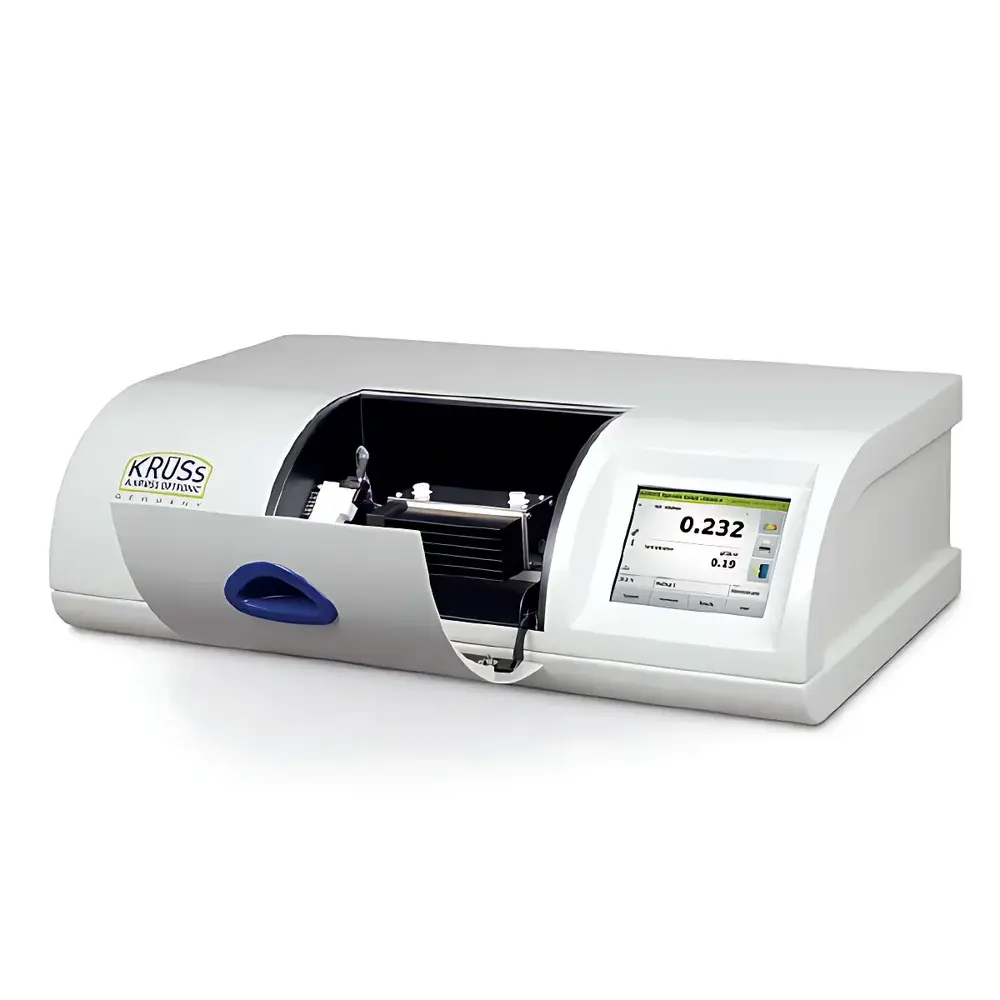
ChemTron P8000 Series Automatic Polarimeter
| Brand | ChemTron |
|---|---|
| Origin | Germany |
| Model | P8000 |
| Product Type | Automatic Polarimeter |
| Temperature Control | Yes (Peltier or external water bath) |
| Display | 5.7" color LCD touchscreen (640×480 px) |
| Light Source | LED (589 nm, optional wavelengths available) |
| Measurement Range | ±90°, ±259°Z, 0–99.9 g/100 mL |
| Accuracy | ±0.003°, ±0.01 °Z, ±0.5 g/100 mL |
| Repeatability | ±0.002° |
| Measurement Time | 1 s |
| Temperature Range | 0–99.9 °C (Peltier) |
| Temperature Accuracy | ±0.2 °C |
| Temperature Resolution | 0.1 °C |
| Data Storage | 999 measurements |
| Interfaces | RS232, USB, Ethernet (LIMS-ready) |
| Sample Cell Options | 0.55–17 mL volume, 10–220 mm path length |
| Sensitivity | ≥0.1% (OD 3) |
| Calibration | Fully automated via menu |
| Compliance | ASTM E1258, ISO 11791, Ph. Eur. 2.2.7, USP <781>, OIML R163, IUCMSA, FDA 21 CFR Part 11, GLP/GMP audit trail capable |
Overview
The ChemTron P8000 Series Automatic Polarimeter is a high-precision optical instrument engineered for quantitative determination of optical rotation in chiral substances—primarily used in pharmaceutical quality control, fine chemical synthesis, food & beverage analysis, and academic research laboratories. Operating on the principle of plane-polarized light transmission through optically active samples, the P8000 measures angular deviation induced by molecular asymmetry, delivering traceable, repeatable results under controlled thermal conditions. Its core architecture integrates a stable 589 nm LED light source (sodium D-line equivalent), precision polarizing optics, and a high-resolution angular detection system. Designed and assembled in Germany, the instrument meets stringent international metrological standards and supports regulatory compliance frameworks including USP , Ph. Eur. 2.2.7, and ISO 11791 for polarimetric measurement validity.
Key Features
- Sub-second measurement cycle (≤1 s per reading) with automatic averaging and real-time statistical validation
- High-intensity LED illumination (≥100,000 h lifetime) with integrated interference filter—stable output at OD 3 (absorbance 3.0)
- Dual temperature control options: Peltier-based (P-series, 0–99.9 °C, ±0.2 °C accuracy) or external water-circulation (T-series, 8–40 °C)
- 5.7-inch full-color capacitive touchscreen interface with intuitive icon-driven navigation and multilingual OS support
- Automated self-calibration routine accessible via main menu; no external reference standards required for daily verification
- Robust mechanical design: aluminum alloy chassis, vibration-damped optical bench, and sealed optical pathway to minimize environmental drift
- Comprehensive data integrity architecture: user-level password protection, audit trail logging, electronic signatures, and encrypted local storage
Sample Compatibility & Compliance
The P8000 accommodates a broad range of sample formats via interchangeable cell holders supporting path lengths from 10 mm to 220 mm and volumes from 0.55 mL to 17 mL—including standard 100 mm quartz cells, micro-volume capillary tubes, and custom-length flow cells for inline process monitoring. All optical components comply with DIN ISO 10110 surface quality specifications. The instrument is fully compliant with Good Laboratory Practice (GLP) and Good Manufacturing Practice (GMP) requirements, including full 21 CFR Part 11 compliance for electronic records and signatures. It ships with documented 3Q validation packages (IQ/OQ/PQ), traceable to national metrology institutes (e.g., PTB, NIST), and supports integration into regulated environments requiring adherence to ASTM E1258 (Standard Test Method for Polarimetry), OIML R163 (International Recommendation for Polarimeters), and IUCMSA guidelines.
Software & Data Management
Data acquisition, processing, and reporting are managed through ChemTron’s embedded firmware v4.x, supporting six native measurement modes: optical rotation (°), International Sugar Scale (°Z), concentration (g/100 mL), specific rotation ([α]), user-defined equations, and multi-point kinetic profiling. All results are timestamped, annotated with operator ID, temperature, and cell parameters, and stored locally with SHA-256 hash integrity verification. Export options include PDF reports (with embedded calibration certificates), CSV for LIMS ingestion, and XML for ERP integration. Ethernet connectivity enables direct communication with laboratory information management systems (LIMS) using TCP/IP protocols; USB ports support firmware updates and mass data transfer without software installation. Up to 100 customizable user profiles can be configured with role-based permissions, and historical datasets are searchable by date, sample ID, or analytical parameter.
Applications
- Pharmaceutical QC: Assay of enantiomeric purity for APIs (e.g., levodopa, ibuprofen, chloramphenicol), excipient characterization, and stability-indicating methods per ICH Q5C
- Sugar industry: Brix and polarization degree quantification in sucrose, fructose, and invert sugar solutions per ICUMSA Methods GS4/3-15 and AOAC 952.04
- Food & beverage: Authenticity testing of honey, maple syrup, and fruit juices; detection of adulteration via optical rotation deviation
- Academic research: Kinetic studies of enzymatic hydrolysis (e.g., invertase, α-amylase), chiral catalyst evaluation, and polymer stereochemistry analysis
- Chemical manufacturing: Batch release testing of chiral intermediates, solvent effect studies, and reaction endpoint determination in asymmetric synthesis
FAQ
What wavelength does the P8000 use for polarimetric measurement?
The standard configuration employs a narrowband 589 nm LED (sodium D-line equivalent), with optional modules available for 405 nm, 488 nm, and 633 nm wavelengths upon request.
Can the P8000 operate unattended in a 24/7 production environment?
Yes—the instrument supports scheduled auto-start, remote status monitoring via Ethernet, and continuous operation with passive cooling; mean time between failures (MTBF) exceeds 25,000 hours.
Is method validation support included with the system?
All P8000 units ship with a complete 3Q documentation package (Installation Qualification, Operational Qualification, Performance Qualification), pre-executed test protocols aligned with USP and ISO/IEC 17025 requirements.
How is temperature uniformity maintained across the sample cell during measurement?
Peltier-controlled models feature dual-zone thermal regulation (cell block + ambient chamber), achieving ±0.05 °C spatial uniformity over the full 100 mm path length as verified by calibrated thermistor mapping.
Does the P8000 support multi-language user interfaces?
Yes—embedded firmware supports English, German, French, Spanish, Chinese (Simplified), Japanese, and Korean, configurable without reboot or external software.




