
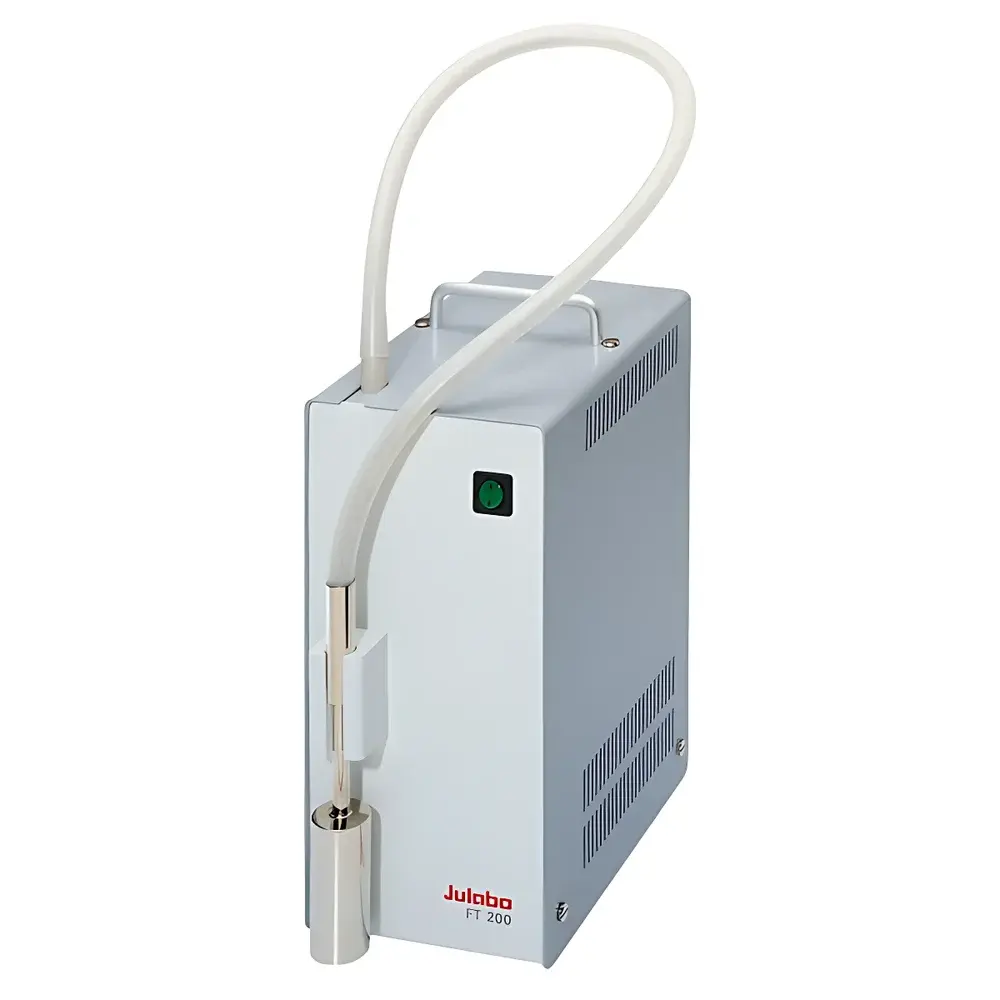
Julabo FT200 Immersion Cooling Circulator
| Brand | Julabo |
|---|---|
| Origin | Germany |
| Model | FT200 |
| Temperature Range | –20 to +30 °C |
| Refrigeration Capacity | 0.25 kW at 20 °C, 0.2 kW at 10 °C, 0.04 kW at –20 °C |
| Ambient Operating Temperature | 5–40 °C |
| Refrigerant | R134a (GWP = 1430) |
| Compressor Type | Single-stage, air-cooled |
| Cooling Head Dimensions | 9 × 4 cm (L × Ø) |
| Unit Dimensions (W × L × H) | 18 × 27 × 39 cm |
| Weight | 18 kg |
| Hose Length | 120 cm |
| Construction | Stainless steel immersion probe |
| External Sensor Included | PT100 (200 × Ø6 mm, 1.5 m cable) |
| Temperature Display Resolution | 0.1 °C |
| CO₂-equivalent Emissions | 0.157 t per unit (based on refrigerant charge) |
Overview
The Julabo FT200 Immersion Cooling Circulator is a compact, single-stage, air-cooled refrigeration system engineered for precise low-temperature control of external liquid baths, reactors, or jacketed vessels. Unlike traditional recirculating chillers with remote heat exchangers, the FT200 integrates its full cooling capacity into a sealed, stainless-steel immersion probe—enabling direct thermal coupling with the process fluid. This architecture leverages the principles of convective heat transfer in forced-circulation mode, delivering rapid cooldown rates and stable setpoint maintenance without requiring dry ice or cryogenic liquids. Designed for integration into laboratory-scale thermal management workflows, the FT200 operates within a temperature range of –20 °C to +30 °C and is commonly deployed in conjunction with Julabo heating circulators to achieve extended temperature spans beyond ambient—particularly in applications demanding sub-ambient stabilization of reaction mixtures, spectroscopic cells, or calibration standards.
Key Features
- Stainless-steel immersion cooling head (9 × 4 cm) optimized for high surface-area-to-volume ratio and corrosion resistance in aqueous and organic solvent environments
- Single-stage R134a refrigeration circuit with air-cooled condenser—no external water supply or drainage required
- Precise temperature regulation via integrated PID controller and factory-calibrated PT100 sensor (included: 200 × Ø6 mm, 1.5 m cable)
- Digital display with 0.1 °C resolution and intuitive keypad interface for local setpoint entry and status monitoring
- Compact footprint (18 × 27 × 39 cm) and lightweight design (18 kg) suitable for benchtop use in fume hoods or confined instrument spaces
- Refrigerant charge compliant with EU F-Gas Regulation (EC) No 517/2014; R134a GWP value documented per ISO 14067
Sample Compatibility & Compliance
The FT200 is compatible with a wide range of non-aggressive liquids—including water, water-glycol mixtures, silicone oils, and low-viscosity organic solvents—provided they remain chemically inert toward 316 stainless steel and fluoropolymer-sealed components. It is not rated for use with halogenated solvents, strong acids/bases, or particulate-laden suspensions. The unit complies with IEC 61010-1:2010 for electrical safety in laboratory equipment and meets EMC requirements per EN 61326-1:2013. While not intrinsically safe, it carries CE marking and conforms to RoHS 2011/65/EU directives. For GLP/GMP environments, optional audit-trail-capable software interfaces (via RS232 or analog output) support traceable temperature logging aligned with FDA 21 CFR Part 11 data integrity expectations when paired with validated third-party acquisition systems.
Software & Data Management
The FT200 operates as a standalone controller with no embedded firmware-based data logging. However, it provides a 0–10 V analog output proportional to measured temperature and an RS232 serial interface (ASCII protocol) for remote setpoint adjustment and real-time readback of PV/SV values. When integrated with Julabo’s optional LabView-compatible drivers or third-party SCADA platforms (e.g., LabSolutions, WinCC), users can implement automated ramp-soak profiles, generate time-stamped CSV reports, and trigger alarms based on deviation thresholds. All communication protocols are deterministic and latency-controlled to ensure synchronization in multi-instrument thermal control networks—critical for reproducible kinetic studies or multi-zone reactor conditioning.
Applications
- Sub-ambient stabilization of NMR sample probes and optical spectrometer cuvettes
- Cooling of rotary evaporator condensers to improve solvent recovery efficiency below room temperature
- Thermal conditioning of small-volume bioreactors (<5 L) during fermentation or cell culture processes
- Calibration of thermocouples, RTDs, and infrared pyrometers against NIST-traceable references
- Low-temperature synthesis in Schlenk lines or glovebox-integrated reaction manifolds
- Pre-cooling of HPLC mobile phase reservoirs to enhance retention time stability and peak resolution
FAQ
Can the FT200 achieve temperatures below –20 °C?
No—the FT200 is rated for a minimum operating temperature of –20 °C under standard ambient conditions (23 °C, 50% RH). Lower temperatures require cascade or cryogenic systems such as the Julabo CF41 or PRESTO series.
Is the included PT100 sensor suitable for immersion in aggressive solvents?
The standard sensor features a 316 stainless-steel sheath and PTFE-insulated cable, making it compatible with most polar and non-polar solvents—but not with concentrated halogenated or oxidizing media. Custom-sheathed variants (e.g., Hastelloy or glass-coated) are available upon request.
Does the FT200 support external temperature feedback from a process vessel?
Yes—via the supplied PT100 input terminal. The controller defaults to internal sensor mode but can be configured to accept external feedback for cascade control loops.
What maintenance intervals are recommended for the air-cooled condenser?
Inspect and clean the condenser fins every 6 months using compressed air or a soft brush; more frequent cleaning is advised in dusty or high-particulate lab environments.
Can multiple FT200 units be daisy-chained for synchronized operation?
Not natively—the device lacks master/slave addressing. Synchronization requires external PLC-level coordination via analog setpoint signals or centralized SCADA command routing.



