
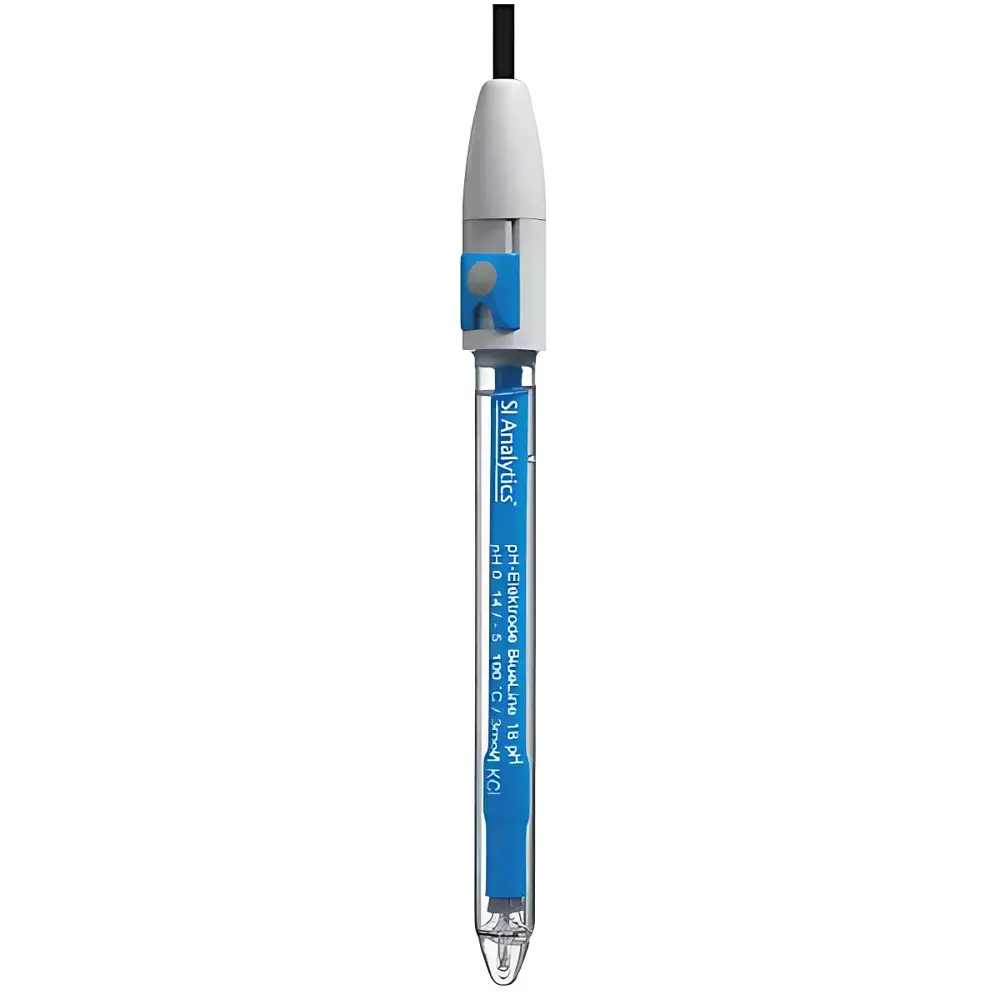
ChemTron BlueLine 22 pH Combination Electrode
| Brand | ChemTron |
|---|---|
| Origin | Germany |
| Model | BlueLine 22 pH |
| Electrode Type | Combination pH Electrode |
| pH Range | 0–14 |
| Temperature Range | –5 to +80 °C |
| Body Material | Polymer (12 mm Ø, 120 mm length) |
| Reference System | Ag/AgCl |
| Reference Electrolyte | KCl 3 mol/L (gel-free, refillable) |
| Junction Type | Fibrous diaphragm |
| Sensing Membrane | Conical glass |
| Zero Point | pH 7.0 ± 0.3 |
| Membrane Resistance (25 °C) | 200 MΩ |
| Connector Options | DIN 19262, BNC, IDS, or threaded |
Overview
The ChemTron BlueLine 22 pH Combination Electrode is a precision-engineered, refillable liquid-junction pH sensor designed for high-reproducibility measurements in routine laboratory, quality control, and industrial process environments. Based on the potentiometric principle, it measures the hydrogen ion activity of aqueous solutions by generating a stable, Nernstian potential difference across a pH-sensitive conical glass membrane relative to an internal Ag/AgCl reference system. Its robust polymer body (12 mm diameter, 120 mm length) ensures mechanical durability and chemical resistance while maintaining ergonomic handling. The electrode operates across the full pH scale (0–14) and over a wide temperature range (–5 to +80 °C), with thermal compensation supported via optional integrated NTC 30 kΩ or Pt1000 sensors—enabling accurate, temperature-corrected readings per ISO 3696 and ASTM D1293 requirements.
Key Features
- Refillable KCl 3 mol/L electrolyte system ensures long-term stability, low junction potential drift, and consistent response time—critical for compliance with GLP and ISO/IEC 17025 documentation standards.
- Conical glass sensing membrane provides rapid hydration, improved surface contact in viscous or heterogeneous samples, and enhanced resistance to clogging versus flat or spherical geometries.
- Fibrous diaphragm junction delivers balanced electrolyte outflow under variable pressure conditions, minimizing contamination risk and supporting reliable performance in low-ionic-strength or protein-rich matrices.
- Modular connector architecture supports DIN 19262, BNC, IDS, and threaded interfaces—ensuring seamless integration with benchtop meters (e.g., Metrohm, Hanna, Thermo Orion), automated titrators, and inline monitoring systems.
- Optional built-in temperature sensors (NTC 30 kΩ or Pt1000) meet FDA 21 CFR Part 11 requirements for electronic record integrity when paired with compliant data acquisition software.
- Zero-point calibration at pH 7.0 ± 0.3 (25 °C) is traceable to NIST-certified buffer standards, enabling straightforward two-point calibration protocols per USP and EP 2.2.3.
Sample Compatibility & Compliance
The BlueLine 22 pH electrode is validated for use in aqueous buffers, pharmaceutical formulations, food extracts, wastewater effluents, and mild organic-aqueous mixtures (≤20% v/v ethanol or methanol). Its gel-free, refillable design avoids the premature aging and diffusion-limited response associated with polymer-gel electrodes—making it suitable for extended immersion, continuous monitoring, and applications requiring frequent recalibration. The fibrous junction resists fouling from colloids, suspended solids, and sulfide-rich media. Compliance includes adherence to IEC 62353 (electrical safety), EN ISO 15197 (in vitro diagnostic performance), and compatibility with ISO 17025 audit trails when used with certified meter platforms and documented SOPs.
Software & Data Management
When connected to ChemTron-compatible or third-party meters with digital output (e.g., via IDS interface), the electrode supports automatic sensor identification, firmware-assisted calibration logging, and timestamped measurement records. Integrated temperature sensors enable real-time slope and offset correction algorithms compliant with ASTM E2064 and ISO 11291-1. All calibration events—including buffer assignment, mV deviation, and asymmetry potential—are stored with user ID, date/time, and environmental metadata—facilitating full traceability under GMP Annex 11 and 21 CFR Part 11 electronic signature frameworks.
Applications
- Routine QC testing of raw materials and finished products in pharmaceutical manufacturing (e.g., dissolution media, injectables, oral suspensions).
- Environmental monitoring of surface water, groundwater, and treated effluent per EPA Method 150.1 and ISO 10523.
- Food and beverage process control—including dairy fermentation, juice acidification, and brewing mash pH profiling.
- Academic research requiring stable, low-drift electrodes for kinetic studies, titration endpoint detection, and buffer capacity evaluation.
- Calibration verification of multi-parameter probes in municipal water treatment plants.
FAQ
Is the BlueLine 22 pH electrode compatible with non-ChemTron meters?
Yes—it supports universal analog input via standard DIN, BNC, or threaded connectors; digital IDS variants require ChemTron or IDS-enabled instruments.
How often should the electrolyte be refilled?
Refill every 2–4 weeks under continuous use, or whenever the electrolyte level drops below the fill hole—maintaining hydrostatic pressure equilibrium is essential for junction stability.
Can this electrode be used in high-temperature sterilization cycles?
No—maximum operational temperature is +80 °C; autoclaving or steam sterilization exceeds design limits and may compromise glass membrane integrity.
What is the expected service life under normal lab conditions?
Typically 12–18 months with proper storage (in 3 mol/L KCl), regular cleaning (e.g., pepsin/HCl for protein fouling), and avoidance of strong oxidizers or fluoride-containing solutions.
Does the electrode include temperature compensation by default?
No—temperature sensing is optional and must be specified at order (e.g., model 22 pH-NTC or 22 pH-Pt1000); analog-only versions require external temperature input.





