
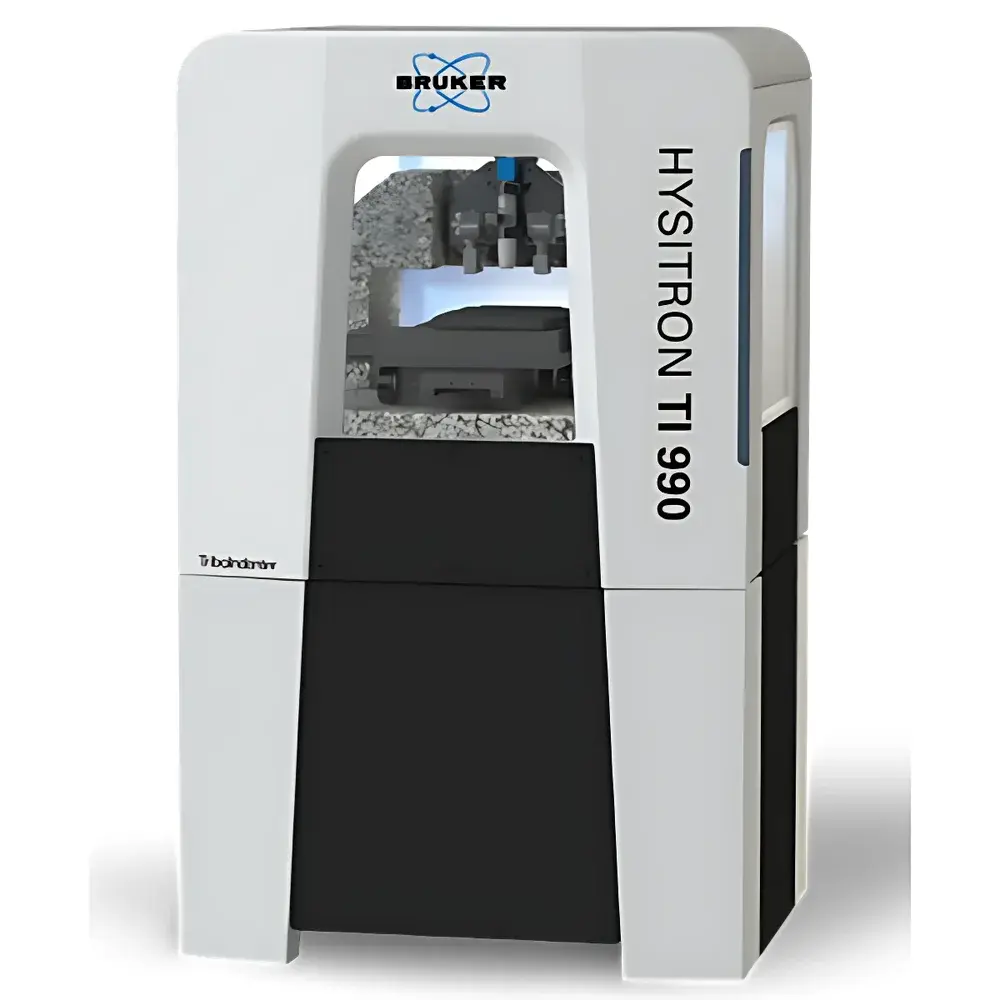
Bruker TI 990 High-Precision Nanomechanical Testing System
| Brand | Bruker |
|---|---|
| Origin | USA |
| Model | TI 990 |
| Drive Technology | Electrostatic actuation |
| Noise Floor | <0.1 nm RMS displacement noise |
| Maximum Load Resolution | 50 nN |
| Depth Resolution | <0.01 nm |
| Active Vibration Isolation | Integrated pneumatic + electromagnetic hybrid system |
| Platform | Precision granite base with environmental enclosure |
| Control Architecture | Performech III dual-lock-in parallel processing module |
| Software Platform | Tribo iQ v4.x (FDA 21 CFR Part 11 compliant audit trail, GLP/GMP-ready reporting) |
Overview
The Bruker TI 990 High-Precision Nanomechanical Testing System represents a benchmark in quantitative nanoscale mechanical characterization. Engineered for precision and reproducibility, it employs electrostatic actuation—eliminating piezoelectric hysteresis and thermal drift—to deliver sub-nanometer displacement control and true force-feedback stability. Its measurement principle is grounded in continuous, high-bandwidth load-displacement sensing during indentation, scratch, and dynamic mechanical analysis (DMA), enabling rigorous determination of hardness, elastic modulus, creep compliance, strain-rate sensitivity, interfacial adhesion, and viscoelastic relaxation spectra at length scales from 1 nm to 10 µm. Designed for integration into ISO/IEC 17025-accredited labs and regulated R&D environments, the TI 990 meets foundational requirements for traceable nanomechanical metrology under ASTM E2546, ISO 14577-1, and USP for nanoindentation-based material qualification.
Key Features
- Electrostatic actuation architecture delivering <0.1 nm RMS displacement noise floor and zero hysteresis across full 500 µm travel range
- Performech III control module featuring dual lock-in amplifiers, real-time parallel signal processing, and adaptive feedback loop tuning for dynamic testing up to 1 kHz
- Integrated active vibration isolation combining pneumatic legs and electromagnetic inertial dampers—validated to meet SEM-grade ambient noise specifications (ISO 25317 Class A)
- Rigid monolithic granite platform with climate-sealed enclosure, maintaining thermal stability ±0.1°C over 8-hour operation
- TriboScan 12 test sequence engine supporting automated multi-point indentation arrays, progressive-load scratch profiling, and frequency-swept DMA-IV with simultaneous fundamental and second-harmonic detection
- CMX (Contact Mechanics eXtended) algorithm suite for depth-dependent modulus deconvolution, pile-up correction, and substrate-independent property extraction
Sample Compatibility & Compliance
The TI 990 accommodates flat, polished specimens up to 200 mm in diameter and 50 mm in thickness—including single-crystal wafers, thin-film stacks, biomaterials, polymers, ceramics, and metallic coatings. Vacuum-compatible stages (optional) enable in-situ TEM-compatible testing. All hardware and firmware comply with CE marking directives (2014/30/EU EMC, 2014/35/EU LVD), and software design adheres to IEC 62304 Class B for medical device-related material evaluation workflows. Data integrity protocols satisfy FDA 21 CFR Part 11 requirements via Tribo iQ’s electronic signature workflow, role-based access control, and immutable audit trail logging with SHA-256 hash verification.
Software & Data Management
Tribo iQ v4.x serves as the unified analytical environment—built on a Python 3.9 scientific computing stack with NumPy, SciPy, and Matplotlib backends. It supports batch processing of >10,000 indents per session, automated ISO 14577-compliant property mapping, and customizable report generation in PDF, CSV, and HDF5 formats. The software includes built-in uncertainty propagation modules aligned with GUM (JCGM 100:2012), enabling confidence interval estimation for modulus and hardness values. Raw time-series data (load, displacement, acoustic emission) are stored in vendor-neutral .h5 containers, ensuring long-term archival compatibility and third-party analysis interoperability.
Applications
- Thin-film mechanical validation for semiconductor BEOL integration (e.g., low-k dielectrics, Cu diffusion barriers)
- Hardness and fracture toughness mapping of additively manufactured metal lattices and gradient alloys
- Viscoelastic quantification of hydrogels and tissue-engineered scaffolds under physiological loading rates
- Interfacial delamination energy assessment in multilayer optical coatings and photovoltaic encapsulants
- In situ temperature-dependent nanoindentation (–150°C to +300°C, optional stage) for polymer glass transition profiling
- Correlation of nanomechanical properties with AFM phase imaging and Raman spectral shifts in 2D materials
FAQ
What calibration standards are supported for traceable measurements?
NIST-traceable fused silica and sapphire reference samples (SRM 2822, SRM 2823) are integrated into the calibration workflow, with automated tip geometry verification using certified pyramidal and spherical reference tips.
Is the system compatible with third-party environmental chambers?
Yes—the TI 990 features standardized vacuum feedthroughs and electrical interface ports compliant with KF-40 and SMA-3.5mm specifications, enabling seamless integration with commercial cryo-, humidity-, or gas-controlled stages.
Can Tribo iQ generate reports compliant with ISO/IEC 17025 documentation requirements?
Yes—Tribo iQ includes configurable templates for accredited lab reporting, including instrument metadata, operator ID, environmental logs, uncertainty budgets, and raw-data checksums—all digitally signed and timestamped.
What is the typical maintenance interval for the electrostatic transducer?
No scheduled maintenance is required; the electrostatic actuator has no consumable components, wear surfaces, or lubricants, and is rated for >10⁹ cycles under nominal load conditions.



