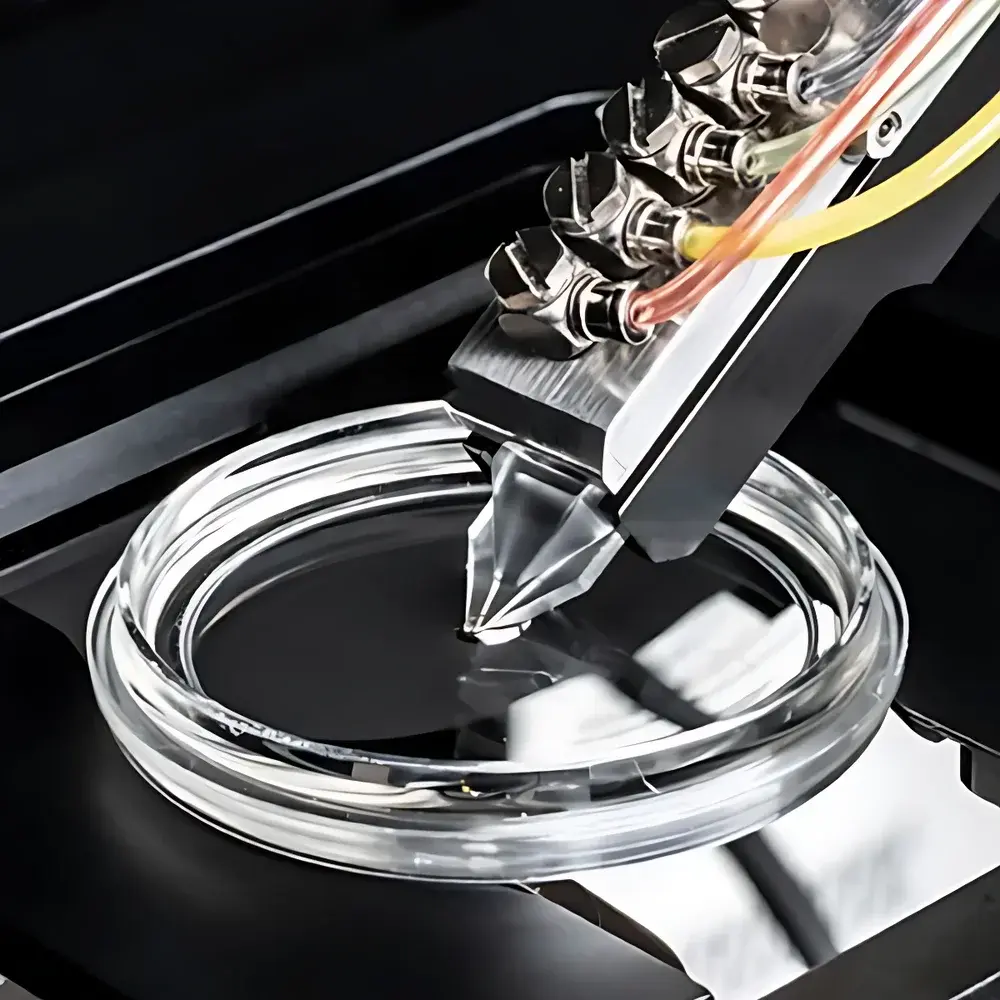
Fluicell BioPen Microfluidic Targeted Single-Cell Drug Delivery System
| Brand | Fluicell |
|---|---|
| Origin | Sweden |
| Model | Fluiwell-BioPen |
| Flow Precision (PRIME chip) | 7–25 nL/s |
| Solution Switching Speed | Sub-second (<1 s) |
| Nozzle Compatibility | Universal microscope integration (standard inverted & upright configurations) |
| Chip Types | PRIME (high-precision, low-volume) and FLEX (modular, multi-channel) disposable chips |
| Control Interface | PC-based Fluicell Control Software v3.x |
| Regulatory Compliance | CE-marked for research use only (RUO), compliant with ISO 13485 design controls for medical device components |
Overview
The Fluicell BioPen is a precision microfluidic platform engineered for targeted, subcellular-scale chemical delivery to individual adherent cells under optical microscopy. Unlike bulk perfusion or pipette-based microinjection, the BioPen operates on laminar flow confinement principles—leveraging hydrodynamic focusing and pressure-driven microjetting through a micron-scale glass or polymer nozzle positioned within micrometers of the cell surface. This enables localized perturbation of the pericellular microenvironment without diffusive contamination of neighboring cells or culture areas. The system supports real-time, repeatable compound application with temporal resolution down to 100 ms and volumetric accuracy in the nanoliter-per-second range (7–25 nL/s with PRIME chips), making it suitable for kinetic studies of receptor activation, ion channel gating, endocytosis dynamics, and stimulus-response coupling in native cellular contexts.
Key Features
- Sub-second solution switching across up to four independent reagent reservoirs—enabling rapid sequential or combinatorial stimulation protocols.
- Disposable microfluidic chips (PRIME and FLEX variants) fabricated using cleanroom-grade photolithography and bonded glass/polymer substrates; each chip integrates integrated fluidic manifolds, pressure-sealed interfaces, and calibrated nozzles (inner diameter: 1–5 µm).
- High-stability pneumatic pressure controller (0.01–700 mbar range, ±0.1% full-scale repeatability) with active feedback regulation to maintain consistent flow rates under variable backpressure conditions.
- Universal mechanical mounting system compatible with standard inverted and upright research microscopes—including Nikon Ti2, Zeiss Axio Observer, Leica DMi8, and Olympus IX83 platforms—without optical path obstruction or stage interference.
- Integrated Z-axis micro-positioning (±0.5 µm resolution) for precise nozzle-to-cell distance control, critical for maintaining laminar confinement and minimizing shear stress during delivery.
Sample Compatibility & Compliance
The BioPen accommodates a broad spectrum of adherent mammalian cell types—including primary neurons, iPSC-derived cardiomyocytes, HEK293T, HeLa, MCF-7, and organotypic brain slices—on standard glass-bottom dishes, chambered coverslips, or custom PDMS micro-patterned substrates. Chip surfaces are plasma-treated for optimal wettability and anti-fouling performance. All wetted materials comply with USP Class VI biocompatibility standards. The system is CE-marked for research use only (RUO) and designed in accordance with ISO 13485:2016 quality management principles for medical device component suppliers. While not intended for clinical diagnostics or therapeutic use, its architecture supports GLP-aligned experimental documentation when paired with audit-trail-enabled software configurations.
Software & Data Management
Control is executed via Fluicell Control Software v3.x—a Windows-based application supporting protocol scripting (Python API available), time-synchronized hardware triggering (TTL I/O), and live monitoring of pressure transducer outputs and valve state logs. Experimental metadata—including chip lot number, pressure setpoints, timing stamps, and user-defined annotations—is automatically embedded into HDF5-formatted data files. Export options include CSV (for kinetics analysis in MATLAB or Python), TIFF stacks (for correlation with time-lapse fluorescence imaging), and JSON (for LIMS integration). The software meets FDA 21 CFR Part 11 requirements for electronic records and signatures when deployed with validated IT infrastructure and role-based access controls.
Applications
- Nanomedicine & Intracellular Delivery: Spatially resolved delivery of fluorescently labeled liposomes, polymeric nanoparticles, or siRNA complexes to single cells—enabling quantification of uptake kinetics, intracellular trafficking routes, and lysosomal escape efficiency in situ.
- Virology & Infectious Disease: Localized exposure of permissive cells to pseudotyped viral particles or envelope glycoproteins to dissect early entry mechanisms without systemic infection risk.
- Neuroscience & Electrophysiology: Precise neurotransmitter uncaging or agonist application adjacent to dendritic spines or axon initial segments during patch-clamp recordings or calcium imaging.
- Tissue Pharmacology: Functional mapping of regional drug sensitivity in ex vivo tissue sections—e.g., selective perfusion of tumor spheroids or intestinal crypts to assess barrier penetration and metabolic response heterogeneity.
- Exosome & Extracellular Vesicle Biology: Controlled deposition of purified exosomes onto recipient cells to evaluate fusion competence, cargo transfer fidelity, and downstream signaling activation at single-vesicle resolution.
FAQ
What is the minimum distance between the BioPen nozzle and the target cell?
Typical working distance ranges from 5–50 µm, adjustable via motorized Z-stage; optimal confinement is achieved at ≤20 µm for most adherent cell types.
Can the BioPen be used with confocal or super-resolution microscopy?
Yes—the nozzle design minimizes optical scattering and shadowing; compatibility has been verified with Airyscan, STED, and lattice light-sheet modalities when mounted in side-access configurations.
Is chip sterilization required between experiments?
No—each chip is single-use and pre-sterilized (gamma irradiation); cross-contamination risk is eliminated by disposable architecture and closed-fluidic path design.
Does the system support simultaneous electrophysiological recording?
Yes—integrated TTL synchronization allows precise alignment of drug delivery onset with patch-clamp amplifier triggers or fluorescence acquisition frames.
What training and technical support does Fluicell provide?
Fluicell offers on-site installation, application-specific protocol development workshops, and remote troubleshooting via secure screen-sharing; all documentation complies with ISO/IEC 17025 traceability standards for method validation support.