
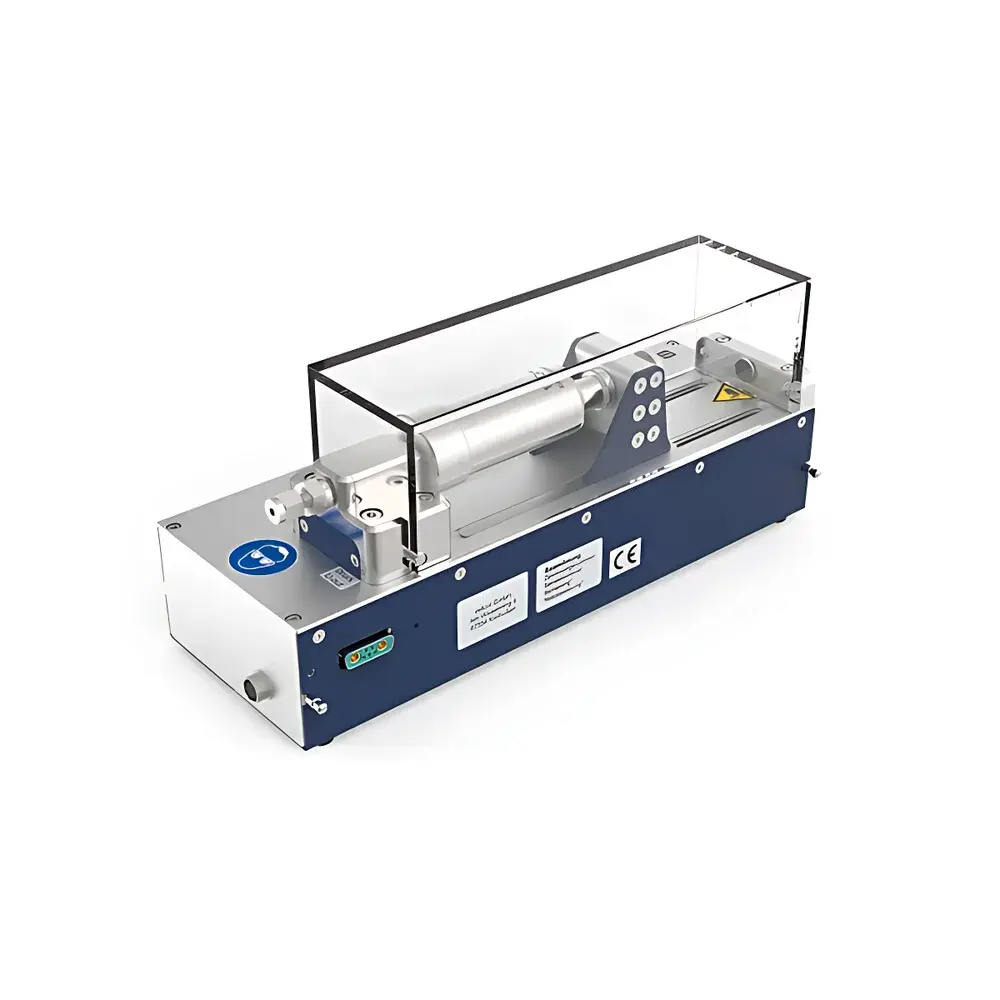
Cetoni neMESYS 2600N High-Pressure Precision Syringe Pump
| Brand | CETONI |
|---|---|
| Origin | Germany |
| Model | neMESYS 2600N |
| Instrument Type | Microfluidic High-Pressure Syringe Pump |
| Maximum Pressure | 510 bar (7400 psi) |
| Flow Stability | Pulse-free, high-repeatability dispensing |
| Control Architecture | Integrated servo motor + PID feedback loop |
| Wetted Materials | 316 stainless steel (plunger, barrel), Viton® seals |
| Syringe Volumes | 3–100 mL (5 standard sizes) |
| Pressure Sensing | Built-in piezoresistive sensor (0–600 bar range) |
| System Scalability | Up to 32 pump modules via internal bus |
| Software Interface | QmixElements GUI + Windows SDK & LabVIEW drivers |
| Compliance | Designed for GLP/GMP environments with audit-trail-capable software logging |
Overview
The Cetoni neMESYS 2600N is a high-precision, microfluidic syringe pump engineered for demanding pressure-driven applications in analytical chemistry, microreactor engineering, and life science instrumentation. Operating on a closed-loop servo-motor-driven architecture with real-time PID control, it delivers pulse-free fluid displacement across a wide dynamic range—enabling stable, repeatable volumetric delivery from nanoliter-per-second to milliliter-per-minute flow rates. Its core design addresses critical limitations of conventional stepper-motor-based pumps: mechanical backlash, step-induced pulsation, and thermal drift. By integrating a high-resolution pressure transducer (0–600 bar full scale) directly into the fluid path, the neMESYS 2600N supports both active pressure regulation and hardware-triggered safety shutdown—essential for high-integrity workflows involving viscous, reactive, or hazardous media.
Key Features
- Pulse-free flow generation via continuous servo-motor actuation and adaptive PID feedback—eliminating flow artifacts that compromise microscale reaction kinetics or optical detection fidelity.
- Maximum operating pressure of 510 bar (7400 psi), validated for long-term operation with 316 stainless steel syringes and Viton® elastomer seals—compatible with aggressive solvents, supercritical CO₂, and high-viscosity polymer melts.
- Five standardized syringe volumes (3, 5, 10, 25, 50, and 100 mL) with Swagelok®-compatible end fittings; all wetted components conform to ASTM F899-22 for surgical-grade stainless steel and ISO 3601-1 for seal compatibility.
- Modular bus architecture supporting up to 32 synchronized pump units on a single controller—enabling multi-channel, pressure-balanced infusion in complex microfluidic networks or parallelized assay platforms.
- Real-time pressure monitoring with configurable alarm thresholds and automatic emergency stop—meeting functional safety requirements aligned with IEC 61508 SIL 2 for laboratory automation systems.
Sample Compatibility & Compliance
The neMESYS 2600N accommodates a broad spectrum of sample types—from aqueous buffers and organic solvents to shear-thinning biopolymers (e.g., hyaluronic acid, alginate), molten thermoplastics, and corrosive reagents including concentrated acids and halogenated hydrocarbons. All fluid-contact surfaces are constructed from electropolished 316 stainless steel (per ASTM A276) and fluorocarbon elastomers rated for >10⁶ cycles under cyclic loading. The system complies with CE marking directives (2014/30/EU EMC, 2014/35/EU LVD), and its software architecture supports 21 CFR Part 11-compliant electronic records when deployed with QmixElements’ audit-trail mode—ensuring traceability for regulated QC/QA laboratories and pharmaceutical process development.
Software & Data Management
QmixElements provides a unified graphical interface for configuration, real-time visualization, and script-based protocol execution. It displays synchronized pressure, flow rate, and position traces with sub-millisecond timestamp resolution. The platform includes native support for method export/import in XML format, event-triggered data capture (e.g., pressure spike → initiate image acquisition), and programmable ramp profiles (linear, exponential, custom spline). Windows-native DLLs and LabVIEW VIs enable seamless integration into existing instrument control frameworks. All user actions—including parameter changes, start/stop commands, and error acknowledgments—are logged with operator ID, timestamp, and hash-verified integrity metadata—facilitating GLP audits and ISO 17025 accreditation documentation.
Applications
- Petroleum core flooding experiments requiring precise differential pressure control across porous media.
- Microfluidic cell encapsulation and droplet generation at stable Weber numbers (We < 0.1) for uniform emulsion formation.
- Continuous-flow synthesis of metal–organic frameworks (MOFs) under elevated temperature/pressure conditions.
- High-pressure liquid chromatography (HPLC) method development using sub-2-µm particles and ultrahigh backpressures.
- In vitro perfusion models simulating physiological shear stress in vascularized organ-on-chip devices.
- Rheological characterization of non-Newtonian fluids via controlled-rate extrusion through micro-orifices.
FAQ
What pressure ranges are supported by the integrated sensor?
The built-in piezoresistive transducer covers 0–600 bar with ±0.25% FS accuracy and 100 Hz sampling—calibrated traceable to PTB (Physikalisch-Technische Bundesanstalt) standards.
Can multiple neMESYS 2600N units be synchronized for phase-aligned flow delivery?
Yes—via the proprietary QmixBus, up to 32 modules achieve sub-100 µs inter-unit timing jitter, enabling coherent multi-inlet mixing in laminar flow reactors.
Is firmware update capability available remotely?
Firmware updates require local USB connection and authenticated access; no remote update functionality is implemented to preserve system integrity per IEC 62443-3-3.
Does the system support third-party pressure transducers?
External analog pressure inputs (0–10 V) are accepted for hybrid monitoring setups, but only the internal sensor enables hardware-level safety interlocks.
How is calibration traceability documented?
Each unit ships with a factory calibration certificate referencing DIN EN ISO/IEC 17025-accredited reference standards, including pressure, displacement, and timing verification data.



