
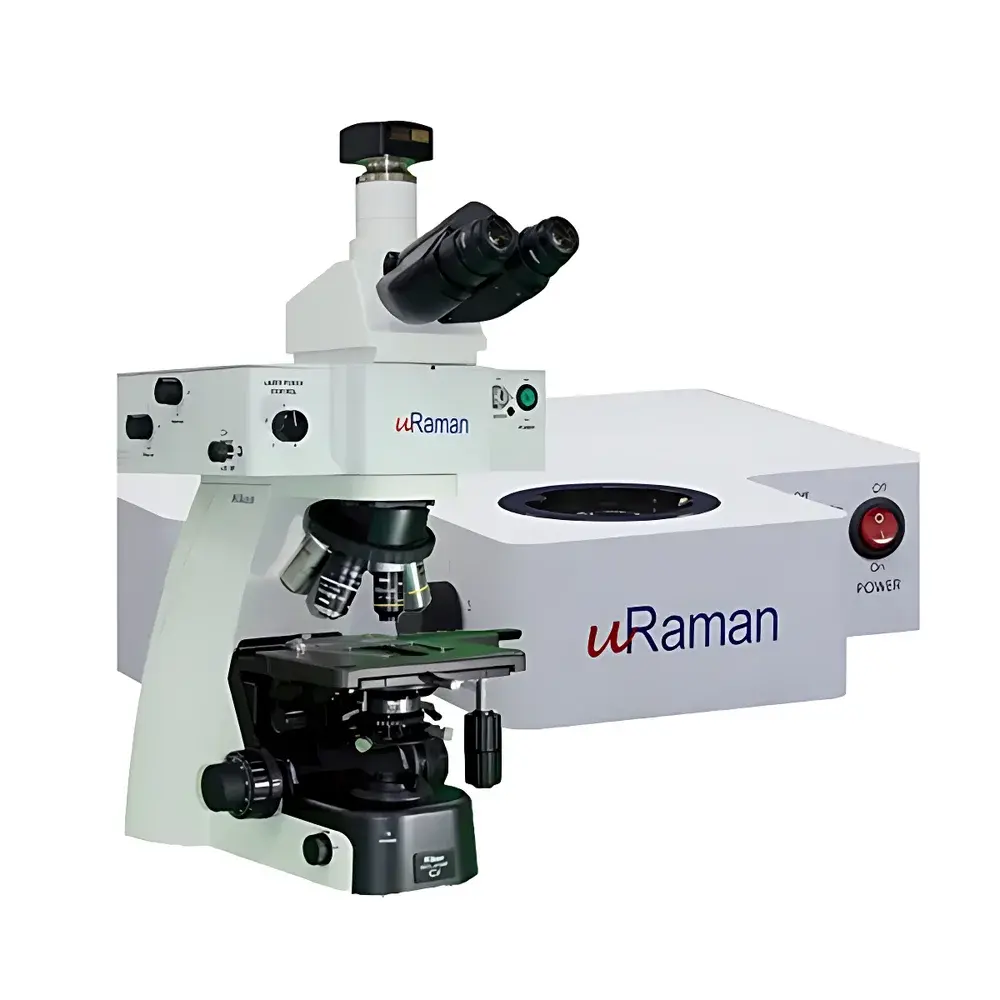
TechnoSpex uSight Microfluidic Confocal Raman Spectroscopy System
| Brand | TechnoSpex |
|---|---|
| Origin | Singapore |
| Manufacturer Type | Authorized Distributor |
| Instrument Type | Confocal Micro-Raman Spectrometer |
| Microfluidic Integration | Yes |
| Modular Microscope Compatibility | Zeiss, Leica, Olympus, Nikon |
| Minimum Spot Size | ≤1 µm (with 100× objective) |
| Real-Time Spectral Acquisition | Supported |
| Detection Modes | Raman, Transmittance, Absorbance, UV-Vis Absorption, Fluorescence Excitation, XY Stage Mapping |
| Customization | Fully Configurable per Application Requirement |
| Key Specifications | Available upon technical consultation |
Overview
The TechnoSpex uSight Microfluidic Confocal Raman Spectroscopy System is an engineered platform integrating high-spatial-resolution confocal Raman spectroscopy with active microfluidic control. It operates on the principle of inelastic light scattering—where monochromatic laser excitation induces vibrational mode shifts in molecular bonds, yielding chemically specific spectral fingerprints. The system’s confocal architecture enables optical sectioning with axial rejection of out-of-focus signal, critical for depth-resolved analysis within microfluidic channels (typically 10–500 µm wide). Unlike conventional benchtop Raman systems, the uSight is purpose-built for dynamic, label-free chemical interrogation inside flowing or static microscale environments—supporting kinetic studies, reaction monitoring, and spatially resolved compositional mapping across chip-based fluidic networks.
Key Features
- Modular confocal Raman spectrometer head designed for seamless integration with commercial upright and inverted research-grade microscopes (Zeiss Axio, Leica DMi8, Olympus IX series, Nikon Ti2).
- Sub-micron lateral resolution (≤1 µm) achieved using diffraction-limited focusing with 100× oil-immersion objectives and precision XYZ piezo stage control.
- Multi-modal spectral acquisition: simultaneous or sequential collection of Raman, transmittance, absorbance (UV-Vis), fluorescence excitation spectra, and hyperspectral line scans.
- Real-time data acquisition at frame rates up to 30 spectra/sec (dependent on integration time and grating configuration), enabling millisecond-scale monitoring of chemical transitions in microfluidic streams.
- Integrated microfluidic interface with standardized PDMS/glass chip docking, pressure-driven flow control compatibility (via external syringe pumps), and thermal stabilization options (±0.1 °C).
- Rugged optomechanical architecture with kinematic mirror mounts, temperature-stabilized CCD/EMCCD detectors, and laser line filtering compliant with ISO 13694 for beam quality assurance.
Sample Compatibility & Compliance
The uSight accommodates a broad range of sample formats including glass/PDMS microfluidic chips, capillary tubes, thin-film substrates, and suspension droplets. Its open optical path allows direct coupling to custom-designed fluidic manifolds or commercial microreactors (e.g., Dolomite, Fluigent). All spectral data acquisition workflows support audit-trail logging and user-defined metadata tagging—fully compatible with GLP-compliant laboratory practices. System software adheres to FDA 21 CFR Part 11 requirements for electronic records and signatures when deployed with optional secure authentication modules. Instrument calibration protocols align with ASTM E1840 (Raman Shift Calibration) and ISO/IEC 17025 traceability frameworks.
Software & Data Management
Acquisition and analysis are managed via uSight Control Suite v4.x—a cross-platform application supporting Windows and Linux. The suite includes real-time spectral preview, automated focus tracking, multi-channel synchronization (flow rate, temperature, laser power), and batch processing pipelines for large hyperspectral datasets. Raw spectra are stored in HDF5 format with embedded instrument metadata (wavelength calibration, grating position, objective ID, exposure settings). Integrated chemometric tools include PCA, cluster analysis, and spectral unmixing algorithms; export options cover CSV, JCAMP-DX, and mzML-compatible formats for third-party platforms (e.g., MATLAB, Python SciPy, Thermo Omics Workbench). Data integrity is enforced through SHA-256 hashing and timestamped version control.
Applications
- Chemical Reaction Monitoring: In situ tracking of polymerization, hydrolysis, or catalytic reactions within segmented flows or droplet reactors.
- Biological Cell Analysis: Non-invasive Raman mapping of intracellular metabolites (e.g., lipids, proteins, nucleic acids) in live cells under controlled perfusion.
- Materials Science: Phase identification and stress distribution analysis in 2D nanomaterials (graphene, MoS₂) deposited on microfluidic substrates.
- Pharmaceutical QC: Quantitative dissolution profiling of micro-formulated APIs (e.g., nanocrystals, liposomes) during continuous-flow release testing.
- Geochemical Sensing: In-line mineral speciation in synthetic pore-fluid analogues under variable pH/ionic strength conditions.
- Forensic Trace Analysis: Identification of dye components, polymer additives, or explosive residues from micro-volume evidence samples processed in closed-chip formats.
FAQ
Is the uSight compatible with my existing microscope?
Yes—the system uses standardized C-mount and infinity-corrected optical interfaces. Mechanical and electrical integration kits are available for Zeiss, Leica, Olympus, and Nikon platforms.
Can I perform time-resolved Raman measurements on fast-flowing samples?
Yes—sub-second spectral acquisition is achievable with optimized laser power and detector gain settings; synchronization with flow triggers is supported via TTL I/O ports.
Does the system support automated spectral calibration?
Yes—built-in neon/argon lamp references and NIST-traceable polystyrene standards enable daily drift correction and wavelength validation.
What level of technical support is provided post-installation?
TechnoSpex offers remote diagnostics, application-specific method development assistance, and annual on-site performance verification aligned with ISO/IEC 17025 guidelines.
Are OEM integration options available for instrument manufacturers?
Yes—custom OEM modules, SDKs for LabVIEW/Python API access, and white-label firmware configurations are offered under NDA.




