
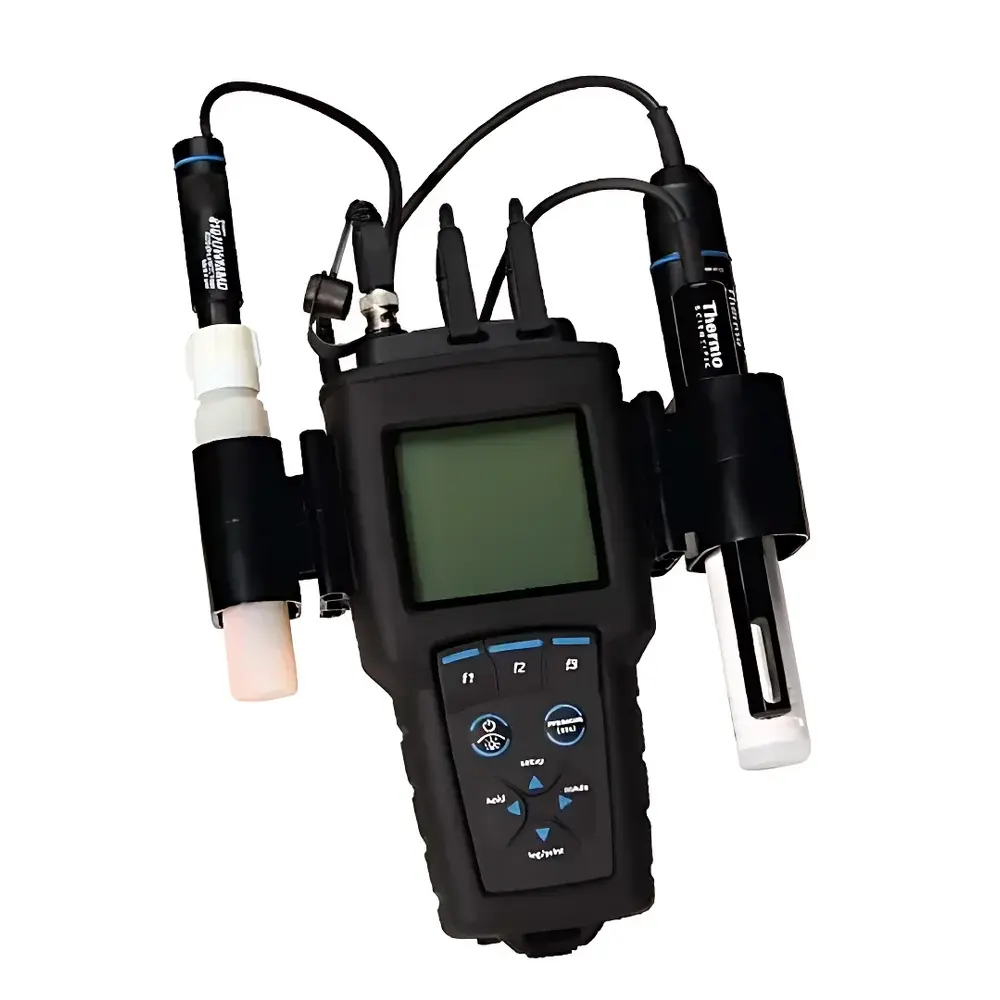
Thermo Scientific Orion Star A329 Portable pH/ISE/Conductivity/Dissolved Oxygen Multiparameter Meter
| Origin | Singapore |
|---|---|
| Manufacturer Type | Authorized Distributor |
| Origin Category | Imported |
| Model | A329 |
| Instrument Type | Portable Multiparameter Water Quality Analyzer |
| Compliance | GLP-Compliant Data Logging (5000 Entries) |
| Protection Rating | IP67 |
| Power | 4×AA Batteries or AC Adapter |
| Connectivity | USB & RS232 |
| Software Support | Orion™ Comli Software (FDA 21 CFR Part 11 Ready) |
Overview
The Thermo Scientific Orion Star A329 Portable Multiparameter Meter is an engineered field-deployable platform for simultaneous, high-integrity measurement of pH, ion-selective electrode (ISE) response, conductivity, total dissolved solids (TDS), resistivity, salinity, and dissolved oxygen (DO) in aqueous environmental and process water samples. Based on potentiometric, conductimetric, and optical (RDO) or electrochemical (Clark-type polarographic) sensing principles, the A329 delivers laboratory-grade accuracy under variable ambient conditions—enabling compliance with ASTM D1293 (pH of water), ASTM D5391 (conductivity of pure water), ISO 5814 (electrochemical DO), and ISO 10523 (pH determination). Its dual-DO probe compatibility—supporting both polarographic and luminescence-based RDO sensors—ensures flexibility across regulatory and operational requirements, including USP (conductivity of purified water) and EPA Method 360.1 (conductivity).
Key Features
- Triple-channel real-time display: Simultaneous readout of up to three parameters (e.g., pH + conductivity + DO) with independent temperature compensation per channel
- AUTO-READ™ stabilization algorithm: Locks readings only upon signal stability, indicated by dynamic status icons; eliminates subjective endpoint judgment
- Intelligent calibration management: Auto-recognition of USA/NIST/DIN pH buffer sets; editable multi-point calibration curves for pH and ISE (up to 5 points); linear and non-linear ISE calibration modes including timed endpoint and auto-blank subtraction
- Advanced temperature handling: ATC (Automatic Temperature Compensation) with selectable reference temperatures (5–25 °C); configurable temperature coefficient (0–10.0%/°C) for conductivity; dedicated ultra-pure water nonlinearity model per ISO 7888
- RDO/polarographic DO probe auto-detection: Seamless switching between sensor types; built-in atmospheric pressure compensation (450.0–850.0 mmHg); automatic salinity correction when paired with conductivity electrode (0–45 ppt)
- IP67-rated rugged enclosure: Fully sealed against dust and immersion to 1 m for 30 min; integrated electrode holder and protective holster included
- GLP-compliant data integrity: Timestamped, user-ID-tagged storage of 5000 measurements with full audit trail; manual, timed, or triggered logging modes; one-touch editing (single/multiple entries)
Sample Compatibility & Compliance
The Star A329 is validated for use with natural waters (freshwater, estuarine, seawater), wastewater effluents, drinking water distribution systems, cooling tower fluids, and pharmaceutical process streams. It supports ISE measurements for F⁻, Cl⁻, NO₃⁻, NH₄⁺, Ca²⁺, and other monovalent/divalent ions using standardized calibration protocols. Conductivity measurements adhere to ISO 7888 and ASTM D1125; salinity is reported as practical salinity (PSU) or NaCl-equivalent (ppt) using the UNESCO 1983 equation. Dissolved oxygen results comply with ISO 5814 for electrochemical sensors and ASTM D888 for optical sensors. All stored data include metadata required for GLP/GMP audits: operator ID, sample ID, calibration history, sensor serial numbers, and environmental conditions.
Software & Data Management
Data export and instrument configuration are managed via Orion Comli Software (Windows-compatible), which supports FDA 21 CFR Part 11 compliance through electronic signatures, role-based access control, and immutable audit logs. Raw datasets (CSV or proprietary .orion format) retain full parameter context—including raw mV, temperature, atmospheric pressure, and calibration coefficients—for traceable reprocessing. Firmware updates, custom method templates, and report generation (PDF/Excel) are performed directly through the software interface. USB mass-storage mode enables drag-and-drop file transfer without driver installation.
Applications
- Field-based regulatory monitoring per EPA NPDES permits and EU WFD (Water Framework Directive) reporting requirements
- In-process verification of pretreatment and polishing stages in municipal and industrial wastewater plants
- Validation of deionized and purified water systems in pharmaceutical manufacturing (USP , )
- Ecological assessment of lakes, rivers, and coastal zones—including nutrient loading studies via nitrate and ammonium ISE profiling
- Calibration and verification of fixed online analyzers during routine maintenance cycles
- Academic and research fieldwork requiring NIST-traceable, multi-parameter correlation under uncontrolled environmental conditions
FAQ
Does the A329 support Good Laboratory Practice (GLP) documentation requirements?
Yes. Each stored measurement includes date/time stamp, operator ID, sample ID, sensor IDs, calibration verification status, and full calibration coefficients—exportable in audit-ready formats.
Can the instrument automatically compensate for salinity when measuring dissolved oxygen?
Yes—when a conductivity electrode is connected, the A329 applies real-time salinity correction to DO readings per ISO 5814 Annex B; manual salinity entry is also supported.
What is the maximum depth rating for underwater operation?
The IP67 rating certifies operation at 1 meter submersion for up to 30 minutes; extended deployment requires optional waterproof extension cables and pressure-rated probe housings.
Is firmware upgrade capability available in the field?
Yes—via USB connection and Orion Comli Software; no hardware modification or service center visit required.
How does the A329 handle low-concentration ISE measurements where drift or interference is common?
It employs adaptive endpoint detection, auto-blanking for background subtraction, and selectable integration time to enhance signal-to-noise ratio—critical for sub-ppb fluoride or nitrate quantification.
Related Products







