
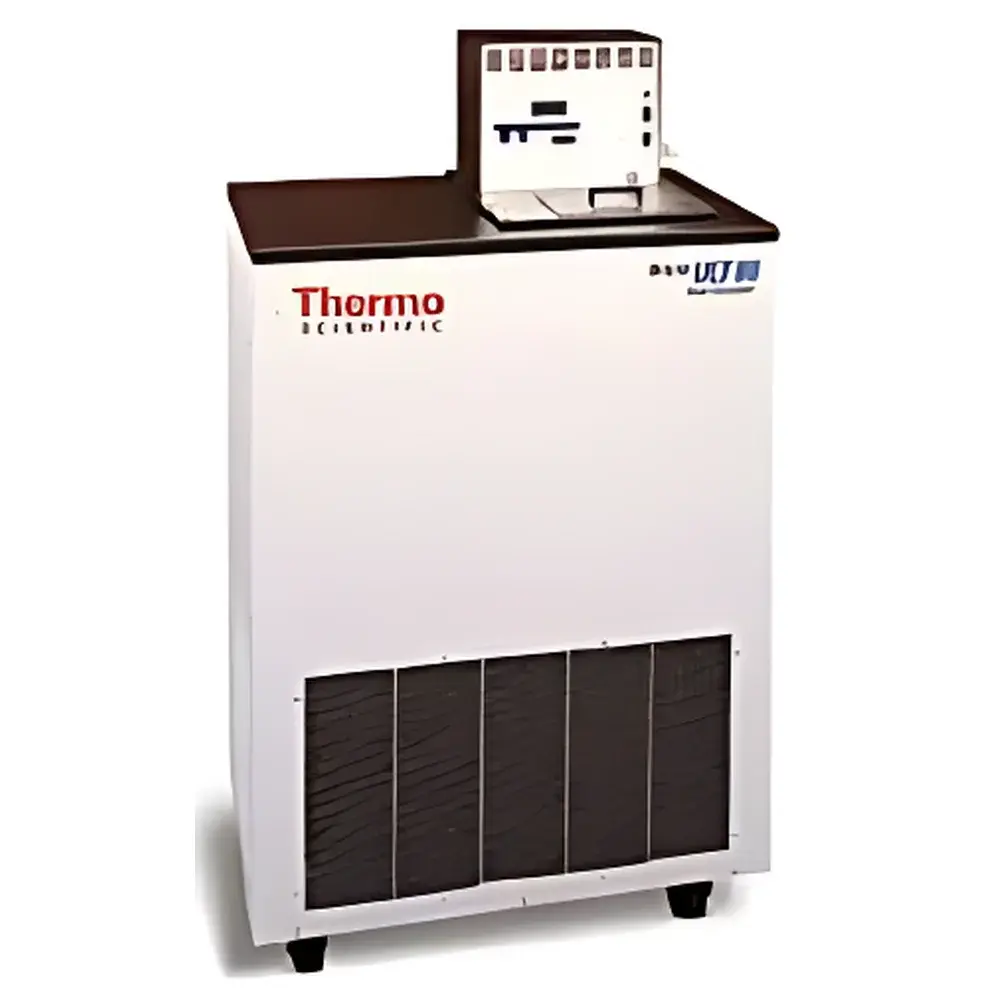
Thermo Fisher Scientific ULT80ZT / ULT95 Ultra-Low Temperature Circulating Chillers
| Brand | Thermo Fisher Scientific |
|---|---|
| Model | ULT80ZT / ULT80 / ULT95 |
| Temperature Range | –80 °C to +80 °C (ULT80) / –90 °C to +80 °C (ULT95) |
| Temperature Stability | ±0.02 °C (at 25 °C) / ±0.03 °C (at –70 °C) |
| Bath Volume | 15.1 L |
| Control | PID with LCD touchscreen interface |
| Heating Power | 1200 W / 1650 W |
| Refrigeration Capacity | 250 W @ –70 °C / 350 W @ –80 °C |
| Communication Interfaces | USB, RS-232, RS-485, Ethernet, Analog I/O, Multi-function I/O port |
| Safety Certifications | UL, CSA, CE, RoHS, DIN 12876 Class 3 / NFL Level |
| Alarm Functions | High/Low temperature, High/Low liquid level |
| Compressor | Inverter-driven variable-speed |
Overview
The Thermo Fisher Scientific ULT80ZT and ULT95 ultra-low temperature circulating chillers are precision-engineered thermal control systems designed for demanding laboratory applications requiring stable, reproducible cooling and heating across extreme temperature ranges. Leveraging the legacy of HAAKE and NESLAB—two globally recognized brands in thermal instrumentation now unified under Thermo Fisher—the ULT series integrates advanced refrigeration architecture, high-fidelity PID control, and real-time thermal adjustment (RTA) to deliver exceptional thermal stability down to –90 °C. These units operate on a dual-stage cascade refrigeration system with inverter-driven compressors, enabling continuous, stepless speed modulation for optimized energy efficiency, reduced mechanical stress, and enhanced temperature uniformity. Unlike conventional chillers limited by single-stage compression or external glycol limitations, the ULT platform maintains sub-0.03 °C stability at –70 °C while sustaining full heating capacity up to +80 °C—enabling seamless bidirectional thermal ramping critical for material testing, cryogenic sample conditioning, and instrument cooling in analytical workflows.
Key Features
- Inverter-driven dual-stage cascade refrigeration system for extended low-temperature performance (–90 °C minimum) and precise thermal regulation
- PID-controlled temperature stability of ±0.02 °C at ambient setpoints and ±0.03 °C at –70 °C—validated per ISO/IEC 17025-compliant calibration protocols
- 15.1 L stainless-steel bath reservoir with integrated circulation pump, optimized for low-viscosity heat-transfer fluids (e.g., ethanol/water or specialized low-temp silicone oils)
- Multi-protocol digital connectivity: native support for USB, RS-232, RS-485, Ethernet (TCP/IP), analog voltage/current outputs (0–10 V / 4–20 mA), and configurable multi-function I/O ports for PLC integration or external alarm triggering
- Real-Time Adjustment (RTA) system dynamically compensates for load fluctuations, ambient drift, or fluid property changes—ensuring consistent thermal delivery without manual recalibration
- Comprehensive safety architecture compliant with DIN 12876 Class 3 (NFL Level) for laboratory refrigeration equipment, including independent high/low temperature and liquid-level monitoring with relay-based fail-safe shutdown
- Energy-saving mode automatically reduces compressor output during low-load conditions while maintaining setpoint integrity—reducing power consumption by up to 35% versus fixed-speed equivalents
Sample Compatibility & Compliance
The ULT80ZT and ULT95 are engineered for compatibility with a broad range of laboratory instrumentation—including spectrophotometers, X-ray diffractometers, NMR pre-coolers, and high-resolution microscopy stages—as well as materials testing platforms requiring cryogenic preconditioning. Bath fluid selection must conform to ASTM D1384 (corrosion resistance) and ISO 6743-20 (refrigeration lubricant classification). All models meet UL 61010-1, CSA C22.2 No. 61010-1, and EN 61010-1 safety standards, carry CE marking under the EU Machinery Directive and Low Voltage Directive, and comply with RoHS 2011/65/EU restrictions on hazardous substances. For regulated environments, firmware supports audit-trail-capable operation when integrated with validated LIMS or ELN systems, aligning with FDA 21 CFR Part 11 requirements for electronic records and signatures where user authentication, change logging, and data immutability are enforced.
Software & Data Management
Units ship with Thermo Fisher’s ChillerLink™ desktop software (Windows-compatible), offering remote configuration, real-time parameter visualization, and automated data logging at user-defined intervals (1 s to 60 min resolution). Logged parameters include bath temperature, setpoint deviation, compressor frequency, heater duty cycle, fluid level status, and alarm event timestamps. Export formats include CSV and XML, compatible with MATLAB, Python pandas, and commercial statistical process control (SPC) packages. Optional OPC UA server integration enables direct interoperability with industrial automation frameworks (e.g., Siemens TIA Portal, Rockwell FactoryTalk) for centralized thermal fleet monitoring. Firmware updates are delivered via signed binary packages with SHA-256 verification to ensure integrity and traceability—supporting GLP/GMP-aligned change control documentation.
Applications
- Cryogenic stabilization of detectors in FTIR, Raman, and mass spectrometry systems
- Temperature-controlled sample preparation for XRD, DSC, and DMA analyses requiring sub-–70 °C conditioning
- Active cooling of high-power laser diodes and photomultiplier tubes to suppress thermal noise
- Environmental simulation chambers requiring precise thermal ramping and hold profiles (e.g., accelerated aging per IEC 60068-2-1/2)
- Calibration laboratories performing thermometer and sensor validation across extended temperature spans
- Biobanking infrastructure supporting controlled-rate freezing of cell suspensions and tissue samples
FAQ
What is the minimum achievable temperature for the ULT95 model?
The ULT95 achieves a verified operational minimum of –90 °C using a proprietary cascade refrigerant blend and optimized oil management system.
Can the chiller maintain stability while simultaneously heating and cooling?
No—like all single-bath circulating chillers, it operates in either heating or cooling mode at any given time; however, its RTA system enables rapid, overshoot-minimized transitions between modes within defined ramp rate limits.
Is DIN 12876 Class 3 certification equivalent to NSF or FDA approval?
DIN 12876 Class 3 addresses mechanical and electrical safety for lab refrigeration equipment; it is not a food-safety or pharmaceutical GMP certification. FDA/NSF approvals apply only to devices contacting consumables or operating in cleanroom environments.
Does the unit support external temperature feedback from a probe placed in the application?
Yes—via analog input (0–10 V or 4–20 mA), the chiller can accept an external PT100 or thermistor signal for cascade control, improving accuracy for applications where bath temperature does not reflect actual sample temperature.
What maintenance intervals are recommended for long-term reliability?
Compressor oil analysis every 12 months, refrigerant leak check annually, and filter/drier replacement every 24 months—per Thermo Fisher’s Preventive Maintenance Protocol ULT-PMP-02, aligned with ISO 55001 asset management principles.



