
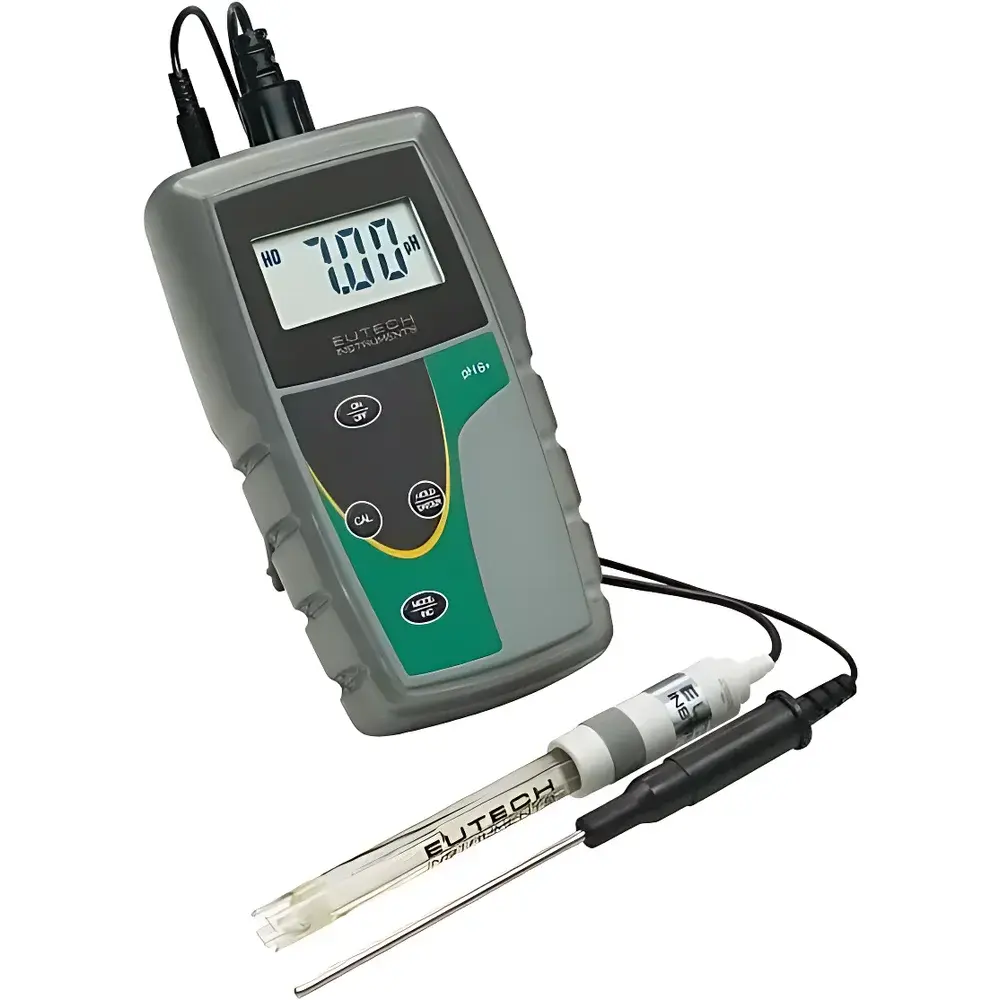
Thermo Fisher Eutech pH 6+ Portable pH/ORP/Temperature Meter
| Brand | Thermo Fisher |
|---|---|
| Origin | Singapore |
| Manufacturer | Eutech Instruments (a Thermo Fisher Scientific brand) |
| Model | pH 6+ |
| Type | Portable Electrochemical Meter |
| Measurement Modes | pH, ORP (mV), Relative mV (RmV), Temperature |
| pH Range | 0.00–14.00 |
| pH Resolution | 0.01 |
| pH Accuracy | ±0.01 |
| Calibration Points | Up to 3-point auto-buffer recognition (USA, NIST, Pure Water) |
| ORP/RmV Range | ±1000.0 mV |
| ORP/RmV Resolution | 0.1 mV (±199.9 mV), 1 mV (>±199.9 mV) |
| ORP Accuracy | ±0.2 mV (±199.9 mV), ±2 mV (>±199.9 mV) ±1 LSD |
| Temperature Range | 0.0–100.0 °C |
| Temperature Resolution | 0.1 °C |
| Temperature Accuracy | ±0.5 °C |
| Temperature Compensation | Automatic or Manual (0.0–100.0 °C) |
| Display | Dual-line LCD (4.5 × 2.3 cm) |
| Power | 4 × 1.5 V AAA alkaline batteries |
| Battery Life | >500 hours |
| Auto-Off | 20 min inactivity |
| Dimensions (Instrument) | 15.7 × 8.5 × 4.2 cm |
| Weight (Instrument) | 255 g |
| Input Connectors | BNC + 2.5 mm phono sockets |
| Operating Environment | 0–50 °C, ≤85% RH non-condensing |
| Enclosure Rating | IP67-rated rubber boot included |
Overview
The Thermo Fisher Eutech pH 6+ is a rugged, entry-level portable electrochemical meter engineered for reliable field and routine laboratory measurement of pH, oxidation-reduction potential (ORP), and temperature. Built upon proven potentiometric principles, the instrument employs high-impedance voltage measurement circuitry to quantify the electromotive force generated at the interface between a glass pH electrode and sample solution—converting it into a calibrated pH value per the Nernst equation. ORP measurements are performed using a noble metal (typically platinum or gold) sensing element referenced against an internal Ag/AgCl reference, enabling quantitative assessment of redox activity in aqueous systems. Designed for operational simplicity without compromising metrological integrity, the pH 6+ delivers traceable accuracy aligned with ISO 8655 and ASTM D1293 standards for pH determination in environmental, industrial process, and educational applications.
Key Features
- High-precision pH measurement with ±0.01 pH accuracy and 0.01 resolution across the full 0.00–14.00 range
- Triple-buffer calibration support with automatic recognition of USA (pH 4.01, 7.00, 10.01), NIST (pH 4.01, 6.86, 9.18), and Pure Water (pH 6.98, 7.00, 7.02) standards—ensuring compliance with method-specific calibration protocols
- Simultaneous dual-parameter display: pH/mV and temperature appear concurrently on the dual-line LCD (4.5 × 2.3 cm)
- Dedicated one-button toggle between pH, ORP, RmV, and temperature modes—minimizing mode confusion during multi-parameter workflows
- Integrated rubberized protective boot rated IP67 for dust resistance and temporary water immersion—validated for outdoor, wastewater, aquaculture, and soil extract field use
- Intelligent auto-shutdown after 20 minutes of inactivity preserves battery life (>500 hours with alkaline AAA cells)
- Data hold function freezes stable readings for documentation; error diagnostics display alphanumeric codes (e.g., “Err 1” = open circuit, “Err 3” = low battery) to accelerate troubleshooting
- Non-volatile memory retains calibration data and user settings during battery replacement or power interruption
Sample Compatibility & Compliance
The pH 6+ is optimized for aqueous samples with conductivity ≥50 µS/cm and total dissolved solids (TDS) < 10,000 ppm. It supports standard combination pH electrodes with BNC connectors and optional ORP electrodes with 2.5 mm phono inputs. The meter complies with IEC 61010-1:2010 for electrical safety in laboratory equipment and meets EN 61326-1:2013 electromagnetic compatibility requirements. Its calibration traceability aligns with national metrology institute (NMI)-certified buffer solutions, supporting GLP documentation practices. While not 21 CFR Part 11 compliant out-of-the-box (lacking electronic signature and audit trail capabilities), its stable calibration history and manual log export functionality make it suitable for non-regulated QA/QC environments including teaching labs, municipal water testing, and agricultural extension services.
Software & Data Management
The pH 6+ operates as a standalone instrument with no proprietary software dependency. All configuration, calibration, and measurement data reside locally on the device. Readings can be manually recorded or transferred via visual transcription from the LCD. For integration into LIMS or ELN systems, users may pair the meter with third-party Bluetooth-enabled data loggers (e.g., Thermo Scientific™ Orion™ Star Log software-compatible adapters, sold separately). Firmware updates are not supported—design emphasis is placed on long-term stability, reproducibility, and minimal maintenance rather than feature expansion.
Applications
- Environmental monitoring: Surface water, groundwater, effluent, and stormwater pH and redox profiling per EPA Method 150.1 and APHA Standard Methods 4500-H+
- Aquaculture and hydroponics: Real-time tracking of pond, tank, and nutrient solution acidity and oxidative status to maintain optimal biological conditions
- Food & beverage quality control: Spot-checking rinse water, brine, and processing solutions where regulatory pH thresholds apply (e.g., USDA-FSIS guidelines)
- Education and training: Undergraduate chemistry and environmental science laboratories requiring robust, intuitive instrumentation for foundational electrochemistry experiments
- Industrial pretreatment: Monitoring neutralization tanks, cooling tower blowdown, and boiler feedwater conditioning prior to discharge or reuse
FAQ
Does the pH 6+ support automatic temperature compensation (ATC)?
Yes—it accepts input from integrated or external ATC probes (e.g., stainless steel Pt1000 sensors) and applies the appropriate Nernstian slope correction across 0.0–100.0 °C. Manual temperature entry is also available when ATC is unavailable.
Can I calibrate using custom buffer values?
No—the pH 6+ only recognizes pre-programmed USA, NIST, and Pure Water buffer sets. Custom buffer entry is not supported, ensuring consistency with internationally accepted reference points.
Is the instrument compatible with all BNC pH electrodes?
It supports standard single-junction, gel-filled, and refillable combination electrodes with BNC output. Double-junction or specialized low-ionic-strength electrodes require verification of impedance compatibility (< 1012 Ω recommended).
What does “±1 LSD” mean in the ORP accuracy specification?
LSD stands for “Least Significant Digit.” The ±2 mV tolerance above ±199.9 mV includes both inherent sensor drift and quantization uncertainty associated with the 1 mV digit resolution in that range.
How often should I recalibrate during continuous use?
For critical measurements, recalibration before each session is recommended. In stable field conditions with consistent sample matrix, verification against a single check buffer every 2–4 hours suffices—per ISO/IEC 17025 guidance on intermediate checks.






