
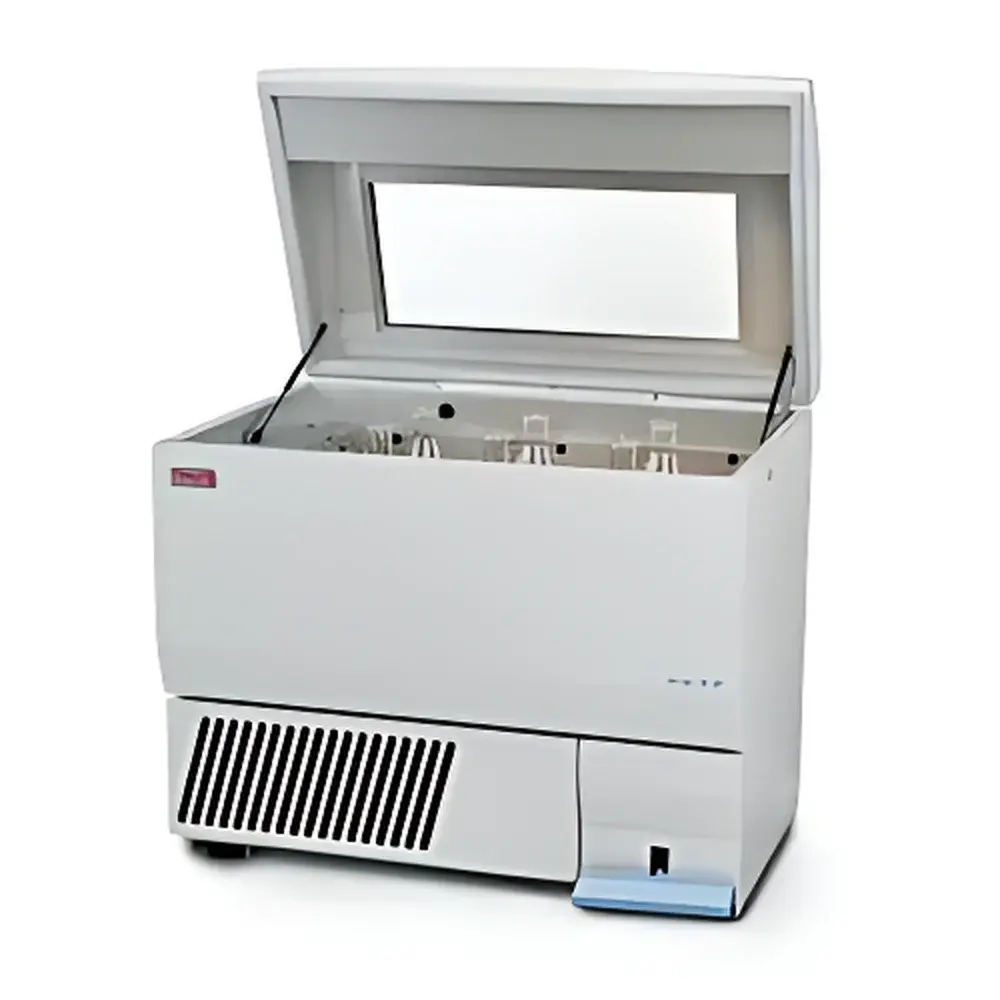
Thermo Fisher MaxQ 436HP and MaxQ 481HP High-Capacity Floor-Model Refrigerated/Heated Orbital Shakers
| Brand | Thermo Fisher |
|---|---|
| Origin | USA |
| Manufacturer Type | Original Equipment Manufacturer (OEM) |
| Country of Origin | Imported |
| Model | SHKE481HP / SHKE436HP |
| Instrument Category | Refrigerated/Heated Orbital Shakers |
| Temperature Range | 4°C to 60°C |
| Airflow System | Front-to-rear, HEPA-filtered, guided laminar airflow |
| Chamber Construction | Seamless stainless steel interior with radiused corners |
| Drainage | Valved floor drain port |
| Viewing Window | Integrated transparent front window |
| Access Port | Rear panel pass-through for probes, CO₂ manifolds, or sensor cables |
| Operation Interface | Foot-operated lid actuation mechanism |
| Compliance | Designed to support GLP/GMP workflows |
Overview
The Thermo Fisher MaxQ 436HP and MaxQ 481HP are high-capacity, floor-standing orbital shakers engineered for demanding life science laboratories requiring precise temperature control, long-term stability, and contamination-sensitive operation. These instruments operate on the principle of controlled orbital motion—typically 25 mm diameter—combined with active refrigeration and heating systems to maintain setpoint accuracy across wide ambient conditions (including up to 35°C ambient). Unlike benchtop units, their reinforced structural frame and low center-of-gravity design minimize vibration transmission while supporting heavy loads (up to 75 kg for MaxQ 481HP; 55 kg for MaxQ 436HP), making them suitable for large-volume flasks (e.g., 5 L Erlenmeyer), stacked microplate carriers, and multi-tier bioreactor vessels. The integrated refrigeration system utilizes environmentally compliant R-134a refrigerant and a dual-stage heat exchanger architecture, enabling reliable operation at 4°C without condensation buildup inside the chamber.
Key Features
- HEPA-filtered air circulation system (99.97% efficiency at 0.3 µm) minimizes airborne particulate ingress and cross-contamination between runs.
- Guided laminar airflow path—from front intake, across shelves, to rear exhaust—ensures ±0.5°C temperature uniformity (measured per ASTM E2234 at 37°C, full load).
- Seamless 304 stainless steel interior with fully radiused corners eliminates crevices, facilitating cleanroom-grade decontamination using vaporized hydrogen peroxide (VHP) or liquid sanitizers.
- Valved floor-mounted drain port enables rapid, spill-contained removal of condensate or accidental liquid overflow—critical for fermentation or cell culture applications where moisture accumulation risks microbial proliferation.
- Rear service panel includes multiple pre-gasketed 50 mm diameter ports for uninterrupted integration of pH/DO probes, gas supply lines (CO₂, O₂, N₂), and external data loggers without compromising chamber integrity.
- Foot-switch-actuated lid mechanism allows hands-free access during sterile procedures, reducing ergonomic strain during repetitive loading/unloading cycles.
Sample Compatibility & Compliance
These shakers accommodate standard laboratory vessel formats—including 250 mL to 5 L glass and polycarbonate flasks, stackable microplate carriers (up to 4× 96-well plates), and custom-fit bioreactor sleeves. Shelf configurations are modular and adjustable in 25 mm increments, supporting heterogeneous load distributions without sacrificing thermal homogeneity. All models comply with IEC 61000-6-3 (EMC emission standards) and IEC 61010-1 (safety requirements for lab equipment). When operated with Thermo Fisher’s ChronoStar v5.2 or later, audit trails, electronic signatures, and user-access controls align with FDA 21 CFR Part 11 and EU Annex 11 expectations. Routine IQ/OQ documentation packages are available upon request for GMP-regulated facilities.
Software & Data Management
While the MaxQ HP series features an intuitive front-panel interface with real-time display of setpoint, actual temperature, speed (rpm), and elapsed time, full data governance is achieved via optional Ethernet or USB connectivity to Thermo Fisher’s ChronoStar platform. This software supports automated calibration logging, deviation alerts (e.g., >±0.8°C excursion for >30 s), and export of timestamped CSV reports compliant with ALCOA+ principles (Attributable, Legible, Contemporaneous, Original, Accurate, Complete, Consistent, Enduring, Available). Remote monitoring via secure TLS 1.2–encrypted connections enables centralized fleet management across multi-site research organizations.
Applications
- Mammalian and insect cell suspension culture under tightly controlled hypothermic (4–10°C) or physiological (37°C) conditions.
- High-yield protein expression in E. coli using autoinduction media, where consistent oxygen transfer and temperature stability directly impact inclusion body solubility.
- Long-duration microbial growth kinetics studies (e.g., Pseudomonas, Bacillus) requiring uninterrupted 72+ hour runs at elevated temperatures (50–60°C) with minimal drift.
- Biopharmaceutical process development, including seed train expansion and early-stage bioreactor inoculum preparation under cGMP-aligned environmental controls.
- Environmental microbiology assays involving thermophilic enrichment cultures or cold-adapted psychrophiles maintained at sub-ambient setpoints.
FAQ
What is the maximum flask size supported on the MaxQ 481HP shelf configuration?
Standard configuration accommodates two 5 L Erlenmeyer flasks side-by-side; custom shelf inserts are available for asymmetric or tall-vessel arrangements.
Does the unit maintain 4°C performance in a 32°C ambient laboratory environment?
Yes—thermal validation data per ISO 13485 Annex C confirms sustained 4.0 ± 0.4°C chamber stability at 32°C ambient, full load, over 24 hours.
Can the HEPA filter be sterilized in place?
No—the HEPA module is replaceable only; however, it is rated for 12 months of continuous operation under typical biosafety level 2 (BSL-2) usage conditions.
Is CO₂ compatibility factory-certified?
Rear ports are mechanically rated for CO₂ line integration; however, CO₂ concentration control requires external gas blending and feedback sensors—not provided with base shaker configuration.
How often does the refrigeration system require maintenance?
Compressor oil and refrigerant levels are verified annually during preventive maintenance; no routine user-serviceable components exist within the sealed refrigeration loop.




